1 listing
Filters
| Product | /oz | Premium | Price | |
|---|---|---|---|---|

 IDC Coin and Bullion
Out of Stock
IDC Coin and Bullion
Out of Stock
|
$96.88 | +43.25% | $96.88 | View Deal |
Prices are fetched automatically and may not reflect current merchant prices. Currency conversions and tax treatment are approximate. Rankings are based solely on price. We are not a dealer and accept no responsibility for transactions with listed merchants. Past performance is not indicative of future results. This site does not provide investment advice. Full disclaimer
About the 1 oz Bison Bullion Silver Bar
A Hand-Poured 1 oz Silver Bar from a Small Private Operation
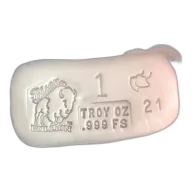
Bison Bullion is a small hand-pour operation, one of a cluster of artisan producers that includes Monarch Precious Metals and Yeager's Poured Silver. Its bars are known for distinctive shapes rather than the uniform rectangles of mass production, and dealers place Bison Bullion at a comparable price point and appeal to the other names in the hand-poured segment. The 1 oz bar is the entry point to the range, containing one troy ounce (31.1035 grams) of .999 fine silver.
Buyers in this segment are not chasing the absolute lowest cost per ounce. Hand-poured silver is bought primarily for the tactile and visual character of the metal itself: each bar comes out of a mould rather than a stamping press, which gives it a rustic, individual finish that a minted bar cannot match. The trade-off is price. Standard 1 oz silver bars run roughly 8 to 15 percent over spot in normal market conditions, and artisan hand-poured pieces sit at the higher end of the segment because the pouring process carries higher production costs than mass minting.
The resale picture deserves attention before buying. Bars from LBMA-accredited refiners command better buyback prices than generic or lesser-known brands, and bars from smaller producers will often sell at melt value only, with no recovery of the brand premium paid on the way in. Small-batch pour operations do attract a loyal following among stackers, but anyone buying purely for investment efficiency will get more silver per dollar from a plain minted bar or a larger size. Bison Bullion also produces heavier bars, including a 5 oz Bison Bullion silver bar, for buyers who want the same character with a lower premium per ounce.
1 oz Bison Bullion Silver Bar Specifications
| Specification | Value |
|---|---|
| Weight | 1 troy oz (31.1035 g) |
| Purity | .999 fine silver |
| Form | Hand-poured bar |
| Producer | Bison Bullion (private mint) |
| Face value | None (not legal tender) |
The .999 purity is the standard for silver bars; some sovereign mints such as the Royal Canadian Mint produce .9999 bars, but the difference in actual silver content between the two standards is 0.09 percent. The practical significance of .999 is regulatory: it meets the purity thresholds that determine tax exemption in Canada, Australia, New Zealand, and Singapore.
As a private mint product, the bar carries no face value and no legal tender status, and it lacks the machine-applied anti-counterfeiting features found on government coins. Hand-poured bars are produced by pouring molten silver into moulds, the same basic method behind cast bars, rather than the cutting, stamping, and polishing process used for minted bars. Cast production normally translates to a more rustic appearance, and in this case the small-batch pour is itself the selling point rather than a cost-saving measure.
Tax Treatment of the 1 oz Bison Bullion Bar by Country
Silver bars are taxed very differently depending on where you buy. The bar's .999 purity matters because several countries set their exemption thresholds at 99.9 percent for silver.
- UK: 20% VAT on new silver bullion. Bars are also subject to Capital Gains Tax on disposal at 10 or 20 percent depending on your rate band, since CGT exemption applies only to UK legal tender coins. This double tax burden makes new silver bars the least tax-efficient route for UK buyers.
- US: No federal sales tax; state rules vary, with roughly 35 states exempting bullion, around 10 taxing it, and 5 applying purchase thresholds. Long-term gains are taxed at the 28 percent collectibles rate. IRA eligibility requires silver of at least 99.9 percent purity from accredited refiners, so check a dealer's listing before assuming a small-mint bar qualifies.
- Canada: GST/HST exempt, since the federal exemption covers silver refined to 99.9 percent or higher in bar form.
- Australia: GST-free as investment-grade silver, which requires 99.9 percent purity or higher.
- New Zealand: GST-exempt; fine silver bullion at 99.9 percent purity or higher qualifies.
- Singapore: 0% GST under the Investment Precious Metals scheme, which covers silver of at least 99.9 percent purity in bar, ingot, or wafer form.
- Hong Kong: No sales tax, no import duty, and no capital gains tax.
- EU: Full standard VAT at national rates, ranging from 17 to 27 percent depending on the country.
In VAT jurisdictions such as the UK and EU, the effective all-in premium on a 1 oz silver bar can reach 25 to 40 percent once tax is added to the dealer margin.
Bison Bullion vs Minted Bars, Other Hand-Pours, and Sovereign Coins
Against mass-produced minted bars. Brands like Sunshine Minting and SilverTowne turn out uniform 1 oz bars at scale, and that scale shows up in the price: minted commodity bars occupy the cheaper end of the 8 to 15 percent premium range for this weight. Hand-poured bars from small operations cost more per ounce because the pouring process is labour-intensive. The minted bars also bring features the artisan segment lacks, such as Sunshine's MintMark SI security device. If the goal is maximum silver per dollar at this weight, the commodity bar wins; the Bison Bullion bar competes on character, not cost.
Against other hand-poured producers. Monarch Precious Metals and Yeager's Poured Silver are the closest rivals, and pricing across the three is comparable. The differences are design themes and shapes rather than economics. Yeager's leans into novelty and art pieces, Monarch is a larger operation with wider distribution, and Bison Bullion is noted for its unusual bar shapes. Choosing between them is largely an aesthetic call.
Against sovereign 1 oz coins. Government-minted silver coins such as the 1oz Silver Britannia and the 1oz Silver Maple Leaf carry premiums of 15 to 25 percent in current conditions, above what bars cost, but they bring legal tender status, government purity guarantees, the tightest bid-ask spreads in the market, and, for the Britannia, CGT exemption in the UK. Coins also retain more of their premium at resale than bars do, which narrows the real cost gap over a full buy-sell cycle.
Stepping up in weight. The single biggest premium saving in silver bars comes from moving up from 1 oz: 10 oz silver bars run 4 to 8 percent over spot, typically 4 to 5 percentage points less than 1 oz bars. Buyers who like the Bison Bullion style but want better economics can move up through the producer's 2 oz, 5 oz, 20 oz, and 100 oz bars instead of stacking ounces one at a time.
1 oz Bison Bullion Silver Bar: frequently asked questions
-
The Bison Bullion 1 oz silver bar is struck in 999 fine silver and weighs 1 oz (one troy ounce, or 31.1035 g). This is a standard bullion-grade purity used across investment silver bars and rounds.
-
Bison Bullion is a private mint producing silver bullion bars and rounds. As a private mint, their products carry no government face value or legal-tender status, but they are struck in .999 fine silver to standard bullion specifications. Bison Bullion products are stocked by a number of online bullion dealers.
-
Keep silver bars in airtight, non-PVC holders or zip-lock bags to minimise exposure to air and humidity, which causes tarnishing. Store them in a cool, dry location away from direct sunlight. Anti-tarnish strips placed inside a sealed container add a further layer of protection. Avoid handling bars with bare hands, as skin oils accelerate surface darkening.