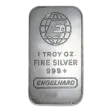
1 listing
Filters
| Product | /oz | Premium | Price | |
|---|---|---|---|---|

 IDC Coin and Bullion
|
$80.12 | +18.47% | $80.12 | View Deal |
Prices are fetched automatically and may not reflect current merchant prices. Currency conversions and tax treatment are approximate. Rankings are based solely on price. We are not a dealer and accept no responsibility for transactions with listed merchants. Past performance is not indicative of future results. This site does not provide investment advice. Full disclaimer
About the 1 oz Engelhard Silver Bar
The Engelhard 1 oz Silver Bar
Engelhard silver bars are discontinued products from one of the most historically significant precious metals refiners in the United States. The company was founded by Charles W. Engelhard Sr. in 1902 in Newark, New Jersey, and by the 1950s had become the world's largest precious metals smelter. Retail silver bar production ran from the late 1960s through approximately 1986, and BASF acquired the company in 2006 for US$5 billion, renaming it BASF Catalysts LLC. No new Engelhard bars have been produced since the mid-1980s.
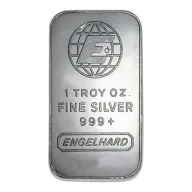
The 1 oz silver bar was made in over 40 distinct varieties across the production years, documented meticulously by the AllEngelhard.com collector community. Varieties range from the earliest landscape-orientation bars with elongated octagon hallmarks (late 1960s) through Canadian-stamped editions, the iconic portrait-orientation bars with the 'E' globe logo (1981-1986), and the final Eagle logo design from 1986. Nearly all carry individual serial numbers, with only two known unnumbered varieties. The total production of 1 oz bars was approximately 4 million pieces, but a significant number were melted during the 1979-1980 silver price spike when silver reached $49.45/oz, making surviving bars rarer than the original production figures suggest.
The practical consequence for buyers is a collector premium. Engelhard 1 oz silver bars trade at a substantial markup over spot price, and the premium is for historical provenance and scarcity, not metal content. A common 1 oz Engelhard bar might carry a premium of $5-20+ over spot, while rare varieties command far more. This makes Engelhard bars a poor choice for investors purely interested in maximising silver weight per dollar, and a deliberate choice for collectors who value the brand's history. Charles Engelhard Jr., who consolidated the family holdings in 1958, is widely cited as the inspiration for Ian Fleming's James Bond villain Auric Goldfinger.
Engelhard 1 oz Silver Bar Specifications
| Attribute | Detail |
|---|---|
| Weight | 1 troy ounce (31.1035 g) |
| Purity | .999 fine silver |
| Manufacturer | Engelhard Industries (Newark, NJ, USA) |
| Production period | Late 1960s to approximately 1986 |
| Serial numbers | Nearly all bars; two known unnumbered varieties |
| Production methods | Cast (poured), pressed, and extruded |
| Legal tender | No |
| Face value | None |
| Total varieties (1 oz) | 40+ documented types |
Major Variety Categories
AllEngelhard.com, the definitive collector reference, catalogues the 1 oz bars into major categories based on production era and design features:
- Landscape varieties (late 1960s): Elongated octagon hallmarks with an extruded finish. The earliest commercial production and among the rarest survivors today.
- Canadian varieties (1968-early 1970s): Stamped "Engelhard Industries of Canada." Separately collected from US-made bars and identifiable by the Canadian text stamp.
- Portrait varieties (1981-1986): The most commonly found category today. Features the Wide 'E' globe logo and Large 'E' designs in portrait orientation.
- Eagle logo (1986): The final design produced before Engelhard exited retail bullion. Identified by an eagle motif replacing the earlier globe logo.
- Art and commemorative bars: Including the 1976 Sports Series (six designs) and various corporate or institutional commissions with dealer counterstamps.
Authentication
The unique serial number is the primary authentication marker, with formats varying by era: numerical-only codes with 5-6 digits for most varieties, and letter-prefix codes (PA, PB, FG series) for specific production runs. The "PB" prefix uses 6 digits, while most other prefixed series use 5. AllEngelhard.com maintains detailed pages on known counterfeits, documenting the font details, spacing, and edge quality that distinguish genuine bars from fakes. Engelhard bars are among the most counterfeited silver bars on the market, making authentication particularly important for this brand.
Tax Treatment of Engelhard Silver Bars
Engelhard bars are privately minted .999 fine silver with no legal tender status. Tax treatment follows standard silver bar rules in each jurisdiction, with no special exemptions.
United Kingdom
Subject to 20% VAT on purchase. Not CGT-exempt; capital gains are taxed at 18% or 24%. The collector premiums that Engelhard bars command make the CGT question more relevant than for generic bars, since larger gains above the £3,000 annual allowance may apply. UK legal tender silver coins like the 1 oz Silver Britannia avoid CGT.
United States
Most states exempt investment-grade silver from sales tax. Engelhard bars meet the .999 purity requirement for IRA inclusion, though specific IRA custodian approval is required. Capital gains are taxed at the collectibles rate of up to 28%. As a discontinued brand with collector premiums, the capital gains liability on Engelhard bars can be significant if bought at market price (including collector premium) and sold at an even higher collector price.
Canada
GST/HST-exempt for silver at 99.9% purity or above. The bar qualifies at .999 fine.
Australia and New Zealand
Australia exempts silver at 99.9% purity from GST. New Zealand exempts fine silver at 99.9% from GST with no capital gains tax.
European Union
Standard VAT applies on silver bars (17-27% by country). The EU margin scheme (Differenzbesteuerung in Germany) may apply to second-hand bars, which Engelhard bars definitively are. This could reduce the effective VAT for EU buyers purchasing through dealers who apply the margin scheme.
Singapore and Hong Kong
Singapore's IPM scheme covers silver at 99.9% purity. Hong Kong has no sales tax or capital gains tax.
Engelhard vs Johnson Matthey and Modern Silver Bars
Johnson Matthey (JM) is the other major historic refiner that produced retail silver bars during the same era. Both companies produced .999 fine, serial-numbered bars across similar size ranges, and both ceased retail bar production (JM sold its bullion arm to Asahi in 2015). In the collector market, Engelhard bars generally command higher premiums than equivalent JM bars. The premium gap reflects Engelhard's greater variety of documented types (40+ for the 1 oz size alone), the Goldfinger cultural association, and the established collector infrastructure at AllEngelhard.com. Both brands are equally sound from a metal-content perspective.
Against modern production bars from LBMA refiners like PAMP Suisse, Valcambi, or Argor-Heraeus, the comparison turns on purpose. Modern Swiss bars trade at modest premiums over spot with LBMA provenance, sealed assay packaging, and authentication technology like PAMP's VeriScan. Engelhard bars trade at collector premiums with provenance established through serial number verification and community cataloguing. A buyer seeking the most cost-efficient silver bar buys modern; a buyer who values historical significance and collecting buys Engelhard.
Compared to generic 1 oz silver bars from current private mints (Sunshine, SilverTowne, Asahi), the price gap is stark. Generic bars trade near spot, typically at premiums of 5-10%. Common Engelhard 1 oz bars carry premiums of $5-20+ over spot, and rare varieties can command multiples of that. The generic bar maximises silver ounces per dollar spent; the Engelhard bar adds a collecting dimension that has historically appreciated faster than spot silver in strong collector markets, but also carries the risk that collector demand could cool independently of the metal price.
1 oz Engelhard Silver Bar: frequently asked questions
-
The cheapest 1oz Engelhard silver bar tracked on this page is $80.12, available from IDC Coin and Bullion at around 18.5% over the $67.63 silver spot price. Because these bars are no longer produced, prices can vary significantly between dealers depending on condition and collector demand.
-
Engelhard Corporation ceased bullion production after BASF acquired it in 2006. Its silver bars, rounds, and ingots are now considered vintage collectibles, and no new Engelhard bullion has been produced since the acquisition.
-
Engelhard bars are no longer made, so supply is fixed and shrinks as pieces are melted or absorbed into collections. Their strong reputation from decades of refining activity, combined with a dedicated collector base, pushes premiums above those of current-production generic silver bars of equivalent weight and purity.
-
Authentic 1oz Engelhard bars carry a clear "ENGELHARD" stamping, declared weight and purity, and a distinctive surface finish. The bar should weigh 31.1 grams. Counterfeits exist, so check the stampings for sharpness and consistency, verify the dimensions, and buy from reputable dealers who guarantee authenticity.
-
Most vintage Engelhard 1oz silver bars do not carry individual serial numbers. The stampings typically show weight, purity, and the refinery mark, with no unique identifying number.