4 products · 7 deals Prices & premiums exclude tax to compare across countries
Filters



Prices are fetched automatically and may not reflect current merchant prices. Currency conversions and tax treatment are approximate. Rankings are based solely on price. We are not a dealer and accept no responsibility for transactions with listed merchants. Past performance is not indicative of future results. This site does not provide investment advice. Full disclaimer
About 20 oz Silver Bars
The 20oz Silver Bar: An Uncommon Middle Weight
A 20 troy ounce silver bar contains 622.1 grams of .999 fine silver, which works out to 0.622 kilograms or about 1.37 pounds. It sits in a gap in the standard silver bar lineup: retail sizes cluster at 1 oz, 5 oz, 10 oz, and 100 oz, and the 20 oz format is produced by fewer refiners and stocked by fewer dealers than any of those. Buyers who choose it are usually after one of two things. The first is consolidation: a single 20 oz bar replaces two 10 oz silver bars, which means fewer pieces to count, store, and track, without stepping all the way up to the 100 oz commitment. The second is the format itself. Many bars at this weight are hand-poured or cast rather than minted, with the chunky, irregular look that comes from pouring molten silver into a mould, and that artisanal aesthetic draws collectors as well as stackers.
The 20 oz bar is almost exclusively a North American product. Troy-ounce denominations are native to the US and Canadian markets, and that is where this size is bought and sold. European dealers rarely stock it, since metric equivalents like 500g and 1 kg bars dominate there. In Australia, 10 oz and kilo bars are the standard choices and the 20 oz format is uncommon, and Asian markets prefer metric bars outright.
The honest economic case is modest. The premium advantage over 10 oz bars is marginal, so buyers choosing 20 oz over 10 oz are typically driven by convenience or by a specific design available at this size rather than by cost savings. For pure cost efficiency per ounce, 100 oz silver bars do better. The 20 oz format earns its place as a deliberate middle ground: more silver per bar than the popular 10 oz size, less capital and weight per piece than 100 oz, and a distinctive poured form that the mass-produced standard sizes rarely offer.
20oz Silver Bar Premiums on the Weight Scale
Premiums on 20 oz silver bars typically run 3-5% over spot. That places them between 10 oz bars, at roughly 3-5%, and 100 oz bars, at roughly 2-4%. The overlap with the 10 oz range is the key point: doubling the bar size buys little to no premium saving, because the steep part of the silver bar premium curve sits lower down the scale. Across silver bars generally, the single biggest premium drop happens between 1 oz and 10 oz, typically a 4-5 percentage point reduction, and after 10 oz each step up saves less.
The 20 oz size can also carry slightly higher premiums than its weight alone would suggest. Production volumes are low and the size is non-standard, which limits competition among refiners and keeps pricing less sharp than on the heavily contested 10 oz and 100 oz formats. Manufacturing method matters too: cast bars run 1-2% cheaper than minted bars of the same weight, and since many 20 oz bars are cast or hand-poured, the format benefits from the cheaper production style.
Tax treatment shifts the effective cost by jurisdiction. In the US, most states exempt bullion bars from sales tax. Canada applies no GST/HST to silver refined to 99.9% purity or higher in bar, ingot, coin, or wafer form, so a .999 fine 20 oz bar qualifies. Australia treats silver of 99.9%+ purity as investment-grade and GST-free. In the UK, silver bars carry 20% VAT on purchase, and in the EU silver attracts full national VAT rates; the 20 oz format is rarely stocked in those markets anyway. Where VAT applies, larger bars offset the fixed tax hit better than small ones, which is part of why heavier formats like 20 oz make more sense in tax-exempt North American markets than in Europe.
Who Makes 20oz Silver Bars
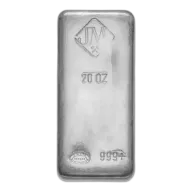
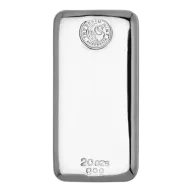
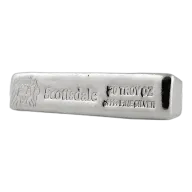
The product range at this weight is narrow, and the bars that exist lean heavily toward the cast and hand-poured style. The most recognisable is the Scottsdale Mint 20 oz cast bar, a hand-poured bar with a distinctive chunky form that has become the reference product at this size. The Jersey Mint 20 oz long cast bar takes the artisanal poured approach in an elongated format. Asahi also produces a 20 oz bar; Asahi acquired Johnson Matthey's refining operations in 2015 and is widely distributed in North America, which gives its bars stronger brand recognition than most private-mint output at this weight.
Beyond those names, various private mints produce generic 20 oz bars, and secondary-market examples circulate with mixed brand recognition. All are .999 fine silver. Because the size is non-standard, there are no tube or multi-bar packaging conventions at this weight; bars are sold individually rather than in the boxed or tubed multiples common at 1 oz and 10 oz.
Buyers weighing brand against price should note that the divide matters more here than at standard sizes. Recognised names like Scottsdale and Asahi resell more easily than unknown private-mint bars, and the hand-poured aesthetic can add a small collector premium on the secondary market for named mints. A generic 20 oz bar saves money up front but gives up that recognition when it is time to sell, in a market segment that is already thinner than the 10 oz bar mainstream.
Selling and Storing a 20oz Silver Bar
Liquidity is the main trade-off at this weight. The 20 oz bar is less liquid than the standard 10 oz and 100 oz sizes: because the weight is non-standard, some dealers do not actively quote it, and others may offer wider buyback spreads than they would on a format they handle daily. Major online dealers including APMEX, SD Bullion, and JM Bullion do buy back 20 oz bars, so an exit route exists, but the market depth is thinner and a sale may take marginally longer than it would for a standard size. Brand softens this considerably. Bars from recognised mints such as Scottsdale and Asahi resell more easily than unknown private-mint bars, and hand-poured bars from named mints can pick up a small collector premium on the secondary market, which partially offsets the non-standard-size discount.
Storage is straightforward. At 622.1 grams, a 20 oz bar is roughly 50% heavier than a 10 oz bar and fits comfortably in a home safe or a safe deposit box. One practical caveat applies to the cast and poured bars that dominate this weight: their irregular surfaces mean they may not stack as neatly as minted bars, so a stack of poured 20 oz bars takes up more space than the same silver in uniform minted formats. There are no standard tubes or monster-box conventions at this size; each bar is stored as an individual piece.
For buyers prioritising resale ease over consolidation, the conventional sizes remain the safer choice: 10 oz and 100 oz bars are popular with dealers and resell efficiently. The 20 oz bar suits holders who value fewer, heavier pieces and accept a slightly slower sale in exchange.
20 oz Silver Bars: frequently asked questions
-
A 20 troy oz silver bar holds 20 troy ounces of fine silver, so its melt value is 20 times $67.63 per troy oz. Retail bar prices add a dealer premium on top. We track 8 listings from 8 dealers at this weight so you can compare the full landed cost.
-
A 20 troy oz silver bar weighs 20 oz (622.07 g). One troy ounce equals 31.1035 grams, so 20 troy oz comes to 622.07 g of fine silver. That is handy to know when comparing storage capacity in metric-unit vault systems.
-
The 20 troy oz bar is a less common size than 1 oz, 10 oz, or 1 kg, so fewer refiners produce it than the standard weights. A range of private mints and refineries does offer 20 oz bars, but availability varies by retailer. The comparison table above shows which issuers are currently in stock.
-
We track 8 listings from 8 dealers for 20 troy oz silver bars. Because this is a less common size than 1 oz or 10 oz, selection can be narrower, so checking all listed offers side by side helps you find the best premium.
-
Purchase tax on silver bars depends on your country. In the UK, silver bars carry 20% VAT. In Canada, silver bars are subject to GST/HST (0%). In Australia, silver bars attract GST (0%). In the US, sales tax rules differ by state.