2 products · 8 deals Prices & premiums exclude tax to compare across countries


Prices are fetched automatically and may not reflect current merchant prices. Currency conversions and tax treatment are approximate. Rankings are based solely on price. We are not a dealer and accept no responsibility for transactions with listed merchants. Past performance is not indicative of future results. This site does not provide investment advice. Full disclaimer
About 50 oz Silver Bars
The 50oz Silver Bar: A Non-Standard Middle Weight
A 50oz silver bar contains 50 troy ounces of .999 fine silver, which works out to 1,555.2 grams, or about 3.43 lbs. It is a non-standard denomination. The common silver bar progression runs 1 oz, 5 oz, 10 oz, then 100 oz, and the 50 oz size sits in the gap between the widely traded 10oz and 100oz formats. Fewer refiners produce bars at this weight than at either of those standard sizes, so the product range is narrower and availability is patchier.
The typical buyer is an accumulator who finds 10 oz bars too small for efficient stacking but does not want the outlay or bulk of a 100 oz bar. The 50 oz format also gives a practical divisibility advantage over the larger bar: an owner can sell half of an equivalent 100 oz position without liquidating the whole thing. Some buyers are also drawn to specific designs at this weight, such as the stackable Scottsdale Stacker series.
Geographically this is a North American product. The US and Canada are the primary markets, where troy-ounce denominations are native and the size fills a genuine gap in the lineup. In the UK and Europe the 50 oz bar is rarely available; metric markets prefer the kilo bar (32.15 oz) as their large-format standard, and the troy-ounce denomination adds friction there. It is similarly uncommon in Australia, where kilo and 10 oz bars are more standard, and it is not a recognised weight in Asia, where metric bars dominate. Buyers in metric markets are usually better served by the kilo bar; buyers in North America are the ones for whom the 50 oz size makes sense.
50oz Silver Bar Premiums on the Weight Scale
Premiums on 50 oz silver bars typically run 2 to 4% over spot. That places them between 10 oz bars, which typically run around 3 to 5%, and 100 oz bars at roughly 2 to 4%. The premium per ounce is marginally better than on 10 oz bars because manufacturing costs are amortised across more metal. The 50 oz bar is not quite as premium-efficient as the 100 oz format, but the difference is small, often less than 1% per ounce. In practice the 50 oz size gets close to the premium efficiency of a 100 oz bar at half the total outlay.
As with silver bars generally, the steepest premium savings come early on the weight scale: the single biggest drop happens between 1 oz and 10 oz, and after 10 oz each step up saves less. The move from 50 oz to 100 oz is therefore a marginal gain rather than a transformative one.
Tax Treatment by Country
Tax treatment follows the standard rules for silver bars. In the US there is no VAT and most states exempt bullion bars from sales tax; IRA-eligible silver must be at least 99.9% pure, which a .999 fine 50 oz bar meets. Canada exempts silver refined to at least 99.9% purity from GST/HST, and Australia applies 0% GST to investment-grade silver at the same 99.9% threshold. New Zealand and Singapore exempt silver at 99.9%+ purity from GST, again covered by the standard .999 fineness. In the UK, silver bars carry 20% VAT on purchase and are CGT-liable on sale, and in the EU silver attracts full national VAT rates on new bars, though the 50 oz format is rarely sold there anyway. Buyback spreads for bars from recognised refiners typically sit 1 to 3% below spot.
Who Makes 50oz Silver Bars
Product variety at this weight is narrower than at 10 oz or 100 oz. This is a niche size, and only a handful of refiners offer branded options. The notable names are:
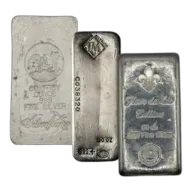
- Scottsdale Mint Stacker 50 oz: a stackable design produced in Arizona, popular with collectors as well as stackers. The interlocking format makes organised storage easier.
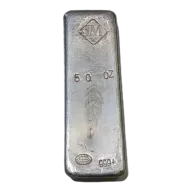
- Asahi 50 oz bar: from the Japanese refiner that acquired Johnson Matthey's precious metals business in 2015 and is now widely distributed in North America.
- Sunshine Minting 50 oz bar: from the major US refiner whose bars carry the MintMark SI anti-counterfeiting feature, a decoder-verified security layer.
- Generic private mint bars: various US and international mints produce unbranded or lesser-known 50 oz bars.
Brand matters more at this weight than at standard sizes. Because the 50 oz denomination is not instantly recognisable the way a 10 oz or 100 oz bar is, a recognised refiner name does more of the work at resale. Bars from Scottsdale, Asahi, and Sunshine sell more easily than products from unknown mints, and generic or unbranded bars from lesser-known refiners typically sell at melt value only, with no brand premium recovered. Buyers choosing between options at this weight should weigh the design appeal of something like the Stacker against the broader recognition of the established refiner names. There is no standard tube or multi-bar packaging convention at this size, so bars are bought and stored individually.
Resale, Handling, and Storage at 50oz
Liquidity is the main trade-off at this weight. The 50 oz bar has lower liquidity than either 10 oz or 100 oz bars because it is not a standard trading denomination. Some dealers do not actively quote it, or group it under "other sizes" rather than listing it as a category. Major online dealers such as APMEX, SD Bullion, and JM Bullion accept 50 oz bars for buyback, but with less consistency than they show for standard sizes. The non-standard weight can also slow a local sale: a buyer at a coin shop may need to weigh and verify the bar, whereas 10 oz and 100 oz bars are instantly recognisable formats. Sticking to recognised brands (Scottsdale, Asahi, Sunshine) mitigates most of this, since known refiner bars move more easily than unknown ones, and sealed bars in original packaging resell better than loose ones.
Physically, the bar is manageable. At 1.555 kg (3.43 lbs) it sits halfway between a 10 oz and a 100 oz bar in both weight and value, and it fits comfortably in a home safe or a safe deposit box. Stackable designs like the Scottsdale Stacker make organised storage straightforward. Standard silver storage care applies: silver tarnishes when exposed to sulphur compounds, so bars should be kept in dry conditions, ideally wrapped or sealed, with anti-tarnish strips as a cheap extra precaution. A meaningful position can be built at this weight without extreme storage challenges, which is part of the format's appeal for accumulators who want fewer, larger pieces than a stack of 10 oz bars but more flexibility than a small number of 100 oz bars.
50 oz Silver Bars: frequently asked questions
-
The metal content of a 50 troy oz silver bar is worth 50 times the silver spot price of $67.63 per troy oz. Dealer prices sit above this intrinsic value to cover fabrication and handling. This page compares 12 listings from 8 dealers so you can find the keenest premium available.
-
A 50 troy oz silver bar weighs approximately 1,555.2 grams, or about 1.555 kg. It is one of the larger standard bar sizes, so the substantial weight makes storage planning worthwhile before purchasing.
-
Silver bars are produced in a wide range of sizes, from 1 oz at the small end up to 1,000 oz (Good Delivery) at the large end. The 50 oz bar is a mid-to-large format, offering a lower per-ounce premium than smaller bars while remaining more divisible than a 100 oz bar.
-
Tax on silver purchases depends on where you buy. In the UK, silver bars carry 20% VAT. In Canada, investment silver is GST-free at 0%. In Australia, investment silver is also GST-free at 0%. In the US there is no federal sales tax, though state-level exemptions vary.