 BGASC
BGASC
1 listing
Filters
| Product | /oz | Premium | Price | |
|---|---|---|---|---|
| $122.46 | +85.28% | $61.23 | View Deal |

Prices are fetched automatically and may not reflect current merchant prices. Currency conversions and tax treatment are approximate. Rankings are based solely on price. We are not a dealer and accept no responsibility for transactions with listed merchants. Past performance is not indicative of future results. This site does not provide investment advice. Full disclaimer
About the 1/2 oz Bounty Silver Coin
The 1/2 oz Cook Islands Bounty Silver Coin
The Bounty is a legal tender bullion series from the Cook Islands, a 15-island South Pacific nation in free association with New Zealand, and it depicts the HMS Bounty, the Royal Navy vessel made infamous by the 1789 mutiny. This half-ounce version contains 15.5518 grams of .999 fine silver. The series occupies what is best described as a budget sovereign niche: it carries genuine legal tender status, denominated in Cook Islands dollars pegged to the New Zealand dollar, which puts it a rung above private mint rounds in legal standing, but it comes from a small issuing nation with limited market recognition compared with the major sovereign coins.
The half-ounce format adds a second layer of distinctiveness, since fractional silver coins are rare in bullion generally; the documented core of the Bounty series is the 1 oz silver Bounty alongside a 1/10 oz silver piece and gold versions. A sub-ounce coin lowers the entry cost per piece, at the usual fractional trade-off of higher production cost relative to metal content.
For US buyers the series carries one important caveat: despite high purity across the documented silver issues, the IRS treats Cook Islands coins as overly collectible due to limited mintages and premium pricing, so they are not IRA-eligible. Outside retirement accounts, the Bounty's pitch is a recognisable, historically resonant sovereign design at premiums that have positioned it as a lower-cost alternative to coins like the American Silver Eagle, with the recognition gap as the price of admission. Where this coin lands on any given day is visible in the dealer comparison on this page.
Bounty Silver Coin Tax Treatment by Country
- US: The series' main market. No federal sales tax, and most states exempt bullion coins; long-term gains are taxed at the collectibles rate of up to 28%. The notable exception to its investment credentials: Cook Islands coins are not IRA-eligible, as the IRS classifies them as too collectible despite meeting purity thresholds on the documented issues.
- UK: Silver coins attract 20% VAT on purchase. The Bounty is not UK legal tender, so it has no CGT exemption and gains on disposal are taxable above the £3,000 annual allowance.
- Canada: Standard bullion rules apply: silver coins refined to 99.9% purity or better are zero-rated for GST/HST, which a .999 coin meets, though the series is not specifically recognised for preferential RRSP treatment.
- New Zealand: Of particular relevance given the Cook Islands' free association with New Zealand and the NZD currency peg. New Zealand exempts silver of 99.9% purity or better from GST, which a .999 coin meets; there is no formal capital gains tax.
- Australia: GST-free treatment requires investment-grade silver of 99.9% purity or better in a form commonly traded on commodity markets; treatment of small-nation legal tender coins can depend on how the ATO views the specific issue.
- EU: Standard national VAT rates apply to silver coins, with margin scheme treatment available on second-hand pieces in some countries.
- Singapore and Hong Kong: No capital gains tax in either jurisdiction; Hong Kong levies no sales tax at all.
The HMS Bounty and the Coin That Carries It
The HMS Bounty was acquired by the Royal Navy in 1787 and became the stage for one of the most famous events in naval history: the 1789 mutiny led by Lieutenant Fletcher Christian against Captain William Bligh. The mutineers burned and scuttled the ship at Pitcairn Island in 1790, where descendants of the mutineers still live today. That story gives the coin genuine historical resonance beyond generic bullion design, and the Cook Islands connection is fitting; the islands were visited and named after Captain James Cook, who reached them in 1773.
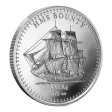
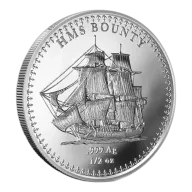
The coin series first appeared in 2009 in both gold and silver. The Cook Islands has no minting facilities of its own, so production has always been contracted out: the 2009 originals were struck by Heimerle + Meule GmbH of Pforzheim, Germany, with later production from at least 2017 handled by Sunshine Minting of Idaho. The ship side shows a finely detailed HMS Bounty under sail against a distinctive stylised grid-and-wave background pattern not found on other bullion coins, paired with the Ian Rank-Broadley effigy of Queen Elizabeth II common to Commonwealth coinage. The ship design has stayed largely consistent across the annual issues, making the series easy to recognise.
Mintages have been a defining feature. The 2017 silver issue was capped at just 5,000 coins, exceptionally low for a bullion coin when American Silver Eagles run to tens of millions a year, and early-year Bounty coins carry numismatic premiums as a result. The Cook Islands itself, with a population around 17,000, has become one of several Pacific nations (alongside Niue, Tuvalu, and Tokelau) known for licensing their sovereign status to coin programmes that far exceed domestic currency needs.
Bounty vs Silver Eagle, Maple Leaf, and Other Small-Nation Coins
Against the American Silver Eagle, the Bounty's documented positioning is lower premium but weaker credentials: the Eagle carries universal IRA eligibility, US legal tender status, and vastly superior liquidity, while the Bounty has traded cheaper and, in its documented 1 oz form, at higher .9999 purity than the post-2021 Eagle's .999. For a US buyer outside a retirement account who wants sovereign legal tender at the lowest cost, the Bounty is the value play; for anyone prioritising resale speed or IRA placement, the Eagle wins.
Against the 1 oz silver Maple Leaf, the comparison is recognition and supply. The Maple Leaf matches four nines purity on the Bounty's flagship sizes, is struck in unlimited mintage to demand, is IRA-eligible, and is recognised by dealers worldwide. The Bounty's limited mintages cut the other way: less liquidity, but scarcity that has given early years collector value.
The closest structural peers are other small-nation issues such as Niue coins, which similarly use external mints (New Zealand Mint and Perth Mint for Niue, against the Bounty's German and American contractors). Both serve as budget sovereign alternatives: legal tender standing above private rounds, recognition below the Britannia, Philharmonic, and other major mints' flagships. At the half-ounce weight specifically the field is nearly empty, since fractional silver is rare across all mints, so the practical alternative for most buyers is stepping up to the 1 oz Bounty or a 1 oz mainstream sovereign coin and comparing the per-ounce cost directly.