1 listing
Filters
| Product | /oz | Premium | Price | |
|---|---|---|---|---|

 IDC Coin and Bullion
Out of Stock
IDC Coin and Bullion
Out of Stock
|
$300.00 | +343.59% | $30.00 | View Deal |
Prices are fetched automatically and may not reflect current merchant prices. Currency conversions and tax treatment are approximate. Rankings are based solely on price. We are not a dealer and accept no responsibility for transactions with listed merchants. Past performance is not indicative of future results. This site does not provide investment advice. Full disclaimer
About the 1/10 oz Bounty Silver Coin
The 1/10 oz Silver Bounty Coin
Fractional silver coins are genuinely rare. While almost every sovereign mint produces 1/10 oz gold, silver at this weight barely exists as a category, which makes the Cook Islands Bounty one of the few legal tender options for buying silver a tenth of an ounce at a time. The coin carries a $0.10 Cook Islands Dollar face value, is struck in .9999 fine silver, and belongs to the same annual series as the popular 1 oz silver Bounty.
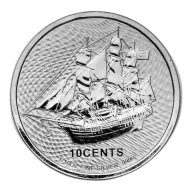
The design is the series' main draw. The coin depicts HMS Bounty, the Royal Navy vessel acquired in 1787 and made infamous by the 1789 mutiny led by Fletcher Christian against Captain William Bligh, set against a distinctive stylised wave-grid background found on no other bullion coin. The reverse carries the Ian Rank-Broadley effigy of Queen Elizabeth II common to Commonwealth coinage.
At a tenth of an ounce of silver, this is not a wealth-accumulation product; the metal content is worth a few dollars. Its use cases are gifts, low-cost introductions to sovereign silver, and completing a Bounty set. The trade-offs are real: the Cook Islands is a small issuing nation with limited market recognition compared with the major sovereign coins, and despite exceeding .999 purity the Bounty series is not IRA-eligible in the US, because the IRS treats Cook Islands coins as overly collectible. Buyers wanting recognised fractional legal tender silver have few alternatives at this weight, which is precisely the niche the coin occupies.
1/10 oz Silver Bounty Specifications
| Specification | Detail |
|---|---|
| Weight | 1/10 troy oz (3.11 g) |
| Purity | .9999 fine silver |
| Face value | $0.10 (Cook Islands Dollar, pegged to NZD) |
| Obverse | HMS Bounty under sail with wave-grid background |
| Reverse | Ian Rank-Broadley effigy of Queen Elizabeth II |
| Legal tender | Cook Islands |
Each coin carries the year date, face value, weight, and purity inscriptions, with detailed relief and fine line work on both sides. The .9999 purity matches the Canadian Maple Leaf and exceeds the .999 of the American Silver Eagle and Britannia, an unusual specification for a budget-tier coin.
The series is an annual release with new dated versions each year, and the ship design has remained largely consistent across years, making it recognisable despite the small issuer. The Cook Islands has no minting facilities of its own: the 2009 originals were struck by Heimerle + Meule GmbH in Pforzheim, Germany, with later production from at least 2017 contracted to Sunshine Minting in Idaho, one of North America's largest private mints and a supplier of blanks to the US Mint.
Tax Treatment of the Silver Bounty
The Bounty is official Cook Islands legal tender, but legal tender status from a small Pacific nation buys less tax advantage than buyers often assume.
- US: the main market for the coin, and the biggest caveat applies here. The Bounty is not IRA-eligible despite its .9999 purity; the IRS classifies Cook Islands coins as overly collectible due to limited mintages and premium pricing. State sales tax follows normal bullion rules, which vary by state.
- UK: silver coins attract 20% VAT on new purchases. The Bounty is not UK legal tender, so there is no CGT exemption; only UK coins such as the Britannia qualify.
- EU: full local VAT applies to silver, at rates from 17% to 27% depending on the country.
- Canada: GST/HST exempt, as the federal exemption covers silver coins refined to 99.9% purity or higher.
- New Zealand: the closest jurisdiction to home, given the Cook Islands' free association with NZ and the NZD peg. Silver of 99.9%+ purity in coin form is GST-exempt, which the .9999 Bounty satisfies.
- Australia: investment-grade silver at 99.9%+ purity is GST-free.
- Singapore and Hong Kong: Singapore exempts qualifying investment precious metals from GST and levies no capital gains tax; Hong Kong has no sales tax at all.
A Mutiny, a Burned Ship, and a Coin Series
The HMS Bounty story is one of the most famous events in naval history. The Royal Navy acquired the vessel in 1787; two years later Lieutenant Fletcher Christian led a mutiny against Captain William Bligh, and in 1790 the mutineers burned and scuttled the ship at Pitcairn Island, where descendants of the crew still live today. The Cook Islands connection runs through the same era of Pacific exploration: the 15-island nation was visited by Captain James Cook in 1773 and today governs itself in free association with New Zealand.
The coin series began in 2009 with gold and silver versions, the originals struck by Heimerle + Meule in Germany. The 2009 launch included fractional gold down to 1/10 oz, and the silver line later added its own 1/10 oz denomination alongside the standard ounce. Production moved to Sunshine Minting in Idaho by 2017, the year the silver coin appeared with an exceptionally low mintage of 5,000; for comparison, American Silver Eagles run to tens of millions annually. Early-year Bounty coins consequently carry numismatic premiums, while later years settled into a more conventional bullion role.
The Cook Islands itself, population around 17,000, has become a prolific coin-issuing state, one of several Pacific nations alongside Niue, Tuvalu, and Tokelau that license their sovereign status for coin programmes. Following Queen Elizabeth II's death in 2022, future issues may transition from the Rank-Broadley effigy to a King Charles III portrait.
Bounty vs Eagle, Maple Leaf, and Other Small-Nation Coins
At the full-ounce weight, the Bounty competes as a budget sovereign coin: legal tender like the American Silver Eagle but typically cheaper, with .9999 purity that exceeds the post-2021 Eagle's .999 and matches the Canadian Maple Leaf. The Eagle answers with universally superior liquidity and IRA eligibility; the Maple Leaf adds unlimited mintage, global recognition, and Mintshield anti-tarnish technology. The Bounty's position is legal status above a private round, recognition below a major sovereign coin.
At 1/10 oz the comparison set changes, because the majors barely play here. Fractional silver is scarce across the industry; the standard fractional formats are gold coins like the 1/10 oz Eagle or 1/10 oz gold Britannia, not silver. The Bounty's closest peers are coins from other small Pacific issuers such as Niue, which similarly contract production to external mints (New Zealand Mint, Perth Mint, against the Bounty's Sunshine Minting) and similarly trade recognition for price.
The practical advice from fractional economics applies regardless of metal: manufacturing costs are spread over a tenth of the content, so small denominations are poor value for accumulation and best treated as gifts or entry purchases. A buyer who wants silver exposure per dollar should take the 1 oz Bounty; a buyer who wants the smallest legal tender silver coin with a story attached is the person this denomination was made for.