1 listing
Filters

 Monument Metals
Prices are fetched automatically and may not reflect current merchant prices. Currency conversions and tax treatment are approximate. Rankings are based solely on price. We are not a dealer and accept no responsibility for transactions with listed merchants. Past performance is not indicative of future results. This site does not provide investment advice. Full disclaimer
About the 2 oz Bounty Silver Coin
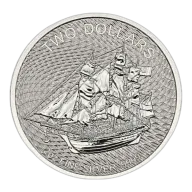
The 2 oz Bounty Silver Coin
The Bounty series features the HMS Bounty, the Royal Navy vessel acquired in 1787 that became infamous for the mutiny led by Fletcher Christian against Captain William Bligh in 1789. The coins are issued as legal tender of the Cook Islands, a 15-island South Pacific nation in free association with New Zealand, and the ship-under-sail design with its distinctive stylised wave-grid background has stayed largely consistent across annual releases, making the series instantly recognisable.
The Bounty occupies a specific niche: it is a budget sovereign coin. It carries genuine legal tender status, which private mint rounds lack, but comes from a small issuing nation with limited market recognition compared with the major sovereign programmes. That positioning usually translates to lower premiums than flagship coins, at the cost of a smaller buyer pool when it is time to sell.
This 2 oz version contains 62.21 grams of .999 fine silver. Two troy ounces is a relatively modern bullion weight rather than a traditional standard; its appeal is mostly the larger canvas it gives a detailed design like a fully rigged sailing ship, since the per-ounce premium saving over 1 oz coins is minimal. Stackers who simply want weight at the lowest cost are better served by 10oz silver bars; buyers who want the Bounty design at the most liquid size should look at the 1oz Bounty silver coin.
2 oz Bounty Coin Specifications
| Attribute | Detail |
|---|---|
| Metal | Silver |
| Purity | .999 fine |
| Weight | 2 troy oz (62.21g) |
| Issuer | Cook Islands (legal tender) |
| Design | HMS Bounty under sail, stylised wave background |
The series design places the HMS Bounty under sail on one side with weight and purity inscriptions, and the effigy of the monarch on the other, as is standard for Commonwealth coinage; issues during Queen Elizabeth II's reign carry Ian Rank-Broadley's portrait. Both sides share the distinctive grid-pattern wave background that does not appear on other bullion coins.
Two-ounce silver coins are physically larger than their 1 oz counterparts and are typically sold in individual capsules rather than mint tubes, which are the standard packaging at 1 oz. Storage is straightforward: keep the capsule sealed and the coin away from humidity, as silver tarnishes when exposed to sulphur compounds.
Tax Treatment of the 2 oz Bounty Silver Coin
As a silver coin, the Bounty receives less favourable tax treatment than gold in several markets, with one notable quirk for American retirement accounts.
- US: Cook Islands Bounty coins are not IRA-eligible despite meeting the purity requirement; the IRS treats Cook Islands coins as overly collectible due to limited mintages and pricing above spot. Sales tax depends on the buyer's state, with most states exempting bullion. Long-term capital gains are taxed at the collectibles rate of up to 28%.
- UK: Silver attracts 20% VAT on new bullion, and the Bounty is not UK legal tender, so it carries no CGT exemption either. UK buyers wanting CGT-free silver need a silver Britannia instead.
- Canada: GST/HST exempt, since the coin meets the federal threshold of 99.9% purity for silver.
- Australia: Investment-grade silver requires 99.9% purity for GST exemption, which .999 fine silver meets.
- New Zealand: Silver at 99.9% purity or better in coin form is GST-exempt. The Cook Islands connection is notable here: the Cook Islands Dollar is pegged to the New Zealand Dollar and the nation is in free association with NZ.
- EU: Silver coins attract full national VAT rates, typically 17-27%.
- Singapore and Hong Kong: Singapore exempts qualifying investment silver from GST and levies no capital gains tax; Hong Kong has no sales tax at all.
The Mutiny Behind the Coin
The HMS Bounty's story is one of the most famous in naval history. The Royal Navy acquired the vessel in 1787, and in 1789 Lieutenant Fletcher Christian led a mutiny against Captain William Bligh. The mutineers eventually burned and scuttled the ship at Pitcairn Island in 1790, where descendants of the mutineers still live today. Few bullion coins carry a backstory with that kind of resonance; most ship designs on coins are generic maritime imagery, while this one depicts a specific, documented vessel.
The Cook Islands themselves were charted by Captain James Cook in 1773, tying the issuing nation to the same era of Pacific exploration the coin commemorates. The bullion series first appeared in 2009 in both gold and silver versions and has run as an annual release since, with new dated issues each year. Early years were strikingly scarce: the 2017 silver issue had a mintage of just 5,000 coins, exceptionally low for a bullion product when major sovereign coins mint in the millions, and those early dates now carry numismatic premiums above ordinary bullion value.
The Cook Islands, with a population of around 17,000, has become a prolific coin-issuing nation, one of several Pacific Island states (alongside Niue, Tuvalu, and Tokelau) that license their sovereign status for coin programmes produced by external mints. The Bounty series is its most established bullion line.
Bounty vs Queen's Beasts, Perth Lunar, and Mainstream 1 oz Coins
At the 2 oz weight, the dominant silver products are the Royal Mint's beast series. The 2 oz Queen's Beasts coins (2016-2021) made 2 oz a mainstream silver bullion weight, and the Tudor Beasts series continues the format today, both struck in .9999 fine silver against the Bounty's .999. For UK buyers the Royal Mint coins have a decisive advantage: they are UK legal tender and therefore CGT-exempt, which the Bounty is not. The Perth Mint also fields 2 oz silver coins in its Lunar series and Koala ranges, with stronger global recognition than the Cook Islands programme.
The Bounty's case rests on price and theme. As a budget sovereign coin it typically undercuts the premiums of the beast and lunar series while still offering legal tender status, and the HMS Bounty design carries genuine historical weight rather than an annual rotating motif. The trade-offs are liquidity and, for Americans, retirement accounts: recognised mint products from the Royal Mint and Perth Mint resell more readily, and the Bounty is not IRA-eligible while mainstream alternatives like the American Silver Eagle and Canadian Maple Leaf are.
Against small-nation peers, the closest comparison is Niue coinage. Both nations use external mints and serve as budget sovereign alternatives to the major programmes, so the choice between them usually comes down to design preference and whichever is cheaper on the day.