5 listings
Filters
| Product | /oz | Premium | Price | |
|---|---|---|---|---|

 Canadian PMX
Out of Stock
Canadian PMX
Out of Stock
|
$72.47 | +16.50% |
$36.17
CA$51
|
View Deal |

 AU Capital Management
Out of Stock
AU Capital Management
Out of Stock
|
$82.52 | +32.76% | $41.26 | View Deal |
|
1/
AU Capital Management
Out of Stock
|
$82.64 | +32.77% | $41.32 | View Deal |
 AU Capital Management
Out of Stock
AU Capital Management
Out of Stock
|
$82.64 | +32.77% | $41.32 | View Deal |
|
20
AU Capital Management
Out of Stock
|
$82.64 | +32.77% | $41.32 | View Deal |
Prices are fetched automatically and may not reflect current merchant prices. Currency conversions and tax treatment are approximate. Rankings are based solely on price. We are not a dealer and accept no responsibility for transactions with listed merchants. Past performance is not indicative of future results. This site does not provide investment advice. Full disclaimer
About the 1/2 oz Great White Shark Silver Coin
The 1/2 oz Great White Shark Silver Coin
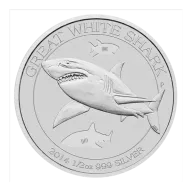
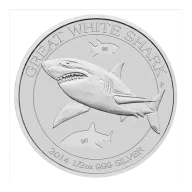
The Great White Shark, or Mokoha in Tokelauan, is the second release in Tokelau's ocean life silver bullion programme and generally the most popular and recognisable issue in the series. Released in 2015, it depicts a great white shark in a predatory pose on the reverse, with the Tokelauan name printed alongside the English one. This 1/2 oz version sits beside the 1 oz, 5 oz, and 0.5 g gold formats issued that year, making the Great White Shark one of the few releases in the series offered in a fractional silver size.
The coin is genuine legal tender of Tokelau, a New Zealand territory in the South Pacific, denominated in New Zealand dollars because Tokelau has no currency of its own. The territory itself is remarkable: around 1,500 people across three atolls totalling about 12 km², with no airport and access only by boat from Samoa. Coins are struck under licence by the New Zealand Mint, though US distribution sometimes credits Highland Mint.
The practical appeal is twofold. Shark-themed silver bullion is scarce; the Royal Mint has never produced a dedicated shark bullion coin, leaving the Tokelau series one of the few options for the theme. And as a half-ounce piece it offers a lower entry price than a full ounce of silver coins, though 1/2 oz silver is an uncommon bullion weight, so buyers should expect it to trade more like a low-mintage niche issue than a mainstream stacker coin such as the 1 oz American Silver Eagle.
Tax Treatment of the Great White Shark Coin
The coin is .999 fine silver and legal tender of Tokelau, backed by a New Zealand dollar denomination. That combination determines its tax position in each market.
- UK: 20% VAT applies on purchase, as with all silver bullion. The coin is not UK legal tender, so it carries no CGT exemption; gains above the £3,000 annual allowance are taxable. Buyers who want CGT-free silver should compare the silver Britannia instead.
- US: IRA-eligible, since it meets the .999 fineness minimum for silver (the IRS threshold is 99.9%). No federal sales tax; state treatment varies, with around 35 states exempting bullion. Long-term gains are taxed at the collectibles rate of up to 28%. The US is the coin's primary international market.
- New Zealand: despite the NZD denomination, silver must be at least 99.9% pure to be GST-exempt, which the coin's .999 fineness satisfies at the threshold; non-investment-grade items attract 15% GST.
- Canada: 0% GST/HST for silver refined to 99.9%+ purity in coin form, which this coin meets.
- Australia: the GST exemption for silver requires 99.9% purity; the Perth Mint's own marine-themed coins are more commonly available domestically.
- EU: full local VAT applies on new silver coins, from 17% to 27% depending on the member state.
- Singapore and Hong Kong: no tax in Hong Kong at all; Singapore exempts qualifying 99.9% silver legal tender coins from GST, and neither jurisdiction levies capital gains tax.
The Tokelau Ocean Life Series Since 2014
Tokelau's marine biodiversity programme was planned as a 12-coin series, with each year featuring a different South Pacific species named in both English and Tokelauan. The inaugural 2014 release was the Kakahi (Yellowfin Tuna), followed by the Mokoha (Great White Shark) in 2015, the year this coin belongs to. Later issues include the Hakula (Sailfish, 2016, with mintage cut to 250,000), Kapoa (Barracuda, 2017), Mago-Taguta (Leopard Shark, 2018), Fonu (Loggerhead Turtle, 2019), Hahave (Flying Fish, 2020, the first year with a 1 oz gold version), Tautu (Porcupine Fish, 2021), Hakuhakulele (Lionfish, 2022), and Laulaufau (Longfin Bannerfish, 2024).
The obverse across the series carries Queen Elizabeth II's right-profile portrait by Ian Rank-Broadley alongside the Tuluma, a traditional Tokelauan box used for storing fishhooks and other valuables, a fitting emblem for a marine series. Later issues transitioned to King Charles III. The matte finish is characteristic of the series rather than a defect, and dealers note coins may show minor surface imperfections as manufactured.
The Great White Shark issue ran to an estimated 500,000 coins in the 1 oz size, high for Tokelau but tiny against major sovereign mint output, where American Silver Eagle mintages exceed 30 million in a year. That positions the series as affordable bullion with moderate collector appeal, and the Great White Shark commands slightly higher secondary market premiums than the Sailfish or Barracuda releases. The Tokelauan species names also give the coins a quiet linguistic distinction: they record words from a Polynesian language spoken by very few people worldwide.
Great White Shark vs Other Marine Silver Coins
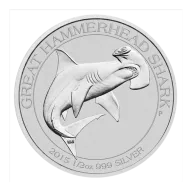
Shark-themed silver bullion is a small field, which is part of this coin's appeal. The closest rival is the Perth Mint's Australian Hammerhead Shark, also a shark-themed bullion coin but from a major sovereign mint with far higher recognition, and correspondingly higher premiums. The Royal Canadian Mint's Predator series has also included shark designs, with .9999 purity and full government mint backing. Buyers choosing between them are weighing the Tokelau coin's lower profile against the stronger resale recognition of the big sovereign mints.
From the same producer, the Fiji Taku (Hawksbill Turtle) is the natural comparison: also struck by the New Zealand Mint, also Pacific island legal tender, also marine themed. The Taku had unlimited mintage and was the more mass-market product, whereas the Great White Shark's estimated 500,000 mintage gives it a degree of scarcity. Within Tokelau's own ocean life series, the shark is generally the strongest performer, commanding slightly higher secondary market premiums than the Sailfish or Barracuda issues.
The 1/2 oz format itself is the bigger differentiator. Half-ounce silver coins are rare in bullion; the weight is primarily a gold coin format, and silver at this size appears mostly as commemoratives. Mainstream alternatives like the 1 oz silver Maple Leaf or 1 oz silver Britannia will always be easier to sell and cheaper per ounce, since government 1 oz silver coins are the standard unit of the market. The case for the half-ounce shark rests on theme and series collecting rather than cost efficiency per ounce of silver.
1/2 oz Great White Shark Silver Coin: frequently asked questions
-
The 1/2 oz Great White Shark coin contains 1/2 oz of .999 fine silver, weighing 15.55 grams. It is part of Tokelau's ocean life series, with the Great White Shark ("Mokoha" in Tokelauan) being the second release from 2015. The coin carries a $5 NZD face value as legal tender of Tokelau.