1 listing Prices & premiums exclude tax to compare across countries
Filters
| Product | /oz | Premium | Price (ex. tax) | |
|---|---|---|---|---|

 African Bullion
|
$109.17 |
+63.64%
+88% inc.VAT
|
$109.15
R2,043 inc.VAT
|
View Deal |
Prices are fetched automatically and may not reflect current merchant prices. Currency conversions and tax treatment are approximate. Rankings are based solely on price. We are not a dealer and accept no responsibility for transactions with listed merchants. Past performance is not indicative of future results. This site does not provide investment advice. Full disclaimer
About the 1 oz Hawksbill Turtle Silver Coin
The Longest-Running Pacific Island Bullion Coin
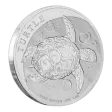
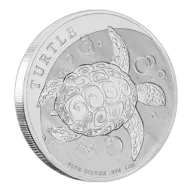
The 1 oz New Zealand Mint Hawksbill Turtle is a .999 fine silver coin issued as legal tender of Niue, a self-governing territory in free association with New Zealand. Denominated at $2 NZD, it has been in continuous production since 2014, making it one of the longest-running Pacific island bullion programmes at over a decade. The series actually began in 2010 under a different name and issuer: the Fiji Taku, before political instability in Fiji forced a transition to Niue in 2014.
The hawksbill turtle (Eretmochelys imbricata) depicted on the coin is critically endangered and native to the tropical waters of the South Pacific, where it is known locally as the "Taku." The coin draws attention to Pacific marine conservation while serving as practical, competitively priced bullion. The design has remained largely unchanged across 15 years of production, following the fixed-design model of the Silver Maple Leaf rather than the annual-change approach of coins like the Kookaburra.
Production is handled by the New Zealand Mint in Auckland, though from 2016 onward the Sunshine Mint in Idaho has also struck some production runs. This dual-mint arrangement is unusual for sovereign bullion; most programmes use a single facility. The annual silver mintage of 350,000 coins is moderate, well below the millions produced by the major sovereign mints but high enough to keep premiums competitive. Individual coins come in plastic flips, with tubes holding 20 coins and master boxes holding 500.
The series is also available in 2 oz and 5 oz silver (the latter limited to 50,000 mintage) as well as gold versions at 1/4 oz, 1/2 oz, and 1 oz. The gold coins are struck at .9999 purity, while all silver versions are .999.
Hawksbill Turtle Specifications Across Sizes
| Attribute | 1 oz Silver | 2 oz Silver | 5 oz Silver | 1 oz Gold |
|---|---|---|---|---|
| Weight | 31.1 g | 62.2 g | 155.5 g | 31.1 g |
| Purity | .999 Ag | .999 Ag | .999 Ag | .9999 Au |
| Diameter | 40.5 mm | N/A | N/A | 32 mm |
| Thickness | 2.3 mm | N/A | N/A | 1 mm |
| Face value | $2 NZD | $5 NZD | $10 NZD | $250 NZD |
| Annual mintage | 350,000 | N/A | 50,000 | ~10,000 |
The 40.5 mm diameter of the 1 oz silver coin is slightly larger than many comparable coins (the 1 oz Silver Britannia is 38.61 mm, the Maple Leaf is 38 mm), giving the turtle design more visual real estate. The coin is also thinner at 2.3 mm compared to the typical 3+ mm of most 1 oz silver coins, resulting in a wider, flatter profile.
The design history spans two distinct eras. During the Fiji Taku period (2010-2013), the obverse featured a smaller portrait of Queen Elizabeth II inside a circle, with "FIJI" and a denomination in Fijian dollars. The 2013 issue replaced the Queen's portrait with the Coat of Arms of Fiji, reflecting the country's republican direction, before the programme moved entirely to Niue. From 2014 onward, the obverse was redesigned with a larger Ian Rank-Broadley portrait and inscriptions changed to "NIUE" with NZD denominations. The reverse turtle design itself has remained largely consistent throughout, though the inscription changed from "TAKU" to "TURTLE" after the Niue transition. The gold face value was increased from $200 to $250 NZD around 2017 to better reflect rising gold prices.
Hawksbill Turtle Tax Treatment by Country
As legal tender of Niue (a self-governing territory in free association with New Zealand), the Hawksbill Turtle carries genuine sovereign backing. Tax treatment varies by the buyer's jurisdiction.
- United States: IRA-eligible for both the silver (.999) and gold (.9999) versions, as both meet IRS purity thresholds for self-directed precious metals IRAs. No federal sales tax on bullion. State-level exemptions cover roughly 35 states.
- United Kingdom: Silver carries 20% VAT on purchase. Gold qualifies for VAT exemption as investment gold at .9999 purity. The coin is not CGT-exempt in the UK; CGT exemption is reserved for UK legal tender. Standard CGT rates apply on disposal.
- Canada: GST/HST exempt as sovereign foreign legal tender bullion meeting the 99.5% purity threshold. Both silver and gold versions qualify.
- New Zealand: GST-free for investment-grade bullion. The Niue-issued coin has a direct legal tender connection to New Zealand through its NZD denomination. No formal capital gains tax applies in New Zealand.
- Australia: Silver is GST-free at 99.9% purity or above for investment-grade bullion. The .999 purity meets this threshold. Gold at .9999 comfortably qualifies for the 99.5% gold threshold.
- Singapore: Qualifies for GST exemption under the Investment Precious Metals scheme at 99.9% silver purity. No capital gains tax.
- Hong Kong: No sales tax, no import duty, and no capital gains tax on bullion of any type.
Hawksbill Turtle vs Britannia, Maple Leaf, and Kookaburra
The Hawksbill Turtle's primary advantage is price. It consistently trades at lower premiums than the major sovereign mint silver coins, making it attractive for buyers focused on accumulating silver weight. The tradeoff is lower brand recognition and weaker secondary market liquidity.
Against the 1 oz Silver Britannia, the Turtle lacks the advanced security features (surface animation, tincture lines, micro-text) that the Royal Mint builds into its flagship coin. For UK buyers, the Britannia's CGT exemption is a decisive advantage that the Niue-issued Turtle cannot match. The Britannia also has a far deeper secondary market in the UK. The Turtle's lower premium at purchase may partially offset these differences for buyers holding long-term in jurisdictions where CGT does not apply.
Compared to the 1 oz Silver Maple Leaf, the Turtle falls short on purity (.999 vs .9999) and security features (the Maple Leaf has Bullion DNA micro-engraving since 2015 and MintShield anti-tarnish since 2018). The Maple Leaf's annual mintage runs into the millions, ensuring strong global liquidity. The Turtle's 350,000 annual mintage provides adequate but not exceptional secondary market support.
The Perth Mint's Silver Kookaburra and Koala are the closest comparison in terms of market positioning: limited-mintage, wildlife-themed coins from a respected mint. Those coins feature annual design changes that generate collector interest, while the Turtle's fixed design targets pure bullion buyers. The Perth Mint's brand carries significantly more weight with dealers and assay offices worldwide.
Among turtle-themed competitors specifically, the 1 oz Cayman Islands Loggerhead Turtle from Scottsdale Mint is a newer entrant with a lower mintage (50,000 silver). It carries higher premiums but appeals to collectors seeking rarity. The Hawksbill Turtle's 15-year track record and higher mintage make it the more liquid and accessible option for silver stackers.
1 oz Hawksbill Turtle Silver Coin: frequently asked questions
-
The cheapest 1oz Hawksbill Turtle silver coin in our comparison is $109.15 from African Bullion, currently around 63.6% over the silver spot price. The coin is struck for Niue and carries a $2 NZD face value, giving it legal-tender status that private-mint rounds lack.
-
The Hawksbill Turtle is a 1 troy oz, 999 fine silver bullion coin struck by New Zealand Mint for the government of Niue. It carries a $2 NZD face value, making it legal tender. The reverse features a detailed depiction of the hawksbill sea turtle, one of the ocean's critically endangered species.
-
The hawksbill turtle (Eretmochelys imbricata) is classified as Critically Endangered on the IUCN Red List. Key threats include habitat loss (nesting beaches eroded or developed), accidental capture in fishing gear, and historically intensive hunting for its distinctive patterned shell, used for centuries in jewellery and decorative items. Despite international trade protections, populations remain severely depleted across tropical waters worldwide.
-
1 dealer in our comparison currently lists this coin, with 1 listing tracked in total. The comparison table above shows live prices and stock status across all of them, so you can find the best-priced in-stock option without checking each dealer separately.