2 listings Prices & premiums exclude tax to compare across countries
 Baird & Co.

Prices are fetched automatically and may not reflect current merchant prices. Currency conversions and tax treatment are approximate. Rankings are based solely on price. We are not a dealer and accept no responsibility for transactions with listed merchants. Past performance is not indicative of future results. This site does not provide investment advice. Full disclaimer
About the 1 oz Pobjoy Mint Noble Silver Coin
The Pobjoy Mint Noble in Silver: A Viking Ship from a Crown Dependency
The 1 oz Pobjoy Mint Noble Silver Coin is the silver variant of the Noble series issued by the Isle of Man government. The Noble holds a unique place in bullion history as the world's first platinum bullion coin designed specifically for investors (launched November 1983), though the silver version came later. Produced irregularly rather than annually, the Noble was struck by Pobjoy Mint from 1983 to 2016, with later production by Coin Investment Trust (2017) and Tower Mint (2018).
The series is named after the medieval Noble, a 14th-century English gold coin, and features a Viking longship design reflecting the Isle of Man's Norse heritage. The island was settled by Vikings in the 8th century and ruled by Norse kings until 1266. The Isle of Man is a self-governing British Crown dependency in the Irish Sea, not part of the United Kingdom, which gives its coinage a distinct legal status with implications for tax treatment in the UK.
Silver Nobles are struck in .999 fine silver with "ONE NOBLE" as the denomination rather than a fixed monetary value. Like the Krugerrand and Mexican Libertad, the Noble is legal tender to the value of its precious metal content, with the denomination floating rather than stamped as a specific currency amount. This is unusual among modern bullion coins, most of which carry a fixed nominal face value in a national currency.
Noble Silver Coin Specifications
| Attribute | Value |
|---|---|
| Weight | 1 troy ounce (31.1 g) |
| Purity | .999 fine silver |
| Issuer | Isle of Man Government |
| Denomination | ONE NOBLE (value by metal content) |
| Legal tender | Yes (Isle of Man) |
| Mints used | Pobjoy Mint (1983-2016), CIT (2017), Tower Mint (2018) |
| Current production | Dormant (no regular production since 2018) |
Platinum Noble Specifications (Historical Reference)
| Size | Weight | Purity | Diameter |
|---|---|---|---|
| 1 oz | 31.10 g | .9995 | 32.7 mm |
| 1/2 oz | 15.55 g | .9995 | 25.1 mm |
| 1/4 oz | 7.78 g | .9995 | 22.0 mm |
| 1/10 oz | 3.11 g | .9995 | 17.0 mm |
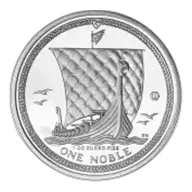
The reverse design across all Noble variants depicts a Viking longship under full sail (described as the "Thusly"), surrounded by seabirds, with the Isle of Man triskelion (three-legged coat of arms) above the ship's flag. A Viking knotwork border frames the design. The 1996 Platinum Noble featured the world's first holographic coin design, incorporating a holographic element in the ship's sail. Bimetallic editions were produced in 1995 (gold ring with platinum centre) and 2009 (silver ring with gold centre).
Noble Coin Tax Treatment: Crown Dependency Complications
The Noble's legal status as Isle of Man currency creates a complex tax position. The Isle of Man is a Crown dependency with its own tax regime, separate from the United Kingdom. This distinction has specific consequences for UK buyers.
- United Kingdom: Silver Nobles are subject to 20% VAT (platinum does not receive the VAT exemption that gold investment coins and bars enjoy). The critical question is CGT treatment. Noble coins are legal tender of the Isle of Man, not of the United Kingdom. UK CGT exemption applies specifically to legal tender coins denominated in sterling (Sovereigns, Britannias). Nobles denominated in "Nobles" rather than pounds sterling are NOT automatically CGT-exempt. Some dealers list certain Isle of Man gold coins as CGT-exempt when they meet specific criteria, but this should be verified with a tax adviser for silver.
- Isle of Man: The Isle of Man has no capital gains tax. Legal tender on the island. No VAT on investment gold purchased locally.
- United States: Gold (.9999) and platinum (.9995) Nobles are IRA-eligible based on purity. Silver at .999 also meets the minimum threshold. The sovereign-mint origin supports custodian acceptance. Capital gains at 28% collectibles rate.
- EU: Gold Nobles qualify for EU investment gold VAT exemption (purity above 900, legal tender, post-1800). Silver versions carry standard VAT.
- Canada: GST/HST exempt as .999 silver meets the purity threshold.
The key takeaway for UK buyers is that Noble coins do not carry the same CGT advantages as Royal Mint Britannias or Sovereigns. The sterling denomination requirement for CGT exemption specifically excludes the Noble's metal-value-based denomination system. This makes the Silver Britannia a structurally superior choice for UK buyers on CGT grounds.
From Platinum Pioneer to Dormant Series
The Noble's historical significance lies in its platinum variant, launched in November 1983 as the world's first platinum bullion coin created for investors. It preceded the Canadian Platinum Maple Leaf by five years (1988) and the American Platinum Eagle by fourteen years (1997). The original platinum run lasted from 1983 to 1989, with a 1985 mintage of 99,000 being the most common date and the 1983 first-year at just 94 pieces for the 1 oz being extraordinarily rare.
Gold and silver variants followed from the mid-1990s onward, produced sporadically rather than on an annual schedule. The 1996 Platinum Noble claimed to be the world's first holographic coin, with the Viking ship's sail incorporating holographic patterning, produced in approximately 10,000 pieces. Despite this innovation, the Noble was overshadowed commercially by the Canadian Platinum Maple Leaf and never achieved comparable market penetration.
Three different private mints produced Nobles during the series' lifetime: Pobjoy Mint (the primary producer from 1983 to 2016), Coin Investment Trust of Liechtenstein (2017), and Tower Mint of England (2018). Pobjoy Mint itself had a long partnership with the Isle of Man government for coin production from 1973 to 2016. The series appears dormant since 2018 with no announced plans for resumption.
Extremely rare proof specimens include 5 oz and 10 oz platinum Nobles with mintages of just 26 and 15 pieces respectively (produced in 1986 and 1988). These are among the rarest modern platinum coins in existence and trade in specialist numismatic markets far above their metal value.
Noble vs Other Island and Small-Nation Bullion
The Noble's direct competitors are limited because the series is dormant. On the secondary market, it competes with other small-nation bullion coins that offer sovereign backing without the scale of major national mints.
The Silver Britannia from the Royal Mint is the obvious UK-regional alternative. The Britannia offers current annual production, advanced security features (surface animation, micro-text), UK CGT exemption (which the Noble lacks), and far deeper secondary-market liquidity. For an active buyer building a silver position, the Britannia dominates on every practical dimension. The Noble's appeal is primarily numismatic and historical.
Against other discontinued or intermittent series (the Australian Platinum Koala, the Canadian Platinum Maple Leaf), the Noble's distinguishing factor is historical priority: it pioneered platinum bullion coinage. Surviving platinum Nobles from the 1983-1989 run carry premiums reflecting both their platinum content and their historical significance as the first of their kind.
For Isle of Man residents specifically, the Noble offers local legal tender status and no CGT (the Isle of Man has no capital gains tax), making it potentially advantageous compared to holding UK-minted silver. For everyone else, the Noble is primarily a collector's piece and historical curiosity rather than a practical bullion investment vehicle, given the lack of current production and limited dealer availability on the secondary market.