1 listing
Filters
| Product | /oz | Premium | Price | |
|---|---|---|---|---|

 The Gold Bullion Company
Stale
The Gold Bullion Company
Stale
|
$85.85 |
+28.95%
+55% inc.VAT
|
$85.96
£77 inc.VAT
|
View Deal |
Prices are fetched automatically and may not reflect current merchant prices. Currency conversions and tax treatment are approximate. Rankings are based solely on price. We are not a dealer and accept no responsibility for transactions with listed merchants. Past performance is not indicative of future results. This site does not provide investment advice. Full disclaimer
About the 1 oz Pobjoy Mint Angel Silver Coin
The 1 oz Pobjoy Angel Silver Coin
The silver Angel is the Isle of Man's interpretation of one of the oldest motifs in English coinage: Archangel Michael slaying a dragon, derived from the gold Angel first struck under Edward IV in 1465. The Pobjoy Mint produced the modern series for the Isle of Man from 1984 until 2016, after which the Tower Mint took the series over, and the Pobjoy Mint itself closed in November 2023. Pobjoy-struck Angels are therefore a finished body of coins, available only through the secondary market.
The 1 oz silver version contains 31.1 grams of fine silver, struck in .999 or .9999 purity depending on the year, and unlike most sovereign silver coins it was not issued annually; the schedule under Pobjoy was irregular, which makes individual dates harder to find than equivalent years of the big annual programmes. The design won a Coin of the Year award in its 1984 debut and the series became the longest-running sovereign bullion line produced by a single private mint.
Buyers come to the silver Angel for the design, the history, and the closed-series scarcity rather than the lowest cost per ounce; for plain accumulation, high-volume coins such as the 1 oz Silver Britannia or generic 1 oz silver rounds do the job more cheaply.
Pobjoy Silver Angel Specifications
| Attribute | Detail |
|---|---|
| Silver content | 1 troy oz (31.10 g) |
| Purity | .999 or .9999 fine, depending on year |
| Diameter | 38.6 mm |
| Thickness | 3.0 mm |
| Legal tender | Isle of Man, at the value of its metal content (no fixed face value) |
| Mint | Pobjoy Mint (1984-2016 issues) |
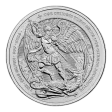
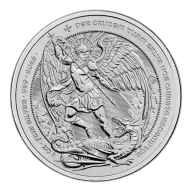
The reverse shows Archangel Michael fighting the dragon within an elaborate Viking knit border, topped by the Isle of Man's triskele coat of arms. The obverse carries a portrait of Queen Elizabeth II; four different royal portraits were used across the Pobjoy years (second portrait in 1984, third 1985-1997, fourth 1998-2014, fifth from 2015). The Angel's orientation also changed over time: left-facing from 1984 to 1993, right-facing from 1994, a more upright right-facing stance from 2008, and a return to the left-facing pose in 2016. The 2009 issue carried three distinct designs not repeated in any other year. These date-and-variant details are the main authentication anchors alongside weight and dimensions.
Tax Treatment of the Silver Angel
The Angel's unusual legal status matters most in the UK. The Isle of Man is a Crown dependency, not part of the United Kingdom, so Angel coins are not UK legal tender.
- United Kingdom: Silver Angels carry 20% VAT on purchase, like all new silver bullion, and because they are not UK legal tender they receive no CGT exemption; gains above the £3,000 annual allowance are taxable. This is the key difference from Royal Mint sterling coins, where silver Britannias share the VAT burden but escape CGT.
- United States: No federal sales tax, and most states exempt bullion. Gains are taxed at the collectibles rate, capped at 28% for long-term holdings.
- Canada: GST/HST exempt as silver of at least 99.9% purity in coin form.
- Australia and New Zealand: GST-free as investment-grade silver at 99.9% purity; years struck at .999 or .9999 qualify.
- EU: Standard VAT rates apply to new silver coins (17-27% by country); margin scheme treatment can reduce the effective rate on second-hand coins in countries such as Germany, which is relevant since all Pobjoy Angels now trade second-hand.
- Singapore and Hong Kong: No applicable purchase tax and no CGT.
From Edward IV's Gold Angel to the Pobjoy Mint
The original English Angel circulated from 1465 through the reign of Charles I, with the last hammered pieces struck in 1642. The coin carried royal mystique: it was used in "touching ceremonies" where the monarch was said to cure scrofula, the "king's evil", through contact with the coin.
The Pobjoy Mint, founded in 1965 by Derek Pobjoy in Surrey, revived the motif in 1984 for the Isle of Man, which as a Crown dependency holds its own coinage rights. The Angel ran continuously under Pobjoy from 1984 to 2016. The mint was a serious innovator beyond the Angel: it struck the Isle of Man's platinum Noble (1983-1989), the world's first investment coin in 0.9995 fine platinum, and produced the world's first titanium coin in 1999. At its peak it struck coins for roughly 20% of the world's governments and central banks, alongside circulating currency for British Overseas Territories. The silver Angel was a companion to the flagship 1 oz gold Angel, issued in years when the mint chose to strike silver rather than on a fixed annual cycle. After Taya Pobjoy announced her retirement in October 2023, the mint closed the following month, fixing the Pobjoy Angel population permanently.
Silver Angel vs Britannia, Maple Leaf, and Generic Silver
Against the major annual silver coins, the Angel trades recognition for character. A Silver Britannia or Canadian Maple Leaf is struck in the millions, carries modern security features (tincture-line micro-engraving on the Britannia, Bullion DNA on the Maple Leaf), and sells instantly to any dealer worldwide. The Pobjoy Angel has none of that technology and a far smaller market, but it offers a Coin of the Year-winning design, an irregular and now permanently closed mintage, and a 550-year-old motif. UK buyers should note the tax asymmetry: both coins carry 20% VAT, but only the Britannia is CGT-exempt, which makes the Angel strictly worse as a pure UK investment vehicle and better understood as a collectible.
Against private-mint silver, the comparison flips. The Angel is genuine legal tender from a sovereign issuer, with documented specifications and a named design lineage, where rounds have no issuing government at all. Rounds win on price; the Angel wins on provenance.
The closest sibling comparison is the gold Angel, which shares the design but qualifies as VAT-free investment gold in the UK and EU, while the silver version is taxed at full VAT rates. A collector wanting the design with the friendlier tax treatment may find the fractional gold Angels the more efficient route.