1 listing Prices & premiums exclude tax to compare across countries
Filters
| Product | /oz | Premium | Price (ex. tax) | |
|---|---|---|---|---|

 Suisse Gold
Out of Stock
Suisse Gold
Out of Stock
|
$74.65 |
+11.91%
+21% inc.VAT
|
$74.62
€70 inc.VAT
|
View Deal |
Prices are fetched automatically and may not reflect current merchant prices. Currency conversions and tax treatment are approximate. Rankings are based solely on price. We are not a dealer and accept no responsibility for transactions with listed merchants. Past performance is not indicative of future results. This site does not provide investment advice. Full disclaimer
About the 1 oz Rand Refinery Krugerrand Silver Coin
The Silver Coin From the Krugerrand Family
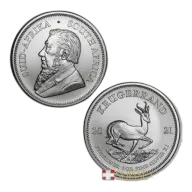
The 1 oz Silver Krugerrand carries the most recognised name in bullion. The gold Krugerrand was the world's first modern bullion coin, introduced in 1967, and the silver version arrived fifty years later in 2017 wearing the same Paul Kruger portrait and springbok reverse. For a stacker, that means buying a sovereign coin whose design dealers everywhere already know on sight, struck to .999 fine silver and matching the American Silver Eagle and Silver Britannia in purity.
The "Rand Refinery" attribution causes regular confusion. Rand Refinery Krugerrands and SA Mint Krugerrands are the same product, not separate series. The Rand Refinery produces the blanks, the South African Mint strikes them, and Rand Refinery handles final packaging and distribution. Some dealers list the bullion coin under Rand Refinery and the proof under SA Mint, but a bullion Silver Krugerrand from either label comes off the same shared production line. Rand Refinery itself, established in 1920, is one of the world's largest gold refineries and has processed roughly 60% of all gold ever mined.
Unlike its gold sibling, the silver coin carries an actual face value of R1, making it legal tender in South Africa in the conventional sense. It is also IRA eligible in the United States, with the 2017 and subsequent editions specifically approved for self-directed IRAs. Buyers wanting the Krugerrand brand at silver prices, or US buyers building an IRA allocation around recognised sovereign coins, are the natural audience.
1 oz Silver Krugerrand Specifications
| Specification | Detail |
|---|---|
| Weight | 31.103 g (1 troy oz) |
| Purity | .999 fine silver |
| Diameter | 38.70 mm (38.725 mm for the 2017 issue) |
| Thickness | 2.84 mm |
| Edge | Reeded |
| Face value | R1 (1 South African Rand) |
| Obverse designer | Otto Schultz |
| Reverse designer | Coert Steynberg |
The silver coin is notably larger than the 32.77 mm gold Krugerrand, in line with other 1 oz silver sovereign coins, which run roughly 38 to 39 mm in diameter. The face value distinguishes it from the gold version, which carries no denomination at all and derives its value purely from metal content.
The coin has no modern embedded security technology such as micro-engraving or holograms. Authentication relies on weight, dimensions, and edge characteristics, so checking the 38.70 mm diameter, 31.103 g weight, and reeded edge against specification is the practical verification route. Proof and bullion strikes can be told apart by the crispness of the design detail.
Silver Krugerrand Tax Treatment by Country
Silver is taxed less favourably than gold in several major markets, and the Silver Krugerrand inherits the standard treatment for .999 fine sovereign silver coins.
- UK: 20% VAT applies on new silver bullion, unlike gold Krugerrands which are VAT-exempt as investment gold. The coin is also not CGT-exempt, because only UK legal tender coins such as the Britannia and Sovereign qualify; the Krugerrand is South African legal tender.
- US: IRA eligible, with the 2017 and 2018-onward silver editions specifically approved. Sales tax depends on the buyer's state; most states exempt bullion, while others tax it or apply thresholds.
- South Africa: the gold Krugerrand's zero-rating under the Value-Added Tax Act covers intact gold coins only. Silver Krugerrands, introduced in 2017, are not covered and attract the full 15% VAT.
- EU: silver coins attract the full local VAT rate, ranging from 17% to 27% depending on the member state. Germany and the Netherlands operate margin schemes on pre-owned silver coins that tax only the dealer's margin.
- Canada: GST/HST exempt, since the federal exemption covers silver refined to 99.9% purity or higher in coin form.
- Australia and New Zealand: GST-free as investment-grade silver, which both countries define at 99.9% purity or above for silver.
- Singapore and Hong Kong: no tax in either jurisdiction; Singapore exempts qualifying Investment Precious Metals from GST and Hong Kong levies no sales tax at all.
Fifty Years From Gold to Silver
The gold Krugerrand was introduced on 3 July 1967 by the South African government to promote South African gold, and by 1980 it accounted for more than 90% of the global gold coin market. The production arrangement behind it dates to 1966, when the South African Reserve Bank authorised a division of labour that still stands: Rand Refinery Ltd. manufactures the blanks and the SA Mint strikes them. The name itself combines Paul Kruger, president of the South African Republic from 1883 to 1900, with the rand, South Africa's currency, which in turn took its name from the Witwatersrand gold reef.
The coin's history has a darker chapter. Western nations imposed import bans during apartheid in the 1970s and 1980s, making Krugerrand ownership illegal in many countries and creating a grey market. Most restrictions were lifted in 1991, and despite that history more than 50 million ounces have been struck since 1967.
The silver version is a recent addition. It was first minted in 2017 to mark the gold coin's 50th anniversary, issued as a Premium Uncirculated coin with a mintage of 1,000,000 and a 50th Anniversary privy mark on the reverse. The design otherwise reproduces the gold original: Otto Schultz's portrait of Paul Kruger on the obverse with "SUID-AFRIKA" and "SOUTH AFRICA" inscriptions, and Coert Steynberg's walking springbok on the reverse, a design based on one originally used on the 5-shilling coin. That design has remained essentially unchanged since 1967, one of the most consistent runs in modern bullion.
Silver Krugerrand vs Eagle, Britannia, and Maple Leaf
At .999 fine, the Silver Krugerrand matches the 1 oz American Silver Eagle and the Silver Britannia in purity, while the Canadian Silver Maple Leaf runs higher at .9999. For a buyer the purity gap is cosmetic; all four are recognised sovereign coins, and the silver content per coin is one troy ounce in each case.
Where the rivals pull ahead is security technology and tax position. The Maple Leaf has carried Bullion DNA micro-engraving since 2015 and the Britannia carries micro-text and tincture-line features, while the Krugerrand has no embedded security technology and relies on weight, dimensions, and its reeded edge for authentication. In the UK, the Silver Britannia is CGT-exempt as UK legal tender; the Krugerrand is not, which matters for British buyers planning to sell at a gain.
What the Krugerrand offers in return is the brand. Its name recognition is historically unmatched, and US buyers get IRA eligibility on the 2017 and later editions. It is also the newest of the four as a silver coin: the Eagle dates from 1986, the Britannia from 1997, the Maple Leaf from 1988, while the Silver Krugerrand only arrived in 2017. Among standard 1 oz sovereign coins, the American Silver Eagle historically commands the highest premiums, driven by US collector demand, while Maple Leafs and Philharmonics sit among the lowest. Buyers choosing the Krugerrand are typically paying for the springbok and the story rather than a tax or premium edge.