1 listing Prices & premiums exclude tax to compare across countries
Filters
| Product | /oz | Premium | Price (ex. tax) | |
|---|---|---|---|---|

 Physical Gold
Out of Stock
Physical Gold
Out of Stock
|
$125.04 |
+86.74%
+124% inc.VAT
|
$124.96
£112 inc.VAT
|
View Deal |
Prices are fetched automatically and may not reflect current merchant prices. Currency conversions and tax treatment are approximate. Rankings are based solely on price. We are not a dealer and accept no responsibility for transactions with listed merchants. Past performance is not indicative of future results. This site does not provide investment advice. Full disclaimer
About the 1 oz Two Dragons Silver Coin
A Limited Royal Mint Release Bridging East and West
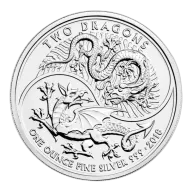
The 1 oz Two Dragons is a one-off silver bullion coin issued by The Royal Mint in 2018, with a worldwide mintage of just 50,000 pieces. It was not the start of an annual series and has never been repeated, making it a genuinely limited release rather than an ongoing programme. The design features two culturally significant dragons arranged in a yin-and-yang composition: the Welsh dragon (Y Ddraig Goch) and the Chinese dragon, symbolising a cultural bridge between the Royal Mint's home in Wales and the Asian bullion markets where it had been expanding its presence.
The coin was issued to mark the 50th anniversary of The Royal Mint's headquarters at Llantrisant in South Wales, where operations relocated in 1968. The designer, Timothy Noad, holds the title of Herald Painter and Scrivener for the College of Arms in London, making him an unusually qualified heraldic artist for a bullion coin. The obverse carries the fifth and final UK coin portrait of Queen Elizabeth II by Jody Clark, surrounded by a textured guilloche background that gives the coin a distinctive ornamental quality not commonly found on bullion issues.
Struck in .999 fine silver (standard for Royal Mint silver bullion) with a £2 face value, the Two Dragons is UK legal tender and therefore exempt from Capital Gains Tax for UK residents. Its 50,000 mintage sits well below the unlimited production runs of the 1 oz Silver Britannia, and secondary market premiums have increased since the original mintage sold out. The gold version (5,000 mintage at .9999 purity, £100 face value) is among the lowest-mintage 1 oz gold bullion coins from any major government mint.
Two Dragons 1 oz Silver Specifications
| Attribute | Value |
|---|---|
| Weight | 1 troy oz (31.21 g) |
| Purity | .999 fine silver |
| Diameter | 38.61 mm |
| Face value | £2 GBP |
| Mintage | 50,000 worldwide |
| Finish | Brilliant Uncirculated |
| Issuing authority | The Royal Mint (UK) |
| Year issued | 2018 |
| Designer | Timothy Noad (reverse) |
The Two Dragons does not incorporate the advanced security features found on the Britannia (surface animation, micro-text, latent image). It relies on standard Royal Mint quality assurance with the UK Government guarantee of weight and purity, supplemented by the guilloche background pattern and detailed heraldic engraving as visual deterrents against counterfeiting. The guilloche pattern on the obverse is particularly distinctive for a bullion coin, giving the surface an ornamental braided-ribbon texture typically associated with banknote design.
The coin was also issued in a 1 oz gold version at .9999 purity, 32.69 mm diameter, with a £100 face value and a worldwide mintage of just 5,000 pieces. Both versions share the same Timothy Noad reverse design and Jody Clark obverse portrait of Queen Elizabeth II with the distinctive guilloche background treatment.
Two Dragons Tax Treatment by Country
As UK legal tender with a £2 face value, the Two Dragons receives the same tax treatment as other Royal Mint silver coins.
United Kingdom
Silver bullion is subject to 20% VAT on purchase in the UK. As the Two Dragons is only available on the secondary market, most dealers sell it under the VAT margin scheme, charging VAT only on their profit margin rather than the full price. This significantly reduces the effective VAT compared to buying new-production silver coins at full VAT.
On disposal, the Two Dragons is CGT-exempt as UK legal tender, the same treatment as the Silver Britannia and Sovereign. Given that secondary market premiums on Two Dragons coins already exceed those of standard bullion coins, the CGT exemption is particularly relevant: any future premium appreciation is entirely tax-free for UK individuals.
United States
The .999 purity meets the minimum fineness threshold for IRA eligibility. State sales tax exemptions vary; approximately 35 states exempt bullion purchases, with some applying transaction thresholds. Capital gains are taxed at the 28% collectibles rate for long-term holdings.
Canada
GST/HST exempt for silver bullion at 99.9% purity or above. Capital gains taxed at a 50% inclusion rate.
Australia
GST-free for investment-grade silver at 99.9% purity. The Two Dragons at .999 meets this threshold. Standard CGT applies with a 50% discount for holdings over 12 months.
Other Jurisdictions
- New Zealand: GST-exempt for silver at 99.9% purity. No capital gains tax.
- Singapore: GST-exempt under the IPM scheme for qualifying silver coins at 99.9% purity. No capital gains tax.
- Hong Kong: No sales tax, no import duty, no capital gains tax.
- South Africa: Silver bullion subject to 15% VAT.
- EU: Silver subject to local VAT rates. Investment gold version (.9999 purity) is VAT-exempt under EU Directive 98/80/EC.
Two Cultures, One Coin
The Two Dragons coin emerged from a specific moment in The Royal Mint's history: the 50th anniversary of its Llantrisant facility in 2018. The Welsh dragon has been a national emblem since at least the early medieval period, appearing on the Welsh flag and deeply embedded in Welsh national identity. The Chinese dragon is one of the most enduring symbols in Chinese mythology, representing power, strength, and good fortune. By placing both dragons in a yin-and-yang arrangement, Timothy Noad created a composition that deliberately mirrors the balance symbol, reflecting cultural exchange between East and West.
The connection between Wales and Asia was not arbitrary. The Royal Mint had been actively expanding into Asian bullion markets during this period, and the dragon provided a natural cultural bridge. Both traditions revere the dragon, though the symbolism differs: the Welsh dragon is a fierce, combative creature associated with national defence, while the Chinese dragon is a benevolent figure associated with prosperity and imperial authority. Noad's design places the Chinese dragon in the upper half of the composition, moving left to right and looking back, while the Welsh dragon occupies the lower half in mirror opposition.
The coin stands apart from other Royal Mint dragon issues. The Queen's Beasts series included a "Dragon of Wales" coin in 2017, but that featured a single heraldic Welsh dragon in a completely different artistic style. The Two Dragons is distinct in its dual-culture concept and yin-yang compositional framework. It was Timothy Noad's appointment at the College of Arms that made him particularly suited to this commission; heraldic design requires balancing formal tradition with visual storytelling, and the Two Dragons demanded both.
The decision not to continue the series after 2018 makes it unusual among Royal Mint releases. Most successful designs are repeated annually or expanded into multi-year programmes. The Two Dragons remained a single issue, which has contributed to its growing collector appeal on the secondary market.
Two Dragons vs Britannia, Queen's Beasts, and Perth Mint Dragon Coins
The 1 oz Silver Britannia is The Royal Mint's primary silver bullion coin and the natural benchmark. The Britannia offers unlimited mintage, advanced security features (surface animation, micro-text, latent image since 2021), lower premiums, and identical CGT exemption as UK legal tender. For straightforward silver accumulation, the Britannia is more practical. The Two Dragons trades a higher premium and limited secondary-market availability for its unique design and 50,000-coin scarcity.
The Queen's Beasts Dragon of Wales (2017) shares The Royal Mint as its origin and a dragon motif, but the similarity ends there. The Queen's Beasts series ran across 10 heraldic designs in 2 oz silver, with each featuring a single beast from the Royal Heraldic tradition. The Two Dragons' yin-yang concept and dual-culture symbolism are compositionally and thematically distinct.
The Perth Mint has issued various dragon-themed coins, including the Dragon and Dragon Bar series. These serve the Asian collector market with different artistic styles and production standards (.9999 purity at Perth versus .999 for the Two Dragons). The Perth Mint coins are typically produced in larger mintages with annual design changes, making them more accessible but less scarce than the Two Dragons' one-off format.
For UK buyers specifically, the Two Dragons' combination of CGT exemption, limited mintage, and cultural significance creates a proposition that no competing dragon-themed coin matches. For non-UK buyers without the CGT benefit, the premium over standard bullion coins needs to be justified by design appeal and collector interest alone.
1 oz Two Dragons Silver Coin: frequently asked questions
-
The Two Dragons is a 1oz .999 fine silver bullion coin issued by The Royal Mint in 2018, designed by heraldic artist Timothy Noad of the College of Arms. The reverse depicts two dragons arranged in a yin-yang composition: the Welsh dragon (Y Ddraig Goch) and the Chinese dragon, symbolising the cultural connections between Wales and Asia.
-
The Two Dragons coin was issued in 2018 as a one-off release, not the start of an annual series. The Royal Mint produced it to mark the 50th anniversary of its headquarters at Llantrisant, South Wales, where it relocated in 1968. No subsequent editions have been produced, making it a single-year issue.