1 product · 21 deals
Filters
| Product | /oz | Premium | Price | |
|---|---|---|---|---|

21 deals
|
$81.86 | +22.80% |
$78.96
£59
|
Compare |
Prices are fetched automatically and may not reflect current merchant prices. Currency conversions and tax treatment are approximate. Rankings are based solely on price. We are not a dealer and accept no responsibility for transactions with listed merchants. Past performance is not indicative of future results. This site does not provide investment advice. Full disclaimer
About 30g Silver Coins
30 Gram Silver Coins
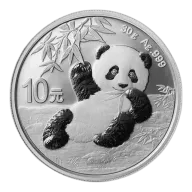
The 30 gram weight class in silver coins exists almost entirely because of the Chinese Silver Panda. In 2016, the People's Bank of China converted the entire Panda series from troy ounces to metric grams, replacing the standard 1 oz denomination (31.103 g) with 30 grams. The conversion aligned the series with China's domestic metric system, where precious metals are quoted in grams rather than troy ounces. The result is a coin containing approximately 3.6% less silver than a full troy ounce.
The 30g Chinese Silver Panda dominates this weight class with 25 active dealers, making it one of the most widely available silver coins in the market. The Panda's annually changing reverse design (a different panda scene each year, with only one exception in the series' history) creates a numismatic following that pushes demand beyond pure bullion buyers. This dual appeal supports healthy liquidity despite the non-standard weight.
Beyond the Panda, the 30g weight has limited representation. A few other Chinese-issued coins use the metric weight (the China Gold Coin Corporation produces additional 30g silver pieces), and the Republic of Chad has issued at least one 30g silver coin, but none approach the Panda's market presence. Buyers at this weight are effectively choosing the Panda ecosystem or nothing.
For buyers comparing the 30g Panda against standard 1 oz silver coins, the key tradeoff is between the Panda's collector appeal and design variety versus the slightly higher silver content and broader liquidity of traditional troy-ounce coins. The 1.1 gram difference (31.103g vs 30g) is modest in absolute terms but matters for buyers who track cost per gram of silver precisely.
30g Silver Coin Premium Considerations
The premium structure for 30g silver coins is shaped by the Chinese Panda's position as both a bullion product and a collector favourite. The annually changing design creates year-specific demand that can push premiums well above generic bullion levels for scarce vintages, while current-year issues trade closer to standard sovereign coin premiums.
Current-year 30g Silver Pandas typically carry premiums comparable to other sovereign-mint silver coins: competitive with the 1 oz Silver Maple Leaf or 1 oz Silver Britannia on a per-gram basis. The slightly lower silver content (30g vs 31.1g) means the effective premium per gram of actual silver is marginally higher than a direct comparison of coin prices would suggest.
Low-mintage years and early metric-era coins (2016-2017, the first years of the 30g format) carry collector premiums above standard bullion pricing. The pre-2016 Pandas at the old 1 oz weight are a separate market with their own numismatic pricing that reflects both the additional silver content and the historical significance of the old format.
Buyback spreads at major dealers are generally competitive because the Panda is one of the "Big Five" precious metal coin series globally (alongside Eagle, Maple, Krugerrand, and Philharmonic). Some dealers quote Panda buyback prices at a slight discount to true 1 oz coins due to the lower metal content, but the difference is small for a well-recognised product. The market understands the 30g Panda as the replacement for the 1 oz denomination, and prices it accordingly.
Major 30g Silver Coins
The 30g weight class is overwhelmingly dominated by the Chinese Silver Panda programme, with a small number of additional products from Chinese mints.
Chinese Silver Panda (30g)
Issued by the People's Bank of China, the Silver Panda has been produced annually since 1989 (switching from 1 oz to 30g in 2016). The obverse depicts the Hall of Prayer for Abundant Harvests (part of the Temple of Heaven complex in Beijing), unchanged since inception. The reverse features a new panda design each year, making it one of only a handful of bullion programmes with genuinely annual artwork changes. Purity is .999 fine silver. The coin is struck by various Chinese mints under the People's Bank of China's authority.
Key considerations: counterfeit risk is higher for Chinese Pandas than for some Western mint products, making authentication and buying from reputable dealers particularly important. PCGS and NGC grading services offer authenticated and graded Pandas for buyers who want certainty, though this adds cost.
Other 30g Silver Issues
The China Gold Coin Corporation produces additional 30g silver pieces, and Central Mint of China issues have appeared at this weight. These are less widely recognised than the Panda but share the metric weight standard adopted by the Chinese precious metals industry. The Republic of Chad has also issued a 30g silver coin, representing rare non-Chinese use of this denomination.
For buyers seeking maximum variety at the 30g weight, options are limited to the Chinese ecosystem. Those who want design variety, competitive premiums, and mainstream bullion weights are better served by the 1 oz silver coin category, where dozens of annual-design series compete from mints worldwide.
30g Silver Coin Liquidity and Storage
Resale liquidity for 30g silver coins is strong within the Panda ecosystem. The Chinese Silver Panda is one of the world's most widely traded bullion coins, with active buy and sell markets at major dealers in the US, Europe, and Asia. The annually changing design means dealers and collectors are always seeking specific years, which supports demand across the full vintage range.
The primary liquidity consideration is geographic. In the United States and Europe, the Panda trades actively through all major online dealers and local coin shops. In Asian markets (China, Singapore, Hong Kong, Japan), the coin is a mainstream bullion product with deep liquidity. In Australia, New Zealand, and South Africa, availability is thinner and spreads may be wider.
The non-standard weight (30g vs 31.1g for a troy ounce) does not significantly impede resale because the market has fully absorbed the 2016 metric conversion. Dealers worldwide understand that the 30g Panda is the current-format Chinese silver bullion coin. Any perceived discount relative to true 1 oz coins reflects the 3.6% lower silver content, not a recognition or liquidity penalty.
Storage follows standard coin conventions. Individual Pandas ship in plastic capsules from the mint, with year-specific collecting creating demand for organised storage in albums or boxes arranged by vintage. The physical dimensions are similar to a standard 1 oz coin, so generic coin storage solutions accommodate them without difficulty. Tubes and monster box packaging are available for current-year bulk purchases.
Authentication is more important for Pandas than for many Western mint products. The coin's popularity and high premiums on older vintages have attracted counterfeiters. Buying from established dealers, seeking NGC or PCGS-graded examples for older years, and checking weight and dimensions against known specifications are standard precautions.