1 listing
Filters
| Product | /oz | Premium | Price | |
|---|---|---|---|---|

 Golden Eagle Coins
|
$75.72 | +11.97% | $378.60 | View Deal |
Prices are fetched automatically and may not reflect current merchant prices. Currency conversions and tax treatment are approximate. Rankings are based solely on price. We are not a dealer and accept no responsibility for transactions with listed merchants. Past performance is not indicative of future results. This site does not provide investment advice. Full disclaimer
About the 5 oz Somalia Elephant Silver Coin
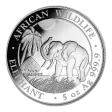
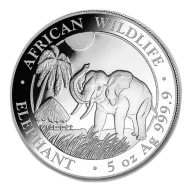
The 5 oz Somalia Elephant Silver Coin
The 5 oz Somalia Elephant is the mid-weight format of the annual-design bullion coin series produced by the Bayerisches Hauptmunzamt (Bavarian State Mint) in Munich. At 155.5 grams of .999 fine silver, nominally denominated in Somali Shillings, this coin represents one of the longest-running African wildlife coin programmes. The Bavarian State Mint has been in continuous operation since 1158, making it one of the oldest mints in the world.
Each year features a completely new elephant design on the reverse, making the 5 oz format particularly appealing as a collector-bullion crossover piece. The larger 65mm canvas showcases the annual elephant artwork in greater detail than the standard 1 oz Somalia Elephant, and earlier years with lower mintages can command significant secondary market premiums over melt value.
The series history is unusual. It originally issued coins for Zambia (1999 to 2003) before transitioning to the Republic of Somalia in 2004. This transition is controversial: Somalia's central bank has reportedly never formally acknowledged these coins as its own legal tender issues. Despite the contested sovereignty, the coins are universally accepted by major bullion dealers worldwide and trade freely on the secondary market.
For buyers, the Somalia Elephant occupies a distinct niche. The annual design changes provide variety and potential numismatic upside that static-design bullion coins cannot offer. The trade-off is higher premiums per ounce compared to pure-bullion alternatives like the 5 oz Noah's Ark, which costs less but looks identical every year.
5 oz Somalia Elephant Technical Details
| Attribute | Value |
|---|---|
| Weight | 155.5 g (5 troy oz) |
| Purity | .999 fine silver |
| Face value | Somali Shillings (varies) |
| Manufacturer | Bavarian State Mint (Munich, Germany) |
| Issuer | Republic of Somalia (nominal) |
| Design | Annual change (new elephant scene each year) |
| Obverse | Somali Republic coat of arms (static) |
| Edge | Reeded |
| Series start | 1999 (Zambia), 2004 (Somalia) |
Series Denomination Range (Silver)
| Size | Introduced |
|---|---|
| 1/10 oz | 2017 |
| 1/4 oz | 2017 |
| 1/2 oz | 2017 |
| 1 oz | 2004 (Somalia era) |
| 2 oz | Various years |
| 5 oz | Various years |
| 10 oz | Various years |
| 1 kg | Various years |
The obverse carries the Somali Republic coat of arms: a shield with a central star, supported by two leopards standing on crossed spears with palm fronds. The reverse elephant scene changes completely each year, showing elephants in different poses and habitats. Pre-2006 coins carried 1,000 Shillings face value for 1 oz; this was reduced to 100 Shillings from 2006 onward.
The Bavarian State Mint also produces a companion Somalia Leopard series using the same format and obverse design.
Somalia Elephant Tax and Legal Status
The Somalia Elephant's contested legal tender status creates some ambiguity in tax classification, though in practice most jurisdictions treat it as a recognised bullion coin.
- United States: Not IRA-eligible. The IRS does not permit Somalia Elephant coins in precious metals IRAs. Despite meeting the .999 purity standard, the coins are classified as collectibles due to their high premiums and collector appeal. State sales tax varies. Capital gains taxed at the 28% collectibles rate.
- United Kingdom: Gold versions are VAT-exempt (listed on the EU/UK investment gold coin list under certain Somali Shilling denominations: 20, 50, 100, 200, 500, 1,500 Shillings). Silver versions carry 20% VAT. Not CGT-exempt (not UK legal tender). Pre-owned silver coins may be available under the margin scheme.
- Germany: The primary European market for this series. Gold versions are VAT-exempt under the EU investment gold directive. Silver subject to 19% Mehrwertsteuer; margin scheme (Differenzbesteuerung) widely used for secondary market coins. The Bavarian State Mint's domestic presence means strong dealer network support.
- EU (general): Gold VAT-exempt on the EU annual investment gold coin list. Silver subject to local VAT rates with margin scheme available in many countries.
- Canada: GST/HST exempt for silver at 99.9% or higher purity. The .999 purity qualifies.
- Australia: GST-free for investment-grade silver at 99.9% purity from a recognised issuing authority. The contested sovereignty may affect classification in edge cases.
- Hong Kong: No sales tax, no import duty, no capital gains tax.
The IRA ineligibility is a meaningful drawback for US buyers who might otherwise use the coin in tax-advantaged retirement accounts. The IRS classification as a collectible reflects the coin's high premiums and annual design changes, which position it closer to numismatic territory than pure bullion.
From Zambia to Somalia: An Unusual Bullion Coin Story
The Somalia Elephant series has one of the more unusual histories in modern bullion. The Bavarian State Mint began producing elephant-themed coins for Zambia in 1999, with initial production of approximately 5,000 coins annually. In 2004, the series transitioned to the Republic of Somalia without public explanation of why the issuing country changed or whether formal authorisation was obtained from either government.
Somalia's central bank has reportedly never accepted these coins as its own legal tender issues. The Somali Shilling itself has been largely worthless in practice since the 1991 civil war; the face values on these coins have no practical spending power. Yet the bullion market has collectively decided to treat them as legitimate sovereign issues, and every major dealer worldwide buys and sells them without question.
Production grew from around 5,000 coins annually in the early years to over 130,000 per year as the series established itself. The Bavarian State Mint, which also produces regular Eurozone coins for Germany, brings sovereign mint credibility to the programme despite the ambiguous Somali endorsement. German distribution is handled through Emporium Hamburg.
Early Zambian-era coins (1999 to 2003) now command substantial premiums due to their low mintages. The face value change from 1,000 Shillings to 100 Shillings in 2006 was likely a practical adjustment to avoid inflation of face values as more denominations were added. Special editions including privy-mark versions, gilded coins, and antiqued-finish variants have been produced in various years, further enriching the collector market.
The annual design change is the series' greatest asset and its primary collector draw. Each year depicts African elephants in a different natural scene, and the 5 oz format shows these designs at their most detailed. Older vintages with desirable designs or low mintages trade at premiums that have nothing to do with silver content, making the series as much a collector programme as a bullion product.
5 oz Somalia Elephant vs Other Annual-Design 5 oz Coins
The Somalia Elephant's primary appeal is the annual design change, which positions it against other 5 oz coins that offer year-over-year variety rather than static repetition.
| Feature | Somalia Elephant | Noah's Ark | RAM Lunar |
|---|---|---|---|
| Design | Annual change | Static | Annual (zodiac cycle) |
| Purity | .999 | .999 | .9999 |
| Legal tender | Contested (Somalia) | Yes (Armenia) | Yes (Australia) |
| Manufacturer | Bavarian State Mint | Geiger/LEV | Royal Australian Mint |
| IRA eligible (US) | No | Unclear | Likely yes |
| Collector premium | High (older years) | Low | Moderate |
| Availability | Wide (global dealers) | Wide | Limited |
Against the 5 oz Noah's Ark, the Somalia Elephant offers annual design variety and potential collector appreciation for older vintages. The Noah's Ark counters with lower premiums, clearer legal tender status, and the simplicity of a consistent appearance year after year. Buyers motivated purely by silver content per pound spent should prefer the Noah's Ark. Those who value variety and potential numismatic upside will favour the Elephant.
Against the 5 oz RAM Lunar, the Somalia Elephant has longer market history and wider global dealer availability. The RAM Lunar offers higher purity (.9999 vs .999), uncontested Australian legal tender status, and clearer IRA eligibility. The RAM Lunar's 12-year zodiac cycle also means designs recur on a predictable schedule, while the Elephant creates a genuinely unique scene each year with no repetition.
The Somalia Elephant is the choice for buyers who see their bullion as part collection, part investment. The annual design changes mean no two years look alike, older coins can appreciate well beyond melt, and the large 5 oz format displays the artwork at its best. The trade-off is paying more per ounce than pure-bullion alternatives and accepting a coin whose legal tender status exists in a grey area.
5 oz Somalia Elephant Silver Coin: frequently asked questions
-
The cheapest 5oz Somalia Elephant silver coin tracked here is $378.60, at around 12.0% over the $67.63 silver spot price. The coin contains 5 oz of silver, so its base metal value moves directly with spot. The current lowest-price dealer is Golden Eagle Coins.
-
The Somalia Elephant is an annual-design bullion coin series struck by Bavarian State Mint in Munich, Germany. Each year's reverse depicts African elephants in a new scene, while the obverse carries the Somali Republic coat of arms. The series began under Zambia in 1999 before transitioning to the Somali Republic from 2004 onward. Coins are 999 fine silver and sold individually or in tubes of 20.
-
Annual mintages have grown considerably since the series began. Early Zambian issues from 1999 to 2003 were produced in runs of around 5,000 coins per year. Production has since expanded to more than 130,000 coins per year across all sizes. The annual design change means each year's coin has a fixed mintage once production closes, which supports secondary-market premiums on older vintages.