0 products · 0 deals
Filters
No products match your filters.
Prices are fetched automatically and may not reflect current merchant prices. Currency conversions and tax treatment are approximate. Rankings are based solely on price. We are not a dealer and accept no responsibility for transactions with listed merchants. Past performance is not indicative of future results. This site does not provide investment advice. Full disclaimer
About the Degussa Goldbars Silver
Degussa Silver Bars
The Degussa name carries a weight in precious metals that few other brands can match. The original Deutsche Gold- und Silber-Scheideanstalt (German Gold and Silver Refinery) traces its origins to 1843, when Friedrich Ernst Roessler, Keeper of the Frankfurt Mint, was authorised to operate the Mint's refinery as a private enterprise. Degussa became LBMA Good Delivery accredited in 1930, and for over 160 years its sun-moon-diamond logo was one of the most recognised marks in the bullion trade.
There are effectively two "Degussas" in the bullion market today. The original refinery's precious metals operations were sold to OM Group in 2001 and then acquired by Umicore in 2003. Umicore continued issuing Degussa-branded bars until the end of 2005 before switching to its own stamp. Separately, the Degussa brand was revived in 2010 by the von Finck family, with retail operations launching in November 2011. By 2016, the revived Degussa had become Europe's largest gold retailer and one of the world's top five, selling 42.5 tonnes of physical gold that year alone.
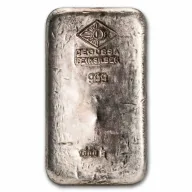
The modern Degussa is a retailer, not a refiner. Silver bars sold under the Degussa name today are manufactured by LBMA-accredited partner refineries and carry the distinctive sun-moon-diamond logo alongside the partner's hallmarks. The silver range includes bars at .999 purity, consistent with the LBMA Good Delivery minimum for silver. Degussa operates from 12 retail stores across Germany plus locations in Geneva, Zurich, Madrid, and London, giving it a physical retail footprint larger than most bullion dealers.
For buyers, the Degussa name provides brand recognition that is particularly strong in the German market, where the company's 180-year heritage gives it a level of consumer trust that newer brands cannot replicate. The practical implication is that Degussa bars tend to have reliable secondary-market demand, especially in Continental Europe, even though the modern bars are not manufactured in-house.
Degussa Silver Bar Specifications
The modern Degussa silver bar range is produced by LBMA-accredited partner refineries under the Degussa brand. All bars carry the sun-moon-diamond logo and are struck at .999 fine silver purity.
| Attribute | Value |
|---|---|
| Purity | .999 fine silver |
| Manufacturer | LBMA-accredited partner refineries (branded Degussa) |
| Logo | Sun-moon-diamond (historic Degussa trademark) |
| Legal Tender | No (bars, not coins) |
| Packaging | Sealed tamper-evident packaging with serial number |
Historic Degussa AG bars (produced before 2006) used different production methods across the Frankfurt, Hanau, and Pforzheim facilities. Silver bars from this era are identifiable by specific die markings that varied by production period and location. These vintage bars carry collector premiums on the secondary market beyond their silver content value.
The original Degussa refinery operated from 1843 to 1975 in Frankfurt, after which production moved to Hanau and Pforzheim. Degussa AG also held LBMA-accredited subsidiaries across multiple countries: Schone Edelmetaal in the Netherlands, Degussa SA in Brazil, Degussa Private Limited in Singapore, and Degussa Canada Ltd.
Degussa Silver Bar Tax Treatment
Degussa silver bars are private-manufacture products with no legal tender status. Tax treatment follows the standard rules for investment-grade silver bars in each jurisdiction.
- Germany (home market): Silver bars are subject to 19% VAT (Mehrwertsteuer). Pre-owned silver bars can be sold under the German margin scheme (Differenzbesteuerung gem. §25a UStG), where VAT is charged only on the dealer's margin. Gains on silver bullion held for more than one year are tax-free under German tax law, a significant advantage that does not exist in most other countries.
- United Kingdom: Silver bars are subject to 20% VAT on purchase. Pre-owned bars may qualify for the margin scheme. Not CGT-exempt (CGT exemption applies only to UK legal tender coins). Degussa operates a London retail location.
- European Union: Silver bars are subject to full local VAT rates, ranging from 17% (Luxembourg) to 27% (Hungary). The EU Investment Gold Directive exempts gold bars at .995+ fineness but provides no equivalent exemption for silver. Germany's one-year holding period CGT exemption is a national rule, not an EU-wide provision.
- United States: State sales tax rules apply, with approximately 35 states exempting investment-grade silver. Federal capital gains taxed at the collectibles rate of up to 28%. Degussa bars are less common in the US market than Swiss or American brands.
- Switzerland: Silver bars are subject to 8.1% VAT (the lowest in Europe). Degussa operates retail stores in Geneva and Zurich.
- Hong Kong: No sales tax, no import duty, no capital gains tax.
- Singapore: Silver bars at .999 purity weighing at least 0.5 troy oz qualify as Investment Precious Metals, exempt from 9% GST.
180 Years of the Degussa Name in Precious Metals
The Degussa story begins in 1843 Frankfurt, when Friedrich Ernst Roessler was granted permission to operate the Frankfurt Mint's refinery as a private business. The context was specific: following the Franco-Prussian War of 1871, the newly unified German Empire needed refining capacity to convert from a silver-backed to a gold-backed currency system, and the old Frankfurt Mint was selected for this foundational role. The company was incorporated as a joint-stock company in 1873 under the full name "Deutsche Gold- und Silber-Scheideanstalt vormals Roessler" (German Gold and Silver Refinery, formerly Roessler). The name perfectly described what the company did: separating and refining gold and silver.
The name was shortened to "Degussa" in the 1920s, and the sun-moon-diamond logo became a trademark recognised throughout the precious metals industry. LBMA Good Delivery accreditation followed in 1930, establishing Degussa as a refiner whose bars were accepted in the London bullion market. The Frankfurt refinery operated until 1975, when production moved to facilities in Hanau and Pforzheim.
The company's precious metals division was sold to OM Group in 2001, and subsequently acquired by Belgian refiner Umicore Group in 2003. Umicore continued to stamp bars with the Degussa name and logo through the end of 2005, then transitioned to its own branding. The parent company, meanwhile, was renamed Evonik in 2005, severing the last corporate link to the Degussa name.
The brand was given a second life in 2010 when the von Finck family acquired the Degussa trademark and launched a precious metals retail business. The first store opened in November 2011. The revived Degussa rapidly expanded: by 2016 it operated 12 stores across Germany with additional locations in Geneva, Zurich, Madrid, and London, and had become Europe's largest gold retailer with 42.5 tonnes sold that year (approximately 25% through online channels). The modern Degussa sells over 1,500 products including bars, coins, jewellery, and watches, but its core business remains physical precious metals.
The distinction between old and new matters to collectors. Historic Degussa AG bars (produced before 2006) are genuine vintage refinery products and command collector premiums, particularly the cast bars. Modern Degussa-branded bars are manufactured by partner refineries under the Degussa name. Both carry the same sun-moon-diamond logo, but the provenance is different. The 162-year production span of the original Degussa operation (1843-2005) makes it one of the longest-running gold bar producers in recorded history.
Degussa vs Heraeus, Umicore, and Other European Silver
In the German market, the primary competitors are Heraeus and Umicore, both LBMA-accredited refiners that manufacture their own bars. Heraeus, founded in Hanau in 1851, produces a full range of silver bars and operates a major refinery. Umicore, headquartered in Brussels, is the actual successor to old Degussa's refining operations (having acquired the refinery via OM Group in 2003). There is an irony in this competitive relationship: when you buy a modern Degussa-branded bar, it is manufactured by a partner refinery, while Umicore bars come from the very facilities that once operated under the Degussa name.
Against C.Hafner, another German refiner with LBMA accreditation, Degussa competes on brand recognition and retail distribution rather than on manufacturing heritage. C.Hafner bars are well-regarded but lack the consumer brand awareness that Degussa's 12-store retail network and 180-year name provide.
Compared to Swiss refiners like PAMP Suisse and Valcambi, Degussa silver bars are less widely distributed internationally. PAMP bars benefit from the CertiPAMP assay card and Veriscan authentication technology, giving them a measurable advantage in markets outside Europe. Valcambi bars, produced at one of the world's largest precious metals refineries, are among the most competitively priced LBMA-accredited silver bars globally. Degussa's strength is concentrated in the German-speaking market, where the brand carries a loyalty that Swiss refiners cannot match despite their broader international reach.
For buyers outside Germany, the choice between Degussa and other established brands typically comes down to availability and premium. Degussa silver bars may carry a slight premium above Valcambi or Heraeus equivalents due to the brand recognition factor, but the difference is modest. Buyers in Germany benefit from the physical retail network and the strong secondary-market demand for Degussa-branded products. International buyers may find Swiss or other European brands more readily available through their local dealers.