6 products · 11 deals Prices & premiums exclude tax to compare across countries
Filters






Prices are fetched automatically and may not reflect current merchant prices. Currency conversions and tax treatment are approximate. Rankings are based solely on price. We are not a dealer and accept no responsibility for transactions with listed merchants. Past performance is not indicative of future results. This site does not provide investment advice. Full disclaimer
About the PAMP Lunar Silver
PAMP Suisse Lunar Silver Bars
The PAMP Lunar series pairs Swiss refinery craftsmanship with the Chinese zodiac cycle, producing minted silver bars that sit between pure investment bullion and collectible themed product. Each year's release features a different zodiac animal, and the bars are struck by PAMP Suisse, one of the most recognised LBMA-accredited refineries in the world. For silver buyers who want something more distinctive than a plain bar without paying coin-level premiums, the Lunar range fills that gap.
PAMP produced the original Lunar Calendar Series from 2012 to 2023, covering all twelve zodiac animals from Dragon through Rabbit. In 2024, they launched the Lunar Legend Series, a creative reboot expected to run through 2035. The Legend series shifts from straightforward animal depictions to the mythological stories behind each zodiac creature. The 2024 Azure Dragon, for instance, draws from the guardian spirit of the east in Chinese mythology, and the 2025 White Snake illustrates the tale of Bai Suzhen.
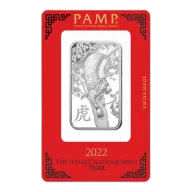
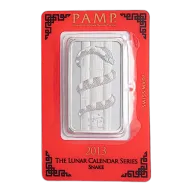
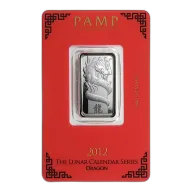
Silver Lunar bars are available in a wide range of sizes, from 10g through to 10 oz, with the 1 oz silver Lunar bar and 10g silver Lunar bar being the most widely traded. Every bar comes sealed in PAMP's distinctive red CertiPAMP tamper-evident assay card, displaying weight, purity, serial number, and an assayer's certification. Bars produced from 2017 onwards include Veriscan anti-counterfeiting technology, which maps the microscopic surface topography of each bar and stores it in a database for verification through an iPhone app or dedicated scanner. Veriscan received LBMA accreditation, the highest industry standard for bullion authentication.
The combination of annual collectibility, LBMA-grade authentication, and a size range that runs from affordable gift pieces up to serious investment weights makes the Lunar series one of PAMP's strongest product lines in silver. Buyers should be aware that the collectible premium above generic silver bars is the trade-off for the themed design and brand recognition.
Silver Lunar Bar Specifications
| Weight | Purity | Notes |
|---|---|---|
| 10g | .999 silver | Smallest silver size |
| 1 oz (31.1g) | .999 silver | Most widely traded |
| 50g | .999 silver | Mid-range metric weight |
| 100g | .999 silver | Popular investment size |
| 5 oz | .999 silver | Imperial mid-range |
| 10 oz | .999 silver | Larger investment format |
All silver Lunar bars are minted (stamped), not cast, which produces the sharp, detailed designs and mirror-like finish that distinguish PAMP products. Each bar carries a unique serial number printed on both the bar reverse and the CertiPAMP assay card.
Security and Authentication
The CertiPAMP assay card is tamper-evident and includes the official assayer's mark. Bars from 2017 onwards include Veriscan technology, which can verify the bar through its sealed packaging using either a Canon CanoScan 9000F Mark II with PAMP's positioning frame, or the Veriscan iPhone app. Pre-2017 bars lack Veriscan but retain serial number verification and CertiPAMP packaging. Counterfeiting of PAMP bars has been documented in the secondary market, making Veriscan verification particularly valuable for bars purchased from non-authorised sources.
Zodiac Cycle Reference
| Year | Animal | Series |
|---|---|---|
| 2012 | Dragon | Calendar |
| 2013 | Snake | Calendar |
| 2014 | Horse | Calendar |
| 2015 | Goat | Calendar |
| 2016 | Monkey | Calendar |
| 2017 | Rooster | Calendar |
| 2018 | Dog | Calendar |
| 2019 | Pig | Calendar |
| 2020 | Rat | Calendar |
| 2021 | Ox | Calendar |
| 2022 | Tiger | Calendar |
| 2023 | Rabbit | Calendar |
| 2024 | Azure Dragon | Legend |
| 2025 | White Snake | Legend |
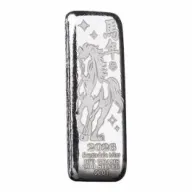
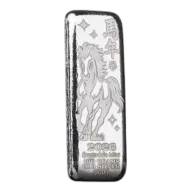
| 2026 | Horse | Legend |
Silver PAMP Lunar Tax Treatment by Country
As private refinery bars rather than legal tender coins, PAMP Lunar silver bars have a straightforward but jurisdiction-dependent tax profile. The bars carry no face value and no government backing, which affects both purchase tax and capital gains treatment in several key markets.
United Kingdom
Silver PAMP Lunar bars are subject to 20% VAT on purchase. Gold bars from PAMP qualify for the investment gold VAT exemption, but this does not extend to silver in any form. All PAMP bars are liable for Capital Gains Tax on disposal, with no CGT exemption available since the bars are not UK legal tender. The annual CGT allowance (currently £3,000) applies. UK buyers seeking tax-efficient silver may prefer silver Britannias, which are CGT-exempt as legal tender.
United States
No federal sales tax applies. State sales tax varies, with roughly 35 states exempting investment bullion entirely. PAMP silver bars meeting .999 fineness from an accredited refinery are IRA-eligible, and PAMP's LBMA accreditation satisfies custodian requirements. Long-term capital gains on silver are taxed at the collectibles rate of up to 28%, higher than the standard 15-20% rate for equities.
Canada
Silver bars refined to 99.9% purity or higher are GST/HST-exempt. PAMP Lunar bars at .999 fineness qualify. Capital gains are subject to a 50% inclusion rate.
Australia
Investment-grade silver at 99.9% purity or higher is GST-free. PAMP Lunar bars at .999 fineness meet this threshold. Capital gains tax applies, with a 50% discount for holdings over 12 months.
Singapore
Silver bars meeting 99.9% purity qualify as Investment Precious Metals (IPM) and are exempt from the 9% GST. No capital gains tax applies in Singapore.
Hong Kong
No sales tax, import duty, or capital gains tax on silver bullion. One of the most favourable jurisdictions for silver purchases.
European Union
Silver bars are subject to the standard VAT rate of the member state (17-27% depending on the country). The EU investment gold exemption does not extend to silver. Some countries, notably Germany and the Netherlands, offer a margin scheme on pre-owned silver, which can reduce the effective tax. Switzerland, PAMP's home market, charges a reduced 8.1% VAT on silver.
South Africa
Silver bullion is subject to 15% VAT. The gold Krugerrand zero-rating does not extend to silver products.
From Zodiac Portraits to Mythological Narratives
PAMP Suisse was founded in 1977 in Castel San Pietro, Ticino, Switzerland, and became part of the MKS Group in 1981. The refinery pioneered the concept of artistic minted bars, starting with the iconic Lady Fortuna design in 1979. Before PAMP, bullion bars were purely functional objects. PAMP treated them as a canvas for artwork, a philosophy that continues through the Lunar series.
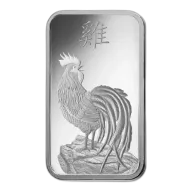
The Lunar Calendar Series launched in 2012 with the Year of the Dragon and ran through 2023, completing a full twelve-year Chinese zodiac cycle with the Year of the Rabbit. The design approach evolved across the cycle. Early releases (2012-2014, 2016) featured single animals depicted from front and back views. From 2015, the designs introduced adult-and-young animal pairings for the Goat, Dog, and Pig years. The 2017 Rooster introduced a distinctive cliff-edge perspective that broke from the earlier style. Each bar's obverse carries the zodiac animal with the corresponding Chinese character, and the reverse shows PAMP's standard elements: logo, weight, purity, serial number, and assayer's mark.
The Lunar Legend Series, beginning in 2024, represents a deliberate creative shift. Rather than simply depicting the zodiac animal, each release tells the mythological story behind the creature. The 2024 Azure Dragon draws from the guardian spirit of the east, associated with spring and rain in Chinese cosmology. The 2025 White Snake illustrates the tale of Bai Suzhen, a story of wisdom, transformation, and prosperity. This narrative-driven approach gives each release cultural depth beyond the zodiac symbol itself, and it distinguishes the second cycle from the first for collectors who completed the original twelve-bar set.
The complete Calendar Series set (all twelve animals in 5g gold) is sold as a single collector item and commands a substantial premium above the sum of individual bars. In silver, individual year bars are widely available from bullion dealers, and the annual cycle drives a natural collecting momentum tied to Chinese New Year.
PAMP Lunar vs Perth Mint, Royal Mint, and Argor-Heraeus
The silver lunar-themed bullion market has several established players, and PAMP's position within it is distinct. The closest competitors are the Perth Mint Lunar Series, the Royal Mint Lunar coins, and Argor-Heraeus's own Swiss lunar bars.
The Perth Mint's Lunar series is the longest-running zodiac bullion programme, with Series I starting in 1996. Perth produces legal tender coins (Australian dollars) rather than bars, which gives them CGT exemption in certain jurisdictions. Perth is currently on Series III (2020-2031), and their coins are struck in .9999 silver, the same purity as PAMP's gold Lunar bars. For silver, PAMP's .999 fineness is fractionally lower than Perth's .9999. Perth's wider weight range and three decades of track record give them deeper secondary market liquidity, particularly for completed sets from earlier series.
The Royal Mint's Shengxiao Collection, launched in 2014, offers UK legal tender status that PAMP bars cannot match. For UK buyers, this means Royal Mint Lunar coins are CGT-exempt on disposal. The Royal Mint discontinued bullion-grade silver Lunar coins after 2020, shifting to proof and brilliant uncirculated finishes at higher premiums. Pre-2021 bullion versions trade on the secondary market at rising premiums.
Argor-Heraeus, also Swiss and LBMA-accredited, produces its own lunar-themed bars. Both refineries share comparable purity and assay card quality. PAMP's key advantage is Veriscan authentication technology, which provides a verifiable digital record of each bar's surface. Argor-Heraeus does not offer an equivalent consumer-facing authentication system.
For buyers choosing between these options, the decision turns on a few factors. If legal tender status and CGT exemption matter, Perth Mint or Royal Mint Lunar coins are the stronger choice. If authentication technology and Swiss refinery prestige are priorities, PAMP's Veriscan gives it an edge over Argor-Heraeus. If the goal is simply to accumulate silver at the lowest premium, a non-themed bar or generic round will always be cheaper per gram. PAMP Lunar bars are for buyers who want both investment metal and a product with cultural and collectible significance.
PAMP Lunar Silver: frequently asked questions
-
PAMP Lunar bars carry a premium above generic bullion for several compounding reasons: PAMP's Swiss LBMA-accredited production, individually serialised CertiPAMP assay cards, Veriscan anti-counterfeiting technology (introduced 2017), and the annual limited-edition zodiac designs that add collectible demand on top of the metal value. Bars from earlier completed years can trade at an additional secondary-market premium.
-
PAMP stands for Produits Artistiques Metaux Precieux, a Swiss precious metals refinery founded in 1977 and accredited by the London Bullion Market Association. The Lunar series features an annual Chinese zodiac animal design on gold, silver, and platinum minted bars. The original Lunar Calendar Series ran from 2012 to 2023 (one full 12-year cycle); the Lunar Legend Series began in 2024, depicting the mythological stories behind each zodiac animal. Gold bars range from 1g to 100g and 1 oz.
-
Lunar bars produced from 2017 onwards include Veriscan, PAMP's authentication system. During production, each bar's microscopic surface texture is scanned and stored in a database. You can verify through the sealed CertiPAMP card using the Veriscan iOS app or a compatible Canon flatbed scanner. Bars produced before 2017 can be checked against the individually engraved serial number on the assay card, though no digital verification is available for those earlier pieces.