1 listing
Filters
| Product | /oz | Premium | Price | |
|---|---|---|---|---|

 Monarch Precious Metals
|
$81.76 | +20.90% | $40.88 | View Deal |
Prices are fetched automatically and may not reflect current merchant prices. Currency conversions and tax treatment are approximate. Rankings are based solely on price. We are not a dealer and accept no responsibility for transactions with listed merchants. Past performance is not indicative of future results. This site does not provide investment advice. Full disclaimer
About the 1/2 oz Egyptian Relic Silver Round
The 1/2 oz Egyptian Relic in .999 Silver
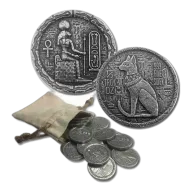
The Egyptian Relic series is produced by Scottsdale Mint, a private mint based in Scottsdale, Arizona, striking legal tender for the Republic of Chad. Each release in the series depicts a figure, deity, or artifact from ancient Egypt, rendered in .999 fine silver with the series signature treatment: an antique finish and rimless, chiseled edges that make each piece look like a fragment of carved stone rather than a conventional bullion product. Real hieroglyphics from ancient Egypt are worked into the designs.
The 1/2 oz size sits below the 1 oz, 2 oz, and 5 oz weights that have carried most of the series releases since its 2016 launch. A half ounce of silver is a small outlay in absolute terms, which makes this an accessible entry point into a series whose larger antique-finish pieces command collector premiums. Silver bullion at 1/2 oz is an unusual weight generally; most silver stacking happens at 1 oz and above, so fractional silver like this trades more on design appeal than on cost-per-ounce efficiency.
The trade-off is the same one that applies across the series. These are design-led products with limited mintages, not commodity bullion. They carry higher premiums than generic silver, and resale liquidity is lower than for mainstream government bullion coins. Buyers choose the Egyptian Relic for the antique artifact aesthetic and the collectible angle, not for the cheapest possible route to silver ounces.
Tax Treatment of Egyptian Relic Silver
Silver receives less favourable tax treatment than gold in most jurisdictions, and the Egyptian Relic series follows the standard rules for silver bullion.
- UK: Subject to 20% VAT on new purchases. Chad legal tender is not UK legal tender, so there is no CGT exemption; gains are taxable like any silver bar or round. Pre-owned pieces sold under the margin scheme can avoid most of the VAT.
- US: No federal sales tax; state rules vary, with most states exempting bullion. Long-term capital gains on bullion are taxed at the collectibles rate of up to 28%.
- EU: Full local VAT rates apply to silver, typically 17-27% depending on the country.
- Canada: The GST/HST exemption requires silver refined to at least 99.9% purity, which .999 fine silver meets, in bar, ingot, coin, or wafer form. Coins with collector value above their metal content may not qualify.
- Australia: The GST exemption for investment-grade silver requires 99.9% purity in a form commonly traded on commodity markets; numismatic and collector pieces attract 10% GST.
For buyers in VAT jurisdictions, the combination of full VAT and a collector premium makes this a noticeably more expensive way to hold silver than silver bars or standard bullion coins.
An Archaeological Aesthetic Since 2016
The Egyptian Relic series launched in 2016 with a King Tut design, followed in the same year by Horus. Subsequent releases have included Queen Nefertiti (2017), Ramesses II (2017), the Sphinx of Hatshepsut (2019), a Chariot of War design, Anubis (2021), and Kek (2022). By the Anubis release the series had produced nine distinct designs. The Ramesses II issue came in two variants: a standard front-facing relief and an Afterlife version depicting the pharaoh as a skeleton.
The common obverse carries the Republic of Chad coat of arms, a goat and lion supporting a shield with rays of light above, alongside the year, weight, face value, and purity. The reverse changes with each release, drawing on ancient Egyptian art, mythology, and hieroglyphics, struck in an antique finish that mimics aged bronze or stone. The signature edge treatment leaves the blank rimless with a rough, chiseled texture, so each piece resembles a carved stone tablet rather than a milled coin.
Mintages have trended downward over the series life, from 25,000 per variant for early 2 oz issues to 5,000 for the 2021 Anubis 5 oz, which has pushed up secondary market premiums on earlier releases. The 2022 Kek design, depicting the frog-headed Egyptian deity of darkness and chaos, attracted unexpected attention from internet meme culture, which drove additional collector interest in that issue.
Egyptian Relic vs Other Themed Silver
The closest stablemate is Scottsdale Mint's own work for the Congo: the Congolese Silverback Gorilla series follows the same private-mint-for-sovereign-issuer model but uses a standard brilliant uncirculated finish rather than the Egyptian Relic's antique treatment. Buyers who want Scottsdale quality without the artifact styling and its premium have that alternative.
Among directly competing Egyptian themes, the Egyptian Gods series from Elemetal and Provident covers similar deity subjects in 2 oz silver, but those are private mint rounds with no legal tender status. The Egyptian Relic pieces carry sovereign backing from the Republic of Chad, denominated in CFA Francs, which matters to some buyers even though the face values are symbolic. Perth Mint has also issued Egyptian-themed coins, but in proof or coloured finishes rather than the antique artifact style.
For a similar overall concept from a different mint, Fiji's Mandala Art series pairs ancient-civilisation themes with an antique finish on sovereign-backed coins from a small nation, with a different aesthetic. The broader decision is between this kind of design-led silver and ordinary bullion: a generic 1 oz silver round delivers more metal per dollar, while the Egyptian Relic trades cost efficiency for limited mintage and a distinctive look.
1/2 oz Egyptian Relic Silver Round: frequently asked questions
-
The cheapest listing we track is $40.88, about 20.9% over the $67.63 silver spot price. The 1/2oz Egyptian Relic contains half a troy ounce of .999 fine silver, so its melt value follows silver directly. Collector premiums on this series tend to run higher than generic rounds.
-
The Egyptian Relic series is produced by Scottsdale Mint (Scottsdale, Arizona) on behalf of the Republic of Chad. Launched in 2016, each release depicts a figure or artifact from ancient Egypt, including King Tut, Horus, Queen Nefertiti, Ramesses II, the Sphinx of Hatshepsut, Anubis, and Kek. Real hieroglyphics are incorporated into the designs, and the coins carry a distinctive antique finish with chiseled, rimless edges meant to evoke carved stone.
-
Verify the weight: a genuine 1/2oz piece should weigh 15.55 grams. The Egyptian Relic series has a distinctive antique finish and rimless chiseled edges that are difficult to replicate. Scottsdale Mint's die quality is precise, so soft or blurry details are a warning sign. A magnet test rules out common steel-core fakes, and purchasing from a recognised bullion dealer provides additional assurance.
-
The 1/2oz Egyptian Relic is 999 fine silver and weighs 1/2 oz (15.55 grams). Weight is measured in troy ounces, the standard for precious metals. At .999 purity it meets investment-grade silver standards.