9 listings
Filters
| Product | /oz | Premium | Price | |
|---|---|---|---|---|

 Bullion Standard
|
$71.25 | +5.36% | $71.25 | View Deal |
 Copper State Coin
|
$71.99 | +6.45% | $71.99 | View Deal |
 Golden Eagle Coins
|
$73.72 | +9.01% | $73.72 | View Deal |
 The Bullion Bank
|
$74.34 | +9.92% | $74.34 | View Deal |
 Golden Eagle Coins
|
$74.72 | +10.49% | $74.72 | View Deal |
| $74.95 | +10.83% | $74.95 | View Deal | |
 First National Bullion
|
$76.64 | +13.33% | $76.64 | View Deal |
 IDC Coin and Bullion
|
$77.38 | +14.42% | $77.38 | View Deal |
| $78.94 | +16.73% | $78.94 | View Deal |


Prices are fetched automatically and may not reflect current merchant prices. Currency conversions and tax treatment are approximate. Rankings are based solely on price. We are not a dealer and accept no responsibility for transactions with listed merchants. Past performance is not indicative of future results. This site does not provide investment advice. Full disclaimer
About the 1 oz American Prospector Silver Round
The 1 oz Engelhard American Prospector Silver Round
The Engelhard American Prospector is one of the most recognised silver rounds ever produced. Originally struck from 1982 to 1987 by the Engelhard Corporation, it holds the distinction of being the first 1 oz silver bullion round ever marketed to retail investors. What began as a straightforward bullion product has become a collector item, with vintage originals trading at premiums of 30-100% or more above spot silver depending on year, condition, and design variant.
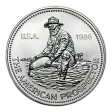
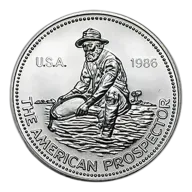
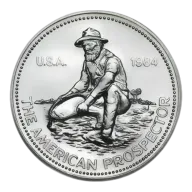
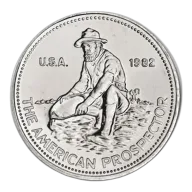
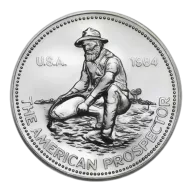
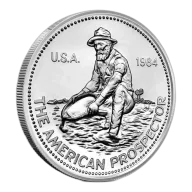
The obverse depicts Claude Chana (1811-1882), a French immigrant who was the first person to officially find gold in Auburn, California, in March 1848, just two months after James Marshall's more famous discovery at Sutter's Mill. Chana is shown kneeling and panning for gold with a pick and pan, with a mountain landscape in the background. A beaded outer circle borders the design.
Engelhard Corporation, founded by Charles W. Engelhard Sr. in 1902 in Newark, New Jersey, grew to become the world's largest refiner and fabricator of platinum, gold, and silver. The Prospector round was Engelhard's flagship retail silver product, designed to make 999 fine silver accessible to individual investors. The introduction of the American Silver Eagle by the US Mint in 1986 is widely believed to have ended Engelhard's retail bullion programme: a government-backed legal tender coin at similar premiums made the private mint round redundant for most buyers.
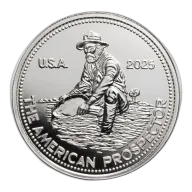
In 2025, BASF (which acquired Engelhard in 2006 for $5 billion) and MKS PAMP Group announced the revival of the Engelhard brand, including new Prospector rounds produced at PAMP's facility. The 2025 rounds faithfully replicate the original design, packaged in replica Engelhard-branded tubes. This creates a two-tier market: new production rounds at bullion-adjacent premiums and vintage originals with their established collector premiums.
American Prospector Specifications
| Attribute | Original (1982-1987) | 2025 Revival |
|---|---|---|
| Weight | 1 troy oz (31.10 g) | 1 troy oz (31.10 g) |
| Purity | 999+ fine silver | 999+ fine silver |
| Diameter | 39 mm | 39 mm |
| Thickness | 2.90 mm | 2.90 mm |
| Edge | Reeded | Reeded |
| Legal tender | No | No |
| Face value | None | None |
| Producer | Engelhard Corporation | MKS PAMP Group (under BASF licence) |
Design Variants
| Period | Reverse Design | Notes |
|---|---|---|
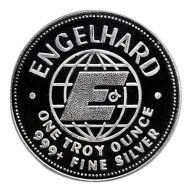
| 1982-1984 | "Large E" interlocking globe logo | Engelhard's corporate logo; most counterfeited variant |
| 1984-1987 | Bald eagle with olive branch | 1984 is transitional: both variants produced |
| 2025 | "Large E" logo (replica) | Faithful reproduction by MKS PAMP |
Fractional sizes (1/10, 1/4, and 1/2 oz) were produced in 1985 only. Three slightly different 1 oz varieties exist for 1985, distinguished by date font width and water detail rendering around the prospector image. Genuine proof variants are extremely rare, with estimated production of fewer than 250-500 pieces per year; these are among the most valuable Engelhard collectibles and command significant premiums at auction.
Counterfeiting is a serious concern for the Engelhard Prospector. The 1984 "Large E" logo variant is the most commonly counterfeited. Known fakes have circulated since at least July 2011. Proof-like rounds in air-tite capsules should be treated with particular suspicion, as genuine Engelhard proofs are exceptionally rare and were not typically packaged this way. Authentication relies on weight (31.10 g), diameter (39 mm), and careful inspection of die characteristics such as the beaded border and logo sharpness. Sigma Metalytics testers can verify silver content. The 2025 revival rounds, produced by LBMA-accredited MKS PAMP, benefit from modern quality control and supply chain credibility that the vintage market lacks. They are packaged in replica original-style Engelhard moulded tubes.
American Prospector Tax Treatment
The Engelhard American Prospector is a private mint round with no legal tender status, no face value, and no government backing. Its tax treatment follows the rules for generic silver bullion in each jurisdiction.
United States
Subject to state sales tax where applicable. Approximately 35 states exempt bullion purchases; the remaining states tax at rates ranging from 4% to 10%+. IRA eligibility is a grey area: IRS Section 408(m) requires silver at 999+ purity from approved refiners. When Engelhard was LBMA/COMEX-approved, original rounds may have qualified, but this depends on the specific IRA custodian's interpretation. The 2025 revival rounds, produced by LBMA-accredited MKS PAMP, are on firmer ground for IRA inclusion. Capital gains are taxed at the collectibles rate of up to 28% federal.
United Kingdom
Subject to 20% VAT on purchase. Not CGT-exempt (not legal tender). No tax advantages over any other silver bullion product. The collector premium on vintage Prospectors makes the VAT burden proportionally smaller as a percentage of total cost, but the tax still applies on the full purchase price. UK silver investors seeking tax efficiency are better served by CGT-exempt Silver Britannias.
Canada
Subject to GST/HST. Rounds at 999+ purity from accredited sources may qualify for the federal precious metals exemption.
Australia
GST-free for investment-grade silver at 999+ purity from accredited refiners. Capital gains tax applies.
European Union
Subject to VAT at local standard rates. No margin scheme advantage, as rounds are not classified as second-hand coins for differential taxation purposes. Vintage Engelhard products have a collector following in Germany, given the Engelhard-BASF corporate history.
Claude Chana, Charles Engelhard, and the Birth of the Silver Round
Claude Chana arrived in California from France in the late 1840s and discovered gold on 22 March 1848 in Auburn Ravine, establishing what would become Auburn's "Gold Country" reputation. His find came just two months after James Marshall's more famous discovery at Sutter's Mill. The prospector depicted on the round, kneeling with pick and pan against a mountain backdrop, has become one of the most recognisable images in the bullion world.
Engelhard Corporation itself has a compelling history. Charles W. Engelhard Sr. founded the company in 1902, and it grew into the world's dominant precious metals refiner and fabricator. His son, Charles Engelhard Jr., is widely believed to be the inspiration for Ian Fleming's James Bond villain Auric Goldfinger. Fleming knew the younger Engelhard socially, and the parallels, a precious metals obsession, German surname, and vast wealth, are striking. Engelhard Jr. died in 1971.
The Prospector round launched in 1982, the same year as the Chinese Gold Panda and just four years before the American Silver Eagle. It was the first 1 oz silver bullion round designed for the retail investor market, a format that would eventually become the backbone of the private mint bullion industry. Engelhard's dominant position in precious metals refining gave the round instant credibility.
The reverse design changed mid-production. The original "Large E" interlocking globe logo (1982-1984) was replaced by a bald eagle clutching an olive branch (1984-1987). The transitional year of 1984 saw both variants produced, making it a key year for collectors distinguishing between the two design periods.
Engelhard ceased retail bullion production in the late 1980s, almost certainly in response to competition from the American Silver Eagle. The government-backed coin offered comparable premiums with legal tender status, making the private round redundant for most buyers. BASF, the German chemical giant, acquired Engelhard in 2006 for $5 billion. The 2025 revival, announced at the ANA World's Fair of Money in Oklahoma City, marked one of the first instances of a defunct bullion brand being revived by its corporate successor. BASF partnered with MKS PAMP Group to produce the new rounds, lending the credibility of an LBMA-accredited Swiss refinery to the resurrected Engelhard name.
Engelhard Prospector vs Silver Eagle, Buffalo Round, and Asahi
The Engelhard Prospector sits outside the normal competitive framework for silver rounds because vintage originals trade as collector items, not as commodity bullion. A vintage Prospector commands premiums of 30-100%+ above spot, while a generic Silver Buffalo Round trades at just 5-10% over spot. The comparison only applies to the 2025 revival rounds, which will trade at bullion-adjacent premiums comparable to other branded rounds.
Against the American Silver Eagle, the Prospector is a private mint product without legal tender status, IRA certainty, or government-backed purity guarantee. The Eagle's advantages are clear: $1 face value, IRA eligibility, global recognition, and edge lettering for authentication. The Prospector's advantage, historically, was lower premiums. That advantage disappeared when Engelhard stopped production and the rounds became collector items. The 2025 revival may restore the premium gap for new-production rounds.
The Asahi Freedom Liberty round is the modern equivalent of what the Engelhard Prospector was in the 1980s: a round from a major, LBMA-accredited refiner with genuine industrial credibility. Asahi inherited Johnson Matthey's refining operations in 2015, much as the Prospector revival inherits the Engelhard name through BASF. The Asahi Liberty Bell round features Latent Imaging Technology, a more sophisticated security feature than anything the original Prospector offered. For current buyers seeking a branded round from a credible refiner, Asahi and the revival Prospector fill similar roles at similar price points.
Against generic Buffalo rounds, the 2025 Prospector revival will carry a brand premium. The Engelhard name, despite decades of dormancy, still commands recognition and a degree of market trust that generic rounds from anonymous mints cannot match. The open question is whether the revival will sustain this premium or whether it will compress toward generic round pricing as production volume increases.
1 oz American Prospector Silver Round: frequently asked questions
-
The cheapest 1oz Engelhard American Prospector tracked here is $71.25 from Bullion Standard, around 5.4% over the $67.63 silver spot price. Vintage originals from 1982-1987 typically carry a collector premium above generic rounds; pricing reflects both the silver content and the brand.
-
The American Prospector is a 1 troy oz .999 fine silver round produced by Engelhard Corporation from 1982 to 1987. The obverse depicts Claude Chana, a French immigrant credited with the first official gold discovery in Auburn, California, in 1848, kneeling at a stream with a pan and pick. It was Engelhard's flagship retail silver product, aimed at individual investors seeking accessible bullion.
-
Yes. The Engelhard American Prospector is 999 fine silver, containing one full troy oz (31.1035 g) of silver. All sizes produced, including the 1/10, 1/4, and 1/2 oz fractionals made in 1985, were struck to the same .999 purity standard.
-
Engelhard produced the American Prospector from 1982 to 1987, with some sources citing production continuing through 1988. The retail bullion programme ended in the late 1980s, likely due in part to competition from the US Mint's American Silver Eagle, launched in 1986. Engelhard Corporation itself was acquired by BASF in 2006. A revival round was announced by BASF and MKS PAMP in 2025.
-
Vintage original Prospectors from 1982-1987 consistently trade above generic silver rounds on the secondary market. The premium reflects Engelhard's discontinued status, strong brand recognition among stackers and collectors, and the variety of die types that make certain years and logo variants more sought after. The 1984 Large E logo and genuine proof-like issues are among the most valued, with proofs estimated at fewer than 500 pieces per year.