1 listing
Filters
| Product | /oz | Premium | Price | |
|---|---|---|---|---|

 The Coin Chest
Out of Stock
The Coin Chest
Out of Stock
|
$91.44 | +46.80% |
$91.38
A$130
|
View Deal |
Prices are fetched automatically and may not reflect current merchant prices. Currency conversions and tax treatment are approximate. Rankings are based solely on price. We are not a dealer and accept no responsibility for transactions with listed merchants. Past performance is not indicative of future results. This site does not provide investment advice. Full disclaimer
About the 1 oz Kookaburra Silver Round
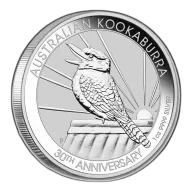
Perth Mint Kookaburra Silver Round
The 1 oz Perth Mint Kookaburra is one of the longest-running annual-design silver bullion series in the world, first struck in 1990. Each year's coin features a new reverse design depicting Australia's iconic laughing kookaburra, the largest member of the kingfisher family and a bird famous for its call that sounds like human laughter. This annual design rotation, combined with a capped mintage of 500,000 coins per year (since 2013), creates genuine year-over-year collectibility that most static-design bullion programmes cannot offer.
The series is backed by the Government of Western Australia and carries legal tender status with a $1 AUD face value (reduced from $5 AUD after the first two years). From 2018, the purity was upgraded from .999 to .9999 fine silver, matching the Canadian Maple Leaf as one of the purest silver bullion coins available. The Perth Mint's "P" mint mark appears on every coin, and the reeded edge provides a standard security feature.
For buyers entering the series today, the current-year Kookaburra trades at moderate premiums above spot, higher than generic rounds but lower than the limited-mintage collector coins. Earlier vintages (particularly the 1990s and the low-mintage 2000 edition at just 84,000 pieces) command significant secondary market premiums, creating a two-tier market where current issues serve investors and back-dates serve collectors.
Kookaburra Technical Specifications
| Attribute | Value |
|---|---|
| Weight | 1 troy ounce (31.135 g) |
| Purity | .9999 fine silver (2018 onward); .999 (1990-2017) |
| Diameter | 40.6 mm |
| Thickness | 2.98 mm |
| Edge | Reeded |
| Face value | $1 AUD (since 1992); $5 AUD (1990-1991) |
| Legal tender | Yes (Australia) |
| Mint mark | P (Perth Mint) |
| Annual mintage cap | 500,000 (since 2013) |
Available Sizes
| Size | Face Value (AUD) | Diameter (mm) | Thickness (mm) |
|---|---|---|---|
| 1 oz | $1 | 40.6 | 2.98 |
| 2 oz | $2 | 50.3 | 4.5 |
| 10 oz | $10 | 75.5 | 8.7 |
| 1 kg | $30 | 101.0 | 14.6 |
The 1 oz coin's 40.6 mm diameter is slightly larger than the 38-39 mm standard used by Eagles, Maples, and Britannias. The 2015 edition replicated the original 1990 design by Stuart Devlin (who also designed Australia's decimal coinage) to mark the series' 25th anniversary. Special privy-mark editions for international coin shows (Berlin World Money Fair, Tokyo International Coin Convention) are produced in small quantities and are highly sought by collectors.
Tax Treatment for the Perth Mint Kookaburra
As Australian legal tender at .999/.9999 silver purity, the Kookaburra qualifies for investment-grade tax treatment in most markets where purity thresholds are the determining factor.
- Australia: GST-free under the investment precious metals exemption. Legal tender at face value. Subject to CGT on disposal, with a 50% discount for individuals holding more than 12 months.
- United States: Meets IRA fineness requirements (.999+ silver) under the generic bullion provision. Some custodians specifically list Perth Mint Kookaburras on approved product lists. Capital gains taxed at the 28% collectibles rate. Sales tax varies by state (approximately 35 states exempt).
- United Kingdom: Subject to 20% VAT on silver. Not CGT-exempt (only UK Royal Mint legal tender qualifies for UK CGT exemption). The legal tender status from Australia provides no UK tax benefit.
- Canada: Subject to GST/HST. May qualify for GST exemption as a legal tender coin meeting the 99.9%+ purity threshold, depending on the dealer's classification.
- New Zealand: GST-exempt at .999+ purity for fine bullion coins.
- Singapore: GST-exempt under the Investment Precious Metals scheme for qualifying silver coins at 99.9%+ purity on the MAS-approved list.
- European Union: Subject to local VAT rates. The margin scheme may apply in Germany and the Netherlands for secondary-market coins.
Kookaburra vs Other Annual-Design Silver Coins
The Kookaburra's defining feature is its annual design rotation combined with government backing and capped mintages. Several other programmes share some of these characteristics, but few combine all three.
Vs Chinese Silver Panda: Both change designs annually. The Panda's mintages are not always disclosed, creating less transparency. The Kookaburra has more consistent availability in Western dealer networks and a longer track record (1990 vs the Panda's 1989 silver launch, though the Panda started in gold in 1982). Both attract collector premiums for early dates.
Vs Perth Mint Koala: Launched in 2007, the Koala is the Kookaburra's younger sibling. It shares the annual-design approach, Perth Mint backing, and .9999 purity (from 2018). The Koala has a lower mintage cap (300,000 vs 500,000), which should theoretically make it scarcer, but the Kookaburra's 35-year history gives it deeper collector infrastructure and stronger secondary market demand for older dates.
Vs Canadian Silver Maple Leaf: The Maple has higher mintages (millions per year), .9999 purity, and Bullion DNA anti-counterfeiting technology that the Kookaburra lacks. The Maple is more liquid for pure investment purposes, with tighter bid-ask spreads at any dealer worldwide. The Kookaburra's advantage is the collectible dimension; a stack of Maples from different years looks identical, but a stack of Kookaburras tells a visual story.
Vs American Silver Eagle: The Eagle has the highest mintages of any silver bullion coin (exceeding 30 million in peak years), the widest global liquidity, and recently moved to .999 purity (previously .9993). It uses a largely static design (Walking Liberty obverse since 1986, updated Eagle reverse from 2021). The Kookaburra cannot match Eagle liquidity, but commands collector interest that the Eagle's mass production does not generate for current-year coins.
Vs Austrian Silver Philharmonic: Static design, higher mintages, EUR 1.50 face value. The Philharmonic is purely an investment product with no annual design variation. The Kookaburra appeals to buyers who want both metal content and year-to-year visual variety.