1 listing
Filters
| Product | /oz | Premium | Price | |
|---|---|---|---|---|

 IDC Coin and Bullion
Out of Stock
IDC Coin and Bullion
Out of Stock
|
$66.87 | -1.12% | $66.87 | View Deal |
Prices are fetched automatically and may not reflect current merchant prices. Currency conversions and tax treatment are approximate. Rankings are based solely on price. We are not a dealer and accept no responsibility for transactions with listed merchants. Past performance is not indicative of future results. This site does not provide investment advice. Full disclaimer
About the 1 oz Panda Silver Round
China's Annually Changing Silver Bullion Icon
The 1 oz Silver Panda from the China Gold Coin Corporation is one of the few government-issued bullion pieces that features a completely new reverse design each year. Produced since 1983, the silver Panda depicts a different giant panda scene annually, with the only constant being the obverse Temple of Heaven (Hall of Prayer for Good Harvests) that has remained unchanged since the series began. This annually changing design creates genuine collector interest alongside the metal content.
A critical specification change occurred in 2016: the standard silver Panda switched from one troy ounce (31.103 g) to 30 metric grams (0.9645 troy oz), reducing the silver content by approximately 3.5%. Pre-2016 coins contain a full troy ounce; post-2016 coins contain slightly less metal. The purity remained .999 fine silver throughout. This distinction matters when comparing prices, as the post-2016 coin contains measurably less silver than competing products like the 1 oz Silver Britannia or 1 oz Perth Lunar.
The silver Panda occupies a hybrid position between pure bullion and numismatic collectible. Early issues (particularly 1983-1985 proofs) command extraordinary premiums, and even recent years trade above comparable sovereign mint silver due to collector demand for the annual designs. Buyers should understand that Panda premiums are higher than most competing silver products, and buy/sell spreads are wider than for generic bullion.
Silver Panda Technical Details
| Attribute | Pre-2016 | Post-2016 |
|---|---|---|
| Weight | 1 troy oz (31.103 g) | 30 g (0.9645 troy oz) |
| Purity | .999 fine silver | .999 fine silver |
| Face value | 10 yuan | 10 yuan |
| Legal tender | People's Republic of China | People's Republic of China |
| Mint | Multiple (Beijing, Shanghai, Shenyang, Shenzhen) | Multiple |
| Mintmarks | Not standardised | Not standardised |
Purity Evolution
The silver Panda's purity changed three times in its early years. The 1983-1985 issues were proof coins containing 27 g of .900 silver. The 1987 edition switched to 1 oz of .925 sterling silver. From 1989 onward, the standard settled at .999 fine silver, which remains current. No silver Pandas were produced in 1986 or 1988, creating gaps in the chronological series.
Annual production for modern silver Pandas reaches approximately 10,000,000 coins (based on 2017-2019 data), making it one of the higher-volume sovereign mint silver products globally. The coins are struck across multiple facilities without standardised mintmarks, so attribution to a specific Chinese mint is difficult without specialised die analysis.
Silver Panda Tax Treatment by Country
The Silver Panda is legal tender of the People's Republic of China, but this status provides no particular tax advantage in most buyer jurisdictions. Tax treatment depends on the destination country's rules for foreign sovereign silver coins.
- United Kingdom: 20% VAT on purchase. Not CGT-exempt (only UK legal tender coins qualify for CGT exemption). The same double-tax burden applies as for any non-UK silver.
- United States: The Silver Panda meets the .999 purity threshold for IRA inclusion. State sales tax varies. Capital gains taxed at the 28% collectibles rate. The gold Panda's IRA status is murkier (the IRS does not clearly recognise the Chinese mint as approved for gold IRA), but silver Pandas are generally accepted by IRA custodians.
- Canada: GST/HST exempt at .999 purity for qualifying bullion coins. Capital gains at 50% inclusion rate. Not listed as RRSP/TFSA eligible by major Canadian custodians.
- Australia: GST-free as investment-grade silver (.999 purity, legal tender coin). Subject to CGT with 50% discount for holdings over 12 months.
- European Union: Standard VAT applies to silver coins (17-27% depending on country). Gold Pandas are VAT-exempt under the investment gold directive, but silver is not covered.
- Singapore: GST-exempt under the Investment Precious Metals scheme (.999 silver coins on the MAS-approved list).
- Hong Kong: No sales tax, no import duty, no capital gains tax. Strong local demand given cultural proximity to China.
From 1983 Proof Rarity to Mass-Produced Bullion
The Silver Panda's history is more complex than most bullion series. It launched in 1983 as a proof-only product in a limited mintage of 10,000 pieces, containing 27 grams of .900 silver. Those original 1983 proofs now command approximately $16,430 in perfect grade, illustrating how the series began as a numismatic product rather than a bullion coin.
Production halted entirely in 1986 and 1988 for reasons that remain unclear in official documentation. The 1987 issue switched to 1 oz of .925 sterling silver, an intermediate step before the series settled on .999 fine silver from 1989 onward. This inconsistent early history means collectors must track purity, weight, and fineness year by year for the pre-1989 period.
The 2001-2002 design freeze is the other notable event in the series timeline. China announced that designs would no longer change annually starting in 2001, so the 2002 Panda carried an identical reverse. Collector backlash was strong enough to reverse the policy, and annual design changes resumed from 2003. The 2001 and 2002 coins are distinguishable only by their obverse date.
The 2015 edition created controversy when gold Pandas were issued without denomination, weight, fineness, or metal inscriptions, leaving only the panda image and year. This omission made counterfeiting easier and was widely criticised. The practice was not repeated for subsequent years. The 2016 switch from troy ounces to metric grams was equally contentious: China's stated reason was alignment with the domestic metric system, but the practical effect was 3.5% less metal per coin at similar pricing.
Silver Panda vs Major Sovereign Mint Alternatives
The Silver Panda competes primarily with other sovereign mint 1 oz silver products, but its pricing and characteristics differ meaningfully from the field.
Against the 1 oz Silver Kangaroo, the Panda shares the annually changing design feature but differs in purity (.999 vs .9999 for the Kangaroo from 2018), weight (30 g post-2016 vs a full troy ounce), and security (the Kangaroo carries a micro-laser engraved letter; the Panda has no equivalent digital or micro-engraved feature). The Kangaroo is more straightforward as a bullion product; the Panda commands higher premiums from its collector market.
Against generic silver rounds, the premium gap is substantial. A generic Buffalo or Walking Liberty round might trade at 5-8% over spot silver, while a current-year Silver Panda can trade at 25-50% or more above spot value. This premium reflects the annually changing sovereign mint design and collector demand rather than any difference in silver content. For buyers focused purely on silver accumulation, the Panda is one of the most expensive ways to acquire an ounce of .999 silver.
Counterfeiting risk is a significant differentiator. The Silver Panda has been disproportionately targeted by counterfeiters compared to other sovereign mint silver. NGC has flagged that skillful counterfeits endanger the series' integrity. The combination of high premiums, annually changing designs (making visual comparison harder), and less sophisticated security features creates an environment favouring counterfeiters. Buying from established dealers or purchasing NGC/PCGS-certified examples reduces this risk substantially. Products like the Canadian Maple Leaf (Bullion DNA authentication) or Perth Kangaroo (micro-engraving) offer stronger built-in anti-counterfeiting measures.
1 oz Panda Silver Round: frequently asked questions
-
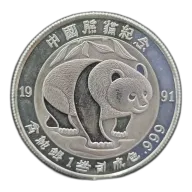
This is a 1 oz (999 fine silver) round produced by China Gold Coin Group Co., Ltd., featuring a panda design. As a privately minted round, it is not legal tender. It contains a full troy ounce (31.1 g) of 999 fine silver and is priced close to the silver spot price plus a modest fabrication premium.
-
This 1oz round contains 1 oz of 999 fine silver (31.1 g). Note that the official government-issued Chinese Silver Panda coin switched from 1 troy oz to 30 grams in 2016, so it contains slightly less silver than this round. This round is a privately minted piece, not the government-issued coin.
-
All fabricated silver products carry a premium over raw spot to cover refining, minting, and distribution costs. Panda rounds also benefit from the recognition of the panda design, which has collector appeal built up over decades from the official Chinese Panda coin series. That design familiarity typically supports a modest premium above generic rounds of the same weight and purity.