1 listing
Filters
| Product | /oz | Premium | Price | |
|---|---|---|---|---|

 IDC Coin and Bullion
Out of Stock
IDC Coin and Bullion
Out of Stock
|
$130.00 | +113.71% | $130.00 | View Deal |
Prices are fetched automatically and may not reflect current merchant prices. Currency conversions and tax treatment are approximate. Rankings are based solely on price. We are not a dealer and accept no responsibility for transactions with listed merchants. Past performance is not indicative of future results. This site does not provide investment advice. Full disclaimer
About the 1 oz South Korean Tiger Silver Round
A Sovereign Mint Product Without Legal Tender Status
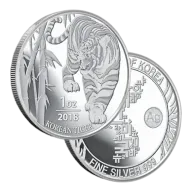
The 1 oz South Korean Tiger silver round occupies an unusual position in the bullion market. It is struck by KOMSCO, the state-owned mint of South Korea responsible for the country's banknotes and government security printing, yet it is classified as a medal rather than a coin. It carries no face value and no legal tender status, which technically makes it a round from a sovereign mint, a hybrid that most private-mint rounds cannot match for credibility.
That sovereign mint origin shows in the security technology. KOMSCO applies the same banknote-level anti-counterfeiting techniques used for South Korean currency, including a holographic latent image on the reverse that shifts between the purity markers when tilted, plus micro-engraved details throughout the design. Few silver rounds at any price carry comparable protection.
The design changes annually, with a new tiger each year depicted in the traditional Korean art style, stern and silent rather than roaring. Annual mintages are low by bullion standards, often in the 20,000 to 30,000 range for the 1 oz silver, and earlier years have seen premiums rise on the secondary market. Buyers comparing this piece against generic silver rounds are paying for design, scarcity, and security features rather than the cheapest possible route to an ounce of silver.
South Korean Tiger 1 oz Silver Specifications
| Attribute | Value |
|---|---|
| Composition | .999 fine silver |
| Weight | 1 troy oz (31.1035 g) |
| Diameter | 40 mm |
| Edge | Smooth (no reeding) |
| Face value | None (medal, not legal tender) |
| Finishes | BU, Proof, and Antiqued variants |
| Mint | KOMSCO (state mint of South Korea) |
The reverse is consistent across years: a stylised map of the Korean peninsula formed from Hangul script characters, with REPUBLIC OF KOREA, the year, weight, and fineness inscriptions. The obverse tiger design changes annually. The reverse also carries the holographic latent image security element, which transitions between "999" and "Ag" as the piece is tilted at different angles.
The series extends beyond the 1 oz silver. A 10 oz silver medal exists at 80 mm diameter, and gold versions run from 1/10 oz up to 1 oz. The 2024 release was marketed as the final release of the standard silver round format; from 2025 KOMSCO moved to a shaped silver medal measuring 61 x 80 mm with antiqued high relief.
Tax Treatment of the Silver Tiger Round
Because the Tiger carries no face value, it is treated as a silver round or medal rather than a coin, and in most jurisdictions that makes no difference to purchase tax, which follows purity rather than legal tender status.
- UK: 20% VAT applies on purchase, the same as silver bars. The round is also not CGT-exempt, since the UK exemption covers UK legal tender coins only. UK buyers pay tax on both entry and exit.
- US: No federal sales tax; most states exempt bullion, while some tax it or apply thresholds. Long-term capital gains on bullion are taxed at the collectibles rate of up to 28%.
- Canada: Exempt from GST/HST, as the .999 fineness clears the 99.9% federal purity threshold for silver.
- Australia: GST-free as investment-grade silver at 99.9% purity or higher.
- New Zealand: GST-exempt, as silver at 99.9% purity or higher qualifies as fine bullion.
- EU: Full standard VAT applies to silver, varying by member state, and rounds get no margin scheme benefit since that scheme covers pre-owned goods.
- Hong Kong: No sales tax and no capital gains tax.
The practical upshot: in VAT jurisdictions the Tiger competes on design and security rather than tax efficiency, while in North America and Oceania it trades on a level tax footing with silver coins.
The Tiger Series Since 2016
KOMSCO launched the Tiger as an annual gold bullion medal in 2016, with silver editions following in 2018. The tiger, ho-rang-i, is a major cultural symbol in Korea, believed to ward off evil spirits and representing courage and power, which made it a natural choice for the state mint's flagship bullion programme. KOMSCO also produces South Korea's banknotes and government security printing, and it applies the same banknote-level anti-counterfeiting technology to the Tiger medals.
Each year brings a new obverse design showing the tiger in a different pose or setting, rendered in the traditional Korean art style with the animal stern and silent rather than roaring. The 2020 release introduced a tiger cub sub-theme that followed the cub through Korea's cities, beginning with Seoul, and the 2022 design depicted a tiger climbing Seoraksan mountain. Throughout, the reverse has stayed constant with its Hangul-script map of the Korean peninsula.
The standard round format reached its end with the 2024 release, which was marketed as the final release of that format. From 2025, KOMSCO introduced a shaped silver medal variant measuring 61 x 80 mm with antiqued high relief, breaking from the round shape entirely. That change gives the 2016 to 2024 standard rounds a defined, closed run. Annual mintages have stayed low throughout, with 1oz silver issues typically in the range of 20,000 to 30,000 units, and the series has developed a strong following in East Asian bullion markets, with premiums on earlier years often increasing on the secondary market.
Tiger vs Panda, Lunar Tiger, and Chiwoo Cheonwang
The closest comparison is the Chinese Panda. Both are Asian government-mint programmes with annual design changes, but the Panda is legal tender while the Tiger is a medal without face value. The Panda also has vastly higher mintage and broader global distribution, so it is easier to buy and sell, whereas the Tiger trades on scarcity.
Against the Perth Mint Lunar Tiger, the overlap is the animal rather than the format. Perth's tiger appears only in its Lunar year as part of the zodiac cycle, while the KOMSCO Tiger is issued every year regardless of the calendar.
The Royal Canadian Mint wildlife coins offer another angle: RCM products carry legal tender status and .9999 fineness against the Tiger's .999 medal status, but the Tiger's annual mintage is much lower.
The most natural sibling is the Chiwoo Cheonwang, KOMSCO's other flagship series featuring the legendary warrior figure. The two share the same mint, the same banknote-grade security features, and similar premium positioning, so the choice between them comes down to design preference. Buyers prioritising the lowest cost per ounce should instead look at generic 1oz silver rounds, which trade closer to spot but carry none of the Tiger's security technology or collectible following.