 Coins Online


 BullionStar
Prices are fetched automatically and may not reflect current merchant prices. Currency conversions and tax treatment are approximate. Rankings are based solely on price. We are not a dealer and accept no responsibility for transactions with listed merchants. Past performance is not indicative of future results. This site does not provide investment advice. Full disclaimer
About the 1 oz Walking Liberty Silver Round
The Cheapest Way to Stack Silver in Coin Form
The 1 oz Walking Liberty silver round is one of the lowest-premium silver products available in a coin-shaped format. It contains one troy ounce (31.1035 grams) of .999 fine silver and is produced by multiple private mints across the United States, including Sunshine Minting, SilverTowne, Highland Mint, Mason Mint, and Golden State Mint. The design reproduces Adolph Weinman's 1916 Walking Liberty motif, one of the most recognised coin designs in American numismatic history, originally struck on the US half dollar from 1916 to 1947 and later revived by the US Mint for the American Silver Eagle in 1986.
For buyers focused on acquiring the most silver per dollar, Walking Liberty rounds offer a meaningful advantage over sovereign-minted coins. Government coins like the 1 oz American Silver Eagle or the 1 oz Canadian Silver Maple Leaf carry premiums of 15-25% over spot due to their legal tender status, government backing, and associated minting costs. Walking Liberty rounds sit in the 5-10% range, closer to the premiums on 1 oz silver bars. That difference can translate to several extra ounces of silver for every hundred spent.
The tradeoff is straightforward. Walking Liberty rounds carry no face value, no legal tender status, and no government guarantee of weight or purity. They are not eligible for US Individual Retirement Accounts (IRAs), and they do not qualify for UK Capital Gains Tax exemption. Resale liquidity is good but not as tight as sovereign coins; dealers buy them back readily, though the spread between buy and sell prices is wider than for Eagles or Britannias. For stackers who plan to hold physical silver long-term and prioritise metal weight over tax efficiency or resale premiums, these rounds are a practical choice. The Walking Liberty design's instant recognisability gives them an edge over truly generic rounds with unfamiliar branding.
Multiple Mints, One Design
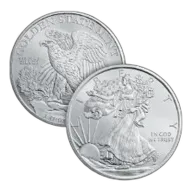
Because Weinman's Walking Liberty design entered the public domain decades ago, any private mint can produce rounds bearing it. This has created a large, competitive market. Sunshine Minting rounds are the most widely traded version, in part because they include the proprietary MintMark SI micro-engraved security feature visible only with a decoder lens. SilverTowne, Highland Mint, Golden State Mint, Mason Mint, and Regency Mint all produce their own versions. The obverse design is consistent across producers (Liberty striding toward the sunrise, draped in the flag, carrying laurel and oak branches), but reverses vary, typically showing the producing mint's logo alongside weight and purity markings. For pure stacking purposes, any version from a reputable mint will do. The Sunshine Mint version commands a slight premium for its security feature, which can simplify resale.
Walking Liberty Silver Round Specifications
| Specification | Value |
|---|---|
| Metal content | 1 troy oz (31.1035 g) fine silver |
| Purity | .999 fine silver |
| Gross weight | 31.1035 g |
| Diameter | Approximately 39 mm (varies by mint) |
| Thickness | Approximately 2.9 mm (varies by mint) |
| Edge | Reeded or plain (varies by mint) |
| Face value | None (private mint product) |
| Legal tender | No |
| Obverse design | Walking Liberty (Adolph Weinman, 1916) |
| Reverse design | Varies by mint (typically mint logo, weight, purity) |
Major Producers
The Walking Liberty round is produced by several private mints. Because the design is in the public domain, specifications vary slightly between manufacturers, particularly diameter, thickness, and edge treatment. The core specification of one troy ounce of .999 fine silver is universal across all reputable producers.
| Mint | Location | Notable feature |
|---|---|---|
| Sunshine Minting | Coeur d'Alene, Idaho | MintMark SI security feature; most widely traded version |
| SilverTowne | Winchester, Indiana | Long-running producer; established brand |
| Highland Mint | Melbourne, Florida | Licensed sports memorabilia and bullion producer |
| Golden State Mint | Westlake Village, California | Produces Walking Liberty in fractional sizes and bar formats |
| Mason Mint | United States | Newer producer with growing dealer distribution |
| Regency Mint | United States | Smaller producer of Walking Liberty rounds |
Packaging
Walking Liberty rounds are sold individually, in tubes of 20, or in bulk boxes of 500. Tubes are the standard unit for stacking and storage, with each tube measuring roughly 80 mm in height. A box of 500 rounds weighs approximately 15.6 kg (over 34 lbs). Individual rounds fit standard 39 mm capsules, though capsule compatibility can vary slightly between mints due to minor diameter differences. Rounds ship in the same plastic tubes used for government-minted 1 oz silver coins, making storage interchangeable.
Tax Treatment for Walking Liberty Silver Rounds
Walking Liberty rounds are private mint products with no legal tender status in any jurisdiction. This distinction matters for tax purposes in several countries, particularly the UK, where legal tender silver coins receive Capital Gains Tax exemption that rounds do not.
United States
Sales tax on silver bullion varies by state. Approximately 35 states exempt bullion from sales tax entirely, while around 10 states apply their standard rate. Five states use purchase thresholds: California exempts transactions over $2,000, Florida over $500, Louisiana over $1,000, Massachusetts over $1,000, and New York over $1,000. Walking Liberty rounds are treated identically to other silver bullion for state sales tax purposes.
On disposal, the IRS classifies precious metals as collectibles. Long-term capital gains (held over one year) are taxed at a maximum federal rate of 28%, higher than the 15-20% rate applied to stocks and bonds. Short-term gains are taxed as ordinary income. The 3.8% Net Investment Income Tax may also apply. Dealers must issue Form 1099-B for sales exceeding certain thresholds.
Walking Liberty rounds are not IRA-eligible. IRS Section 408(m) restricts precious metals IRAs to sovereign coins meeting specific purity requirements and bars or rounds produced by refiners accredited by NYMEX, COMEX, or certain national assay offices. Private mint rounds do not qualify. The 1 oz American Silver Eagle, which uses the same obverse design, is IRA-eligible.
United Kingdom
Silver rounds are subject to 20% VAT on purchase. No exemption applies: investment gold is VAT-free in the UK, but silver bullion in all forms (coins, bars, rounds) carries the full rate. Pre-owned silver can be purchased under the margin scheme from certain dealers, with VAT charged only on the dealer's margin rather than the full price. New Walking Liberty rounds do not qualify for the margin scheme.
On disposal, Walking Liberty rounds are subject to Capital Gains Tax at the individual's rate (currently 18% for basic rate taxpayers, 24% for higher rate). They are not UK legal tender and therefore do not qualify for the CGT exemption available to 1 oz Silver Britannias. The annual CGT-free allowance (currently £3,000) applies. For UK buyers, this double taxation on entry (VAT) and exit (CGT) makes rounds a poor choice compared to CGT-exempt silver Britannias.
Canada
Silver bullion refined to 99.9% purity or higher is exempt from GST/HST when sold in bar, ingot, coin, or wafer form. Walking Liberty rounds at .999 purity qualify for this exemption. No provincial variation applies to this federal exemption. Capital gains are subject to a 50% inclusion rate, with 50% of the gain added to income and taxed at the individual's marginal rate.
European Union
Silver bullion is subject to standard VAT rates across EU member states, ranging from 17% (Luxembourg) to 27% (Hungary). No investment silver exemption exists at the EU level. Germany and the Netherlands offer a margin scheme (Differenzbesteuerung and margeregeling respectively) on pre-owned silver coins, but new rounds do not qualify. Estonia exempts legal tender silver coins from VAT, but private mint rounds are not eligible.
Australia
Investment-grade silver (99.9% purity or higher in a form commonly traded on commodity markets) is GST-free. Walking Liberty rounds at .999 purity meet this threshold. Capital gains apply, with a 50% CGT discount for assets held longer than 12 months.
New Zealand
Fine silver bullion at 99.9% purity or higher is GST-exempt (the standard rate is 15%). Walking Liberty rounds at .999 qualify. New Zealand has no formal capital gains tax, though gains from bullion acquired for the purpose of resale may be treated as taxable income by the IRD.
Singapore and Hong Kong
Singapore exempts Investment Precious Metals (IPM) from the 9% GST, covering silver at 99.9% purity from accredited refiners in bar, ingot, wafer, or qualifying coin form. Rounds from accredited sources are covered. Singapore has no capital gains tax. Hong Kong has no sales tax, no import duty, and no capital gains tax on bullion.
South Africa
Gold Krugerrands are zero-rated for VAT in South Africa, but silver bullion (including silver Krugerrands and all rounds) is subject to the full 15% VAT. There is no exemption for silver rounds. Capital gains are taxed at a 40% inclusion rate for individuals.
Weinman's Design: From Half Dollar to Modern Round
The Walking Liberty design has one of the longest lineages in American coinage. In 1915, US Mint Director Robert W. Woolley launched a design competition through the Commission of Fine Arts to replace the Barber coinage that had been in circulation since 1892. Three sculptors were invited to compete: Adolph Weinman, Hermon MacNeil, and Albin Polasek. On 28 February 1916, the Commission selected five of Weinman's sketches. Two went into production: the Mercury dime (formally the Winged Liberty Head dime, minted 1916 to 1945) and the Walking Liberty half dollar.
Weinman was born in Karlsruhe, Germany in 1870 and emigrated to the United States at age ten. He trained under Augustus Saint-Gaudens and Philip Martiny, becoming one of the most accomplished American sculptors of his generation. His Walking Liberty obverse depicts Liberty striding confidently toward the sunrise, draped in the American flag, carrying branches of laurel (civil glory) and oak (military glory) in her left arm. The original reverse, used on the half dollar, featured a bald eagle perched on a rocky crag with wings partially raised.
The Walking Liberty half dollar was minted continuously from 1916 to 1947, with a total production run of approximately 485 million coins across the Philadelphia, Denver, and San Francisco mints. The design's reception was not immediately smooth. Chief Engraver Charles Barber, whose own designs were being replaced, resisted the new artistic direction. Woolley's insistence on external artists over the in-house engraving staff created institutional friction that persisted throughout the production setup. Despite these difficulties, the Walking Liberty half dollar became one of the most admired American coins of the twentieth century.
Revival on the American Silver Eagle
In 1986, the US Mint launched the American Silver Eagle bullion programme and selected Weinman's Walking Liberty obverse as its design. Mint Sculptor-Engraver John Mercanti adapted the original design for modern high-speed coining presses, strengthening details that would otherwise be lost in mass production. Mercanti also designed the heraldic eagle reverse used from 1986 to 2021. In 2021, the reverse was updated to a design by Emily Damstra depicting an eagle coming in for a landing, while the Weinman obverse was retained. The American Silver Eagle has become the world's best-selling silver bullion coin, and the Walking Liberty design now appears on millions of coins struck annually.
Private Mint Rounds
Because Weinman's original design dates to 1916, it has been in the public domain for decades. Private mints have produced Walking Liberty silver rounds since at least the 1980s, taking advantage of the design's instant recognisability and the public's familiarity with it from both the original half dollar and the Silver Eagle. Sunshine Minting, based in Coeur d'Alene, Idaho, became the dominant producer and introduced the MintMark SI micro-engraved security feature to differentiate its rounds from competitors and address counterfeiting concerns. SilverTowne in Winchester, Indiana and Highland Mint in Melbourne, Florida are also longstanding producers. Golden State Mint in Westlake Village, California expanded the Walking Liberty range to include fractional sizes (1/2 oz, 1/4 oz, 1/10 oz) and bar formats alongside the standard 1 oz round.
The Walking Liberty round occupies a distinct position in the silver market. It shares its obverse design with the most popular government-minted silver coin in the world, yet costs significantly less because it carries no legal tender status, no government purity guarantee, and no sovereign mint branding. For buyers, this creates an unusual value proposition: a highly recognisable design at generic-round pricing.
Walking Liberty Round vs American Silver Eagle, Buffalo Round, and Britannia
The most immediate comparison for the Walking Liberty round is the 1 oz American Silver Eagle, since both carry the same obverse design. The Silver Eagle is a US government legal tender coin with a $1 face value, struck by the US Mint in .999 fine silver. It includes anti-counterfeit edge lettering (added in 2021), carries IRA eligibility, and trades with extremely high liquidity. The Walking Liberty round has none of these features. The premium difference reflects this gap: Silver Eagles typically trade at 15-25% over spot, placing them well above the Walking Liberty round's 5-10% range. A buyer choosing between them is deciding whether legal tender status, IRA eligibility, and tighter resale spreads are worth the extra cost per ounce.
The 1 oz Silver Buffalo round is the Walking Liberty round's closest competitor in the generic round market. Both are .999 fine, produced by multiple private mints, and trade at similarly low premiums. The Buffalo round uses the design from James Earle Fraser's 1913 Buffalo nickel (Indian Head obverse, American bison reverse), which is also in the public domain. The choice between them is largely aesthetic. Both are equally liquid among US dealers, and neither carries legal tender status or IRA eligibility. The Walking Liberty round benefits from its visual association with the American Silver Eagle, which may give it a slight edge in instant recognition. The Buffalo round has its own strong following and is produced in even larger volumes by more mints.
For UK and Commonwealth buyers, the 1 oz Silver Britannia is the relevant comparison, though it occupies a fundamentally different market position. The Britannia is Royal Mint legal tender (£2 face value), making it exempt from UK Capital Gains Tax. It carries four integrated security features (surface animation, micro-text, latent image, and tincture lines) and trades at significantly higher premiums. For UK buyers specifically, the Britannia's CGT exemption can outweigh its higher purchase premium over a holding period of several years, since the tax saved on disposal may exceed the premium difference paid at purchase. The Walking Liberty round, subject to both 20% VAT on purchase and CGT on sale in the UK, is hard to justify for UK-based buyers unless purchased offshore or through a VAT-exempt channel.
The 1 oz Canadian Silver Maple Leaf offers another sovereign-mint alternative. It is struck at .9999 purity (four nines, versus three nines for the Walking Liberty round), carries Royal Canadian Mint Bullion DNA anti-counterfeiting technology, and is eligible for both US IRAs and Canadian RRSPs. Its premium over spot is moderate, sitting between generic rounds and the American Silver Eagle. For Canadian buyers, the Maple Leaf's RRSP eligibility and the strong domestic dealer network make it a more practical choice than importing private mint rounds.
The Walking Liberty round's core advantage across all these comparisons is price. It delivers one troy ounce of .999 silver at the lowest available premium in a coin-shaped format. That advantage is most compelling for US-based stackers in sales-tax-exempt states who plan to hold physical silver and are not concerned with IRA eligibility or international resale. For buyers in jurisdictions where sovereign coins offer tax advantages (UK CGT exemption, US IRA eligibility, Canadian RRSP eligibility), the premium savings on rounds may be offset by the tax benefits of government-minted coins.
1 oz Walking Liberty Silver Round: frequently asked questions
-
The cheapest 1oz Walking Liberty silver round we track is $71.42, from Coins Online at around 5.6% over the $67.63 silver spot price. These rounds carry some of the lowest premiums available on silver because they are privately minted with no legal tender status.
-
A Walking Liberty silver round is a privately minted 1 troy oz bullion round, not a legal tender coin. It carries the classic Walking Liberty design by sculptor Adolph Weinman, originally created for the US half dollar (1916-1947) and later adapted for the American Silver Eagle. Private mints including Golden State Mint produce these rounds freely because the design is in the public domain. They carry no face value and no government backing.
-
Yes. This Golden State Mint Walking Liberty round is .999 fine silver (31.1 grams), not to be confused with the vintage Walking Liberty half dollar, which is 90% silver (12.5 grams total, about 0.36 oz of silver). The modern private-mint round contains nearly three times more silver than the original coin, at higher purity. Always check which product you are comparing when researching prices.
-
A 1oz Walking Liberty round contains 1 oz of .999 fine silver, equivalent to 31.1035 grams or one troy ounce. Troy ounces are slightly heavier than standard (avoirdupois) ounces: one troy oz is 31.1g versus 28.3g for a standard ounce, so always confirm the weight unit when comparing silver products.