1 listing
Filters
| Product | /oz | Premium | Price | |
|---|---|---|---|---|

 The Coin Chest
Out of Stock
The Coin Chest
Out of Stock
|
$72.47 | +16.49% |
$144.66
A$205
|
View Deal |
Prices are fetched automatically and may not reflect current merchant prices. Currency conversions and tax treatment are approximate. Rankings are based solely on price. We are not a dealer and accept no responsibility for transactions with listed merchants. Past performance is not indicative of future results. This site does not provide investment advice. Full disclaimer
About the 2 oz Tudor Beasts Silver Round
The 2 oz Tudor Beasts Silver Round
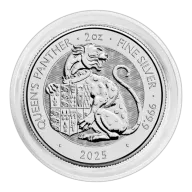
The 2 oz Tudor Beasts is part of the Royal Mint's ten-design series (2022-2026) that serves as the successor to the Queen's Beasts. Each year introduces two new beasts drawn from the stone statues that originally stood on the Moat Bridge of Hampton Court Palace, built by Cardinal Thomas Wolsey from 1514 and later acquired by Henry VIII. The series is designed throughout by David Lawrence.
This product is classified as a round rather than a coin in the database, though the Tudor Beasts programme is primarily issued as legal tender coins with face values denominated in GBP. The 2 oz silver version carries a face value of GBP 5 and is struck in .9999 fine silver, matching the purity of its predecessor Queen's Beasts series and exceeding the .999 standard of the Britannia.
The series straddles the transition from Queen Elizabeth II to King Charles III. Early issues (2022) bear the Jody Clark portrait of Elizabeth II; from 2023 onward, the Martin Jennings portrait of Charles III appears on the obverse. Some collectors specifically seek matched sets featuring both portrait variants for the same beast design.
Released beasts include the Seymour Panther and Lion of England (2022), Yale of Beaufort and Bull of Clarence (2023), Seymour Unicorn and Tudor Dragon (2024), Queen's Panther and Greyhound of Richmond (2025), with the Queen's Lion and a tenth beast due in 2026. Each beast holds a shield bearing Tudor heraldic arms, with a guilloche patterned background serving as both an aesthetic element and a counterfeiting deterrent.
Tudor Beasts 2 oz Silver Specifications
| Attribute | Value |
|---|---|
| Weight | 2 troy oz (62.42 g) |
| Purity | .9999 fine silver |
| Diameter | 38.61 mm |
| Face value | GBP 5 |
| Edge | Milled |
| Designer | David Lawrence |
| Issuer | The Royal Mint |
| Series length | 10 designs (2022-2026) |
The .9999 (four nines) silver purity is a consistent feature of the Royal Mint's "beasts" franchise, shared with the predecessor Queen's Beasts series. This distinguishes both programmes from the Britannia's .999 standard. The higher purity carries no practical impact on value but represents a technical differentiator for buyers who prioritise maximum silver fineness.
The guilloche patterned background on all bullion reverses serves as both an aesthetic element and a counterfeiting deterrent. This geometric lattice pattern is absent from proof versions (which use a plain field), providing an instant way to distinguish bullion from numismatic strikes. The security approach is simpler than the Britannia's four-feature suite (surface animation, latent image, tincture lines, micro-text) but remains effective for the series' target market.
The 38.61 mm diameter matches the Queen's Beasts at the same weight. Individual coins are supplied in capsules rather than tubes, which is standard for the 2 oz silver format from the Royal Mint.
Tudor Beasts Tax Status by Country
As UK legal tender, the Tudor Beasts carries significant tax advantages for British buyers that most silver bullion products cannot match.
- UK: CGT exempt on all Tudor Beasts coins (gold, silver, and platinum) due to legal tender status. This is unusual for silver, since most silver products are subject to CGT on disposal. The 20% VAT still applies on purchase of silver versions, but the CGT exemption on the exit side partially offsets this cost over time. Gold versions are both VAT-free on purchase and CGT-exempt on sale.
- US: Not IRA-eligible. Subject to the standard 28% federal collectibles tax rate on capital gains. No special status.
- EU: Silver versions subject to local VAT rates (17-27% depending on country). The margin scheme may apply on secondary market purchases in Germany and the Netherlands. Gold versions are VAT-exempt under the EU Investment Gold Directive.
- Canada: Silver at .9999 purity qualifies for GST/HST exemption.
- Australia: GST-free as investment-grade silver at .9999 purity, subject to the product coming from an accredited source. CGT applies on disposal with a 50% discount for holdings over 12 months.
From Hampton Court to the Tudor Beasts Coinage
The ten beasts in this series derive from stone statues that Henry VIII placed on the Moat Bridge at Hampton Court Palace after acquiring the estate from Cardinal Wolsey. The original statues deteriorated over the centuries; the current versions standing at Hampton Court are 20th-century replicas carved by Joseph Cribb in the 1930s. Each beast represented a dynastic claim or family connection of the Tudor monarchs.
The Seymour Panther and Seymour Unicorn represent Jane Seymour, Henry's third wife and mother of Edward VI. The Lion of England is the oldest royal beast in English heraldry. The Yale of Beaufort connects to Lady Margaret Beaufort, Henry VII's mother. The Bull of Clarence represents the House of York. The Tudor Dragon references Henry VII's Welsh origins and the red dragon of Cadwaladr.
David Lawrence, the illustrator who designed all ten reverses, has over 30 years of experience in coin design. His approach reinterprets the Hampton Court statues for a numismatic format, producing more dynamic and detailed compositions than the cleaner heraldic style of Jody Clark's Queen's Beasts designs. The Queen's Beasts precedent suggests a Completer Coin consolidating all ten beasts may follow the final 2026 release, though this has not been confirmed.
Tudor Beasts 2 oz vs Queen's Beasts and Britannia
The most direct comparison is with the completed Queen's Beasts series (2016-2021), which established the 2 oz silver format at the Royal Mint. Both series use .9999 silver, carry UK legal tender status with CGT exemption, and feature David Lawrence's guilloche backgrounds. The Queen's Beasts is now secondary market only, which can mean either higher collector premiums for popular designs or opportunities to acquire at bullion-adjacent pricing.
Against the 2 oz Silver Britannia, the Tudor Beasts matches on CGT exemption and face value (GBP 5) but offers higher purity (.9999 vs .999). The Britannia has a four-feature security suite (surface animation, latent image, tincture lines, micro-text) that the Tudor Beasts lacks, relying solely on its guilloche pattern. The Britannia's ongoing production and wider recognition give it better international liquidity.
For US or international buyers without UK tax considerations, the Tudor Beasts competes on collectibility: the finite ten-design structure, annual releases, and the historical Hampton Court narrative create a collector appeal that ongoing series like the Britannia do not replicate. The trade-off is narrower dealer networks outside the UK and no IRA eligibility.