 Baird & Co.




Prices are fetched automatically and may not reflect current merchant prices. Currency conversions and tax treatment are approximate. Rankings are based solely on price. We are not a dealer and accept no responsibility for transactions with listed merchants. Past performance is not indicative of future results. This site does not provide investment advice. Full disclaimer
About the 1/4 oz Philharmonic Gold Coin
The 1/4 oz Gold Philharmonic in Context
The 1/4 oz Philharmonic from Austria's Münze Österreich contains 7.776 grams of 999.9 fine gold, struck in the same design that has run unbroken since 1989. Among 1/4 oz gold coins, it competes directly with the 1/4 oz Britannia, 1/4 oz Maple Leaf, and 1/4 oz Kangaroo on purity, and with the 1/4 oz Krugerrand and 1/4 oz American Eagle on market presence.
The Philharmonic's consistent advantage is price. It has historically traded at some of the lowest premiums of any government-issued 999.9 gold coin, a pattern that holds across all denominations including this 1/4 oz size. The coin carries a face value of 25 euros (denominated in Austrian schillings before the 2002 currency switch) and is legal tender in Austria, though not in other eurozone countries despite bearing euro denominations.
For European buyers, the Philharmonic holds a particular practical advantage: it appears on the EU's annual list of investment gold coins, ensuring VAT-exempt status in all member states without the need for individual coin-by-coin verification. The 1/4 oz size at roughly 22mm diameter is compact and affordable, sitting at a price point that allows regular monthly purchases for stackers building positions in physical gold.
1/4 oz Gold Philharmonic Specifications
| Attribute | Value |
|---|---|
| Fine gold content | 7.776 g (1/4 troy oz) |
| Purity | 999.9 (24 karat) |
| Diameter | 22.0 mm |
| Face value | 25 EUR |
| First issued | 1991 |
| Mint | Münze Österreich (Austrian Mint) |
| Edge | Reeded |
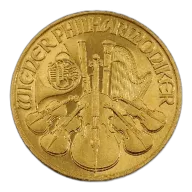
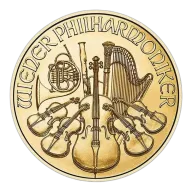
The obverse depicts the pipe organ of the Musikverein's Golden Hall in Vienna, one of the most acoustically celebrated concert venues in the world. The Rieger organ shown was built in 1907. The reverse features an ensemble of instruments from the Vienna Philharmonic Orchestra: a cello at centre, flanked by four violins, with a Wiener Horn, bassoon, and harp behind. The Wiener Horn is specifically a Vienna horn, distinct from a standard French horn, reflecting the orchestra's commitment to historically informed performance practice.
The 1/4 oz denomination was introduced in 1991 alongside the 1/2 oz and 1/10 oz, two years after the original 1 oz Philharmonic launched in 1989. Unlike the 1/4 oz Britannia with its latent image and micro-text, or the 1/4 oz Maple Leaf with its MintShield technology, the Philharmonic carries no specialised anti-counterfeiting features. Authentication relies on the intricacy of the instrument engraving and precise weight and dimension tolerances.
Tax Treatment of the 1/4 oz Gold Philharmonic
The Philharmonic qualifies as investment gold across all major bullion markets. At 999.9 fine, it exceeds the purity thresholds required for tax-exempt treatment in every jurisdiction covered here.
Purchase Tax
- UK: VAT-free as recognised investment gold. No VAT regardless of whether purchased from a UK dealer or imported from the EU.
- EU: VAT-exempt in all member states under the EU Investment Gold Directive (98/80/EC). The Philharmonic appears on the EU's annual published list of qualifying coins.
- US: No federal sales tax. State sales tax varies; over 35 states exempt bullion purchases. See the state-by-state table for specifics.
- Canada: GST/HST-exempt. Gold coins at 99.5%+ purity in coin form qualify for the federal exemption.
- Australia: GST-free as investment-grade gold (99.5%+ purity threshold met).
- New Zealand: GST-exempt. Gold coins at 99.5%+ purity qualify.
- Singapore: GST-exempt under the Investment Precious Metals (IPM) scheme. Gold at 99.5%+ purity in coin form qualifies.
- Hong Kong: No sales tax of any kind. No import duty.
- South Africa: Gold coins are zero-rated for VAT.
Capital Gains and Retirement Accounts
The Philharmonic is not UK legal tender, which means it does not qualify for the CGT exemption available to the 1/4 oz Britannia. UK residents selling Philharmonics at a profit are liable for CGT above the annual allowance (currently £3,000). For UK investors focused on tax efficiency, the Britannia's CGT exemption makes it the stronger choice despite typically carrying a slightly higher purchase premium.
In the US, the Philharmonic is IRA-eligible because its 999.9 fineness exceeds the IRS minimum of 99.5% for gold held in a self-directed precious metals IRA. Capital gains on bullion sold outside an IRA are taxed at the collectibles rate of up to 28%. In Germany, gains are completely tax-free if the coin is held for more than one year. In Australia, a 50% CGT discount applies for assets held longer than 12 months.
Philharmonic vs Other 1/4 oz Gold Coins
The 1/4 oz gold coin market is dominated by six sovereign mint products, all at 1/4 troy ounce. The Philharmonic, Britannia, Maple Leaf, and Kangaroo share 999.9 purity. The Krugerrand and American Eagle are 916.7 fine (22 karat) but contain the same fine gold weight, with copper alloy adding total coin mass and scratch resistance.
| Coin | Purity | Diameter | Face Value | Security Features |
|---|---|---|---|---|
| Philharmonic | 999.9 | 22.0 mm | 25 EUR | Design detail only |
| Britannia | 999.9 | 22.0 mm | £25 | Latent image, micro-text, tincture lines |
| Maple Leaf | 999.9 | 20.0 mm | $10 CAD | MintShield, Bullion DNA |
| Kangaroo | 999.9 | 20.1 mm | $25 AUD | Micro-laser engraving |
| Krugerrand | 916.7 | 22.06 mm | None | Reeded edge (180 serrations) |
| Eagle | 916.7 | 22.0 mm | $10 USD | Reeded edge |
On premiums, the Philharmonic typically sits at the lower end alongside the Krugerrand. The Britannia and Eagle tend to command slightly higher premiums in their home markets (UK and US respectively). The Maple Leaf sits in between, while the 1/4 oz Perth Lunar commands noticeably higher premiums due to its limited mintage and annual design changes.
The Philharmonic's weakness relative to the Britannia and Maple Leaf is the absence of modern anti-counterfeiting technology. The Austrian Mint has not added security features comparable to the Britannia's four-feature suite or the Maple Leaf's MintShield. For buyers who prioritise authentication assurance, that gap matters. For buyers focused on acquiring the most fine gold per pound or dollar spent, the Philharmonic's lower premiums make it a strong choice.
The design factor is subjective but relevant: the Philharmonic is one of the only major bullion coins with a cultural rather than national-symbol motif. The instruments of the Vienna Philharmonic Orchestra give it a distinctive aesthetic that many collectors value, and the design has remained unchanged since the series launched in 1989.
1/4 oz Philharmonic Gold Coin: frequently asked questions
-
The cheapest 1/4 oz Gold Philharmonic available from dealers we track is £889.40, currently sold by Baird & Co. That price reflects £3,256.26 gold spot price plus the dealer's premium. Prices update throughout the day as spot moves.
-
Baird & Co currently has the lowest price at £889.40. We compare prices across 4 dealers in real time, so the ranking can shift as dealers update their pricing. Use the comparison table above to see the full list.
-
The Gold Philharmonic is struck in 999.9 fine gold (24 carat, four nines purity) by the Austrian Mint (Münze Österreich) in Vienna. The 1/4 oz coin contains 7.776 g of fine gold. The purity is government-guaranteed and the coin carries a face value denominated in euros, making it legal tender in Austria.
-
A 1/4 oz Gold Philharmonic contains exactly one quarter of a troy ounce of fine gold, equal to 7.776 g. The coin is struck to 999.9 purity, meaning virtually all of its weight is pure gold. The 1/4 oz size was introduced by the Austrian Mint in 1991 alongside the 1/2 oz and 1/10 oz denominations.