 Gold Bank


Prices are fetched automatically and may not reflect current merchant prices. Currency conversions and tax treatment are approximate. Rankings are based solely on price. We are not a dealer and accept no responsibility for transactions with listed merchants. Past performance is not indicative of future results. This site does not provide investment advice. Full disclaimer
About the 1 oz The Royal Mint Lunar Gold Coin
The Royal Mint Lunar Gold Coin
The 1 oz Royal Mint Lunar gold coin, officially known as the Shengxiao Collection, contains one troy ounce of 999.9 fine gold and follows the 12-year Chinese zodiac cycle. The series launched in 2014 with the Year of the Horse and has run through to the Year of the Snake in 2025, with a second cycle beginning in 2026. Each coin carries a face value of £100, making it UK legal tender and therefore CGT-exempt for British investors.
This CGT exemption is the series' most significant advantage over competing lunar coins. The Perth Mint Lunar (Series I from 1996, now on Series III) is the dominant lunar bullion programme globally, but profits from selling Perth Mint coins attract UK CGT above the annual allowance. The Royal Mint Lunar is the only zodiac-themed gold coin from a major sovereign mint that offers UK tax exemption on disposal, making it the default choice for British buyers who want Chinese zodiac coins in their portfolio.
A major shift occurred in 2021, when the Royal Mint discontinued bullion-grade Lunar releases and moved to proof and brilliant uncirculated finishes only. This significantly increased premiums on new issues and repositioned the series from a pure investment product toward a collector-hybrid product. Pre-2021 bullion-grade coins now trade on the secondary market and have seen increasing premiums as a result of this production change.
The primary reverse designer for the early years was Wuon-Gean Ho, a British-Chinese printmaker specialising in wood engravings. Her background in this medium gave the coins a distinctive visual texture that sets them apart from the more traditional Chinese-influenced motifs of the Perth Mint Lunar. Harry Brockway, P.J. Lynch, and David Lawrence contributed later designs as the series progressed.
Royal Mint Lunar Gold Coin Specifications
| Attribute | Value |
|---|---|
| Weight | 1 troy ounce (31.103g) |
| Purity | 999.9 fine gold (24 carat) |
| Diameter | 38.61 mm |
| Thickness | 2.7 mm |
| Face value | £100 |
| Edge | Milled |
| Issuing authority | The Royal Mint |
| Legal tender | Yes (United Kingdom) |
Zodiac Cycle (First Series, 2014-2025)
| Year | Animal | Reverse Designer |
|---|---|---|
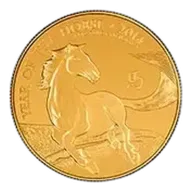
| 2014 | Horse | Wuon-Gean Ho |
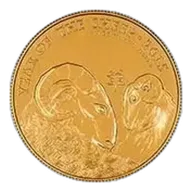
| 2015 | Sheep | Wuon-Gean Ho |
| 2016 | Monkey | Wuon-Gean Ho |
| 2017 | Rooster | Wuon-Gean Ho |
| 2018 | Dog | Harry Brockway |
| 2019 | Pig | Harry Brockway |
| 2020 | Rat | P.J. Lynch |
| 2021 | Ox | P.J. Lynch |
| 2022 | Tiger | David Lawrence |
| 2023 | Rabbit | Various |
| 2024 | Dragon | Various |
| 2025 | Snake | Various |
The 38.61 mm diameter is significantly larger than the standard 1 oz Gold Britannia at 32.69 mm, giving the annual zodiac animal designs more surface area. The 2.7 mm thickness is comparable to the Britannia's 3 mm. The larger diameter makes the coin physically distinctive in hand and in display, which aligns with its positioning as a collectible bullion product where visual impact matters alongside metal content.
The series also includes gold denominations at 1 kg (£1,000), 5 oz (£500), and 1/10 oz (£10), plus silver versions at 1 kg, 5 oz, 1 oz (£2), 1/4 oz, and 1/10 oz. A guilloche background pattern on the obverse was introduced with the series. The number 8, considered the luckiest number in Chinese culture, is deliberately incorporated into each coin's design or mintage. Obverse portraits: Ian Rank-Broadley (2014-2015), Jody Clark (2016-2023), Martin Jennings (2024 onwards).
Royal Mint Lunar Gold Coin Tax Treatment
The UK tax position is the series' defining competitive advantage.
- United Kingdom: CGT-exempt. All Royal Mint Lunar coins are UK legal tender, and sterling currency is not a chargeable asset for capital gains purposes. Gold is also VAT-free as investment gold. A UK investor selling Royal Mint Lunar gold coins at any profit pays zero CGT, while the same investor selling Perth Mint Lunar coins at the same profit would owe CGT above the annual £3,000 allowance at 18% or 24%.
- United States: The 999.9 purity exceeds the IRS 99.5% minimum for gold in a precious metals IRA. UK legal tender coins meeting purity requirements are generally IRA-eligible, though investors should confirm with their custodian. Capital gains taxed at the collectibles rate of up to 28%.
- European Union: VAT-exempt as investment gold under Directive 98/80/EC.
- Canada: GST/HST exempt for gold at 99.5% purity or higher. Meets purity requirements for RRSP eligibility through approved custodians.
- Australia: GST-free as investment-grade gold. CGT applies with a 50% discount for holdings over 12 months.
- Singapore: GST-exempt under the IPM scheme. No capital gains tax.
- Hong Kong: No sales tax, no import duty, no capital gains tax. Cultural appeal of zodiac coins in Asian markets adds to demand from this region.
The Shengxiao Collection: British Minting Meets Chinese Tradition
The Royal Mint Lunar series was the first official UK coin programme to draw on the Chinese zodiac. "Shengxiao" is the Chinese term for the zodiac cycle, and the name signals the Royal Mint's intent to bridge British minting heritage with one of the most ancient cultural traditions in the world. The series launched in 2014 with the Year of the Horse, the seventh animal in the zodiac cycle rather than the first (Rat). This was a pragmatic production decision rather than a cultural one.
Wuon-Gean Ho, the primary designer for the first four years, brought an unusual artistic background to the series. A British-Chinese printmaker specialising in wood engravings, she was not a conventional coin designer. Her style is evident in the rich, textured surfaces of the early coins, which have a hand-crafted quality distinct from the smoother, more polished aesthetic typical of bullion coins. The choice of a designer with genuine dual British-Chinese heritage reinforced the series' cultural positioning.
The 2021 discontinuation of bullion-grade releases marked a fundamental shift. From 2014 to 2020, buyers could acquire Royal Mint Lunar coins at standard bullion premiums. From 2021, only proof and brilliant uncirculated versions were available, carrying substantially higher premiums. The 2014 Horse silver bullion had 300,000 pieces; the 2023 Rabbit gold proof had just 388. This shift fragmented the secondary market: pre-2021 bullion coins became sought-after as the only route to bullion-grade Royal Mint Lunar gold.
The second zodiac cycle begins in 2026 with a new Year of the Horse design. It is not yet confirmed whether the Royal Mint will reinstate bullion-grade production for the new cycle or continue with proof and BU only.
Royal Mint Lunar vs Perth Mint Lunar and Other Zodiac Gold
The Perth Mint Lunar is the benchmark in this category. Series I began in 1996, Series II in 2008, and Series III in 2020. Perth offers a dramatically wider range of sizes (1/20 oz to 10 oz in gold, 1/2 oz to 10 kg in silver), higher production volumes, unbroken bullion-grade availability, and near-universal dealer recognition. In a straight comparison on liquidity, size range, and premium efficiency, Perth wins.
The Royal Mint Lunar's advantage is specifically tax-driven. UK buyers who want zodiac-themed gold that is CGT-exempt have exactly one option: the Royal Mint Lunar. Perth Mint coins, despite being 999.9 fine and sovereign-backed, attract UK CGT. On a 1 oz gold coin sold at a £500 profit, this difference could mean £90-120 in tax savings (at 18-24% above the allowance).
The RAM Lunar from the Royal Australian Mint is a newer entrant (2020), offering 999.9 gold at limited 5,000-coin mintages. It competes on scarcity and contemporary design but has no UK tax advantage. The RAM Lunar trades at lower premiums than both the Perth and Royal Mint versions, partly due to lower brand recognition.
Against the standard 1 oz Gold Britannia, the Royal Mint Lunar shares the same CGT exemption but lacks the Britannia's four visual security features and its deeper secondary market liquidity. The Britannia is the practical choice for investors prioritising resale ease; the Lunar appeals to those who value annual design changes and the zodiac theme, particularly buyers with cultural connections to the Chinese calendar.
1 oz The Royal Mint Lunar Gold Coin: frequently asked questions
-
The cheapest 1oz Royal Mint Lunar gold coin across the 2 dealers we track is currently £3,464.61 at Gold Bank. Prices vary between dealers, so comparing before you buy can save a meaningful amount on a coin at this price point.
-
The best available price of £3,464.61 represents a premium of around 6.4% over the £3,256.26 gold spot price. Royal Mint Lunar coins typically carry a higher premium than standard bullion coins because post-2020 issues are Brilliant Uncirculated or Proof quality only, rather than the lower-premium bullion finish available in earlier years.
-
The Royal Mint Lunar series, officially called the Shengxiao Collection, launched in 2014 and follows the 12-year Chinese zodiac cycle: Horse, Sheep, Monkey, Rooster, Dog, Pig, Rat, Ox, Tiger, Rabbit, Dragon, and Snake. A second cycle begins in 2026. The reverse design changes each year, with different artists commissioned across the series. From 2021, the Royal Mint moved to Brilliant Uncirculated and Proof editions only, replacing the earlier bullion-grade releases.
-
Yes. Royal Mint Lunar gold coins are struck in 999.9 fine gold, which is equivalent to 24 carat. This is the highest standard purity used in mainstream bullion coinage.
-
Tax treatment depends on where you are based. In the UK, Royal Mint Lunar coins are UK legal tender and are therefore exempt from Capital Gains Tax, unlike gold bars. In the US, precious metal gains are taxed as collectibles at up to 28% on long-term gains. In Canada, 50% of any capital gain is included in taxable income. Investment-grade gold is free of VAT in the UK and across the EU, though silver carries VAT in those markets.