 Summit Bullion




Prices are fetched automatically and may not reflect current merchant prices. Currency conversions and tax treatment are approximate. Rankings are based solely on price. We are not a dealer and accept no responsibility for transactions with listed merchants. Past performance is not indicative of future results. This site does not provide investment advice. Full disclaimer
About the 1 oz Engelhard Gold Bar
A Discontinued Classic from America's Historic Refiner
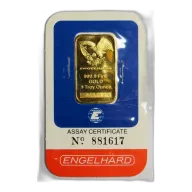
The 1 oz Engelhard Gold Bar is a product of Engelhard Corporation, once the world's largest precious metals smelter and refiner. Founded in 1902 by Charles W. Engelhard Sr. in Newark, New Jersey, the company grew to dominate the precious metals refining industry through the mid-20th century. Engelhard exited the retail bullion market in the late 1980s to focus on industrial catalysts, and BASF acquired the company in 2006 for US$5 billion. No new Engelhard bars have been produced since the mid-1980s, making every bar on the market today a secondary-market product with at least four decades of history behind it.
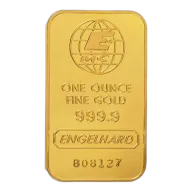
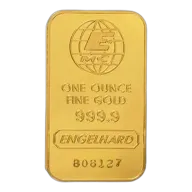
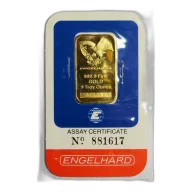
Engelhard gold bars are .999 fine (three nines), carrying the company's distinctive hallmarks, a unique serial number, and weight/purity stamps. Multiple design varieties exist across Engelhard's production history, including landscape and portrait orientations, various logo treatments (the early 'E' mark, the globe logo, and the final Eagle logo from 1986), and production variations from different facilities including the Canadian and Australian operations. This variety has created a collector market that layers on top of the bars' metal value.
The collector premium is the key distinction between an Engelhard gold bar and a currently produced alternative from PAMP Suisse or Valcambi. An Engelhard bar trades above the premium of a generic gold bar due to the brand's historical significance, the finite supply, and active collector demand. Charles Engelhard Jr. is widely cited as the inspiration for Ian Fleming's James Bond villain Auric Goldfinger, adding a cultural footnote that few bullion products can claim.
For investors focused purely on gold exposure at the lowest cost, a modern LBMA bar from an active refiner will be cheaper. For those who value provenance, historical significance, and the possibility of collector premium appreciation, the Engelhard bar offers something that no currently produced product can replicate.
Engelhard Gold Bar Varieties and Details
| Attribute | Detail |
|---|---|
| Weight | 1 troy oz (31.1035 g) |
| Purity | .999 fine gold (three nines) |
| Manufacturer | Engelhard Corporation (US) |
| Production Period | Late 1960s to mid-1980s |
| Face Value | None (bar format) |
| Serial Numbers | Unique, present on nearly all varieties |
| Production Status | Discontinued (BASF acquisition, 2006) |
Engelhard produced gold bars alongside their more extensively documented silver bar programme. Production methods included cast (poured) and pressed (minted) bars, with weight and purity remaining identical across methods. The external finish varies: cast bars have the rougher, organic surface characteristic of poured metal, while pressed bars have the smoother finish of die-struck production.
Authentication of Engelhard bars relies on serial number verification, font consistency with the production era, hallmark positioning, and edge finishing. The AllEngelhard.com community maintains comprehensive catalogues of Engelhard bar varieties for both gold and silver, serving as the standard reference for collectors and dealers verifying authenticity. Counterfeits exist, particularly for larger sizes, and buyers should purchase from established dealers or verify against known authentic examples.
Tax Treatment of Engelhard Gold Bars
As a .999 fine gold bar, the Engelhard bar qualifies for investment gold tax treatment in all major markets. The discontinued production status does not affect tax classification; the bar's purity and form are the determining factors.
United Kingdom
Gold bars at 995+ purity are VAT-exempt on purchase. The Engelhard bar qualifies at .999 fineness. Subject to CGT on disposal at the investor's marginal rate (18% or 24%), with the £3,000 annual allowance. Not CGT-exempt. Eligible for SIPP inclusion. The collector premium element of the bar's value is included in the CGT calculation, meaning gains above the original purchase price (including any collector premium paid) are taxable.
United States
Engelhard bars at .999 purity meet the IRA fineness requirement for gold (99.5%+). Engelhard's former LBMA accreditation and the bars' established provenance support IRA qualification, though acceptance depends on the specific custodian. Some dealers explicitly list Engelhard bars as IRA-eligible. Capital gains taxed at the collectibles rate of up to 28%. State sales tax exemptions apply in approximately 35 states.
Canada
GST/HST exempt at 99.5%+ purity. Capital gains taxed at a 50% inclusion rate.
Australia and New Zealand
GST-free at investment-grade purity. The .999 fineness exceeds the 99.5% threshold in both countries.
European Union
VAT-exempt as investment gold at 995+ fineness under Directive 98/80/EC.
Singapore and Hong Kong
GST-exempt in Singapore under the IPM scheme. No tax of any kind in Hong Kong.
Engelhard vs Modern LBMA Gold Bars
The choice between an Engelhard gold bar and a modern refiner bar comes down to a question of what you are paying for above the metal value. Modern bars offer lower premiums, current production backing, and tamper-evident assay packaging. Engelhard bars offer historical provenance, finite supply, and the potential for collector premium appreciation.
Against a 1 oz PAMP Fortuna bar, the Engelhard bar carries a higher purchase premium driven by collector demand rather than manufacturing or branding costs. PAMP bars benefit from current production, sealed CertiPAMP assay cards, Veriscan authentication technology, and the broadest global dealer network of any bar brand. For immediate resale liquidity, a PAMP bar is the stronger choice. For long-term holding with an eye to collector value, the Engelhard's finite supply makes the comparison more nuanced.
Compared to a 1 oz Valcambi bar or 1 oz Heraeus bar, the Engelhard bar is substantially more expensive per ounce of gold content. These modern bars sit at the cost-efficient end of the branded bar market, with the lowest premiums available for LBMA-accredited products. Buyers accumulating gold at the tightest spread will find no reason to pay the Engelhard collector premium.
The closest competitor in the discontinued-refiner category is Johnson Matthey (JM). JM was the other major US/UK refiner producing retail bars in the same era; its bullion arm was sold to Asahi Refining in 2015. Both brands trade above current production premiums on the secondary market. Engelhard bars generally command higher collector premiums than equivalent JM bars, driven by the greater variety of production types documented by the collector community and the Goldfinger cultural connection. For buyers drawn to vintage bullion, the Engelhard and JM bars are the two flagship products in the category.
1 oz Engelhard Gold Bar: frequently asked questions
-
The cheapest 1oz Engelhard bar on our comparison is $4,295.74 from Summit Bullion, roughly 0.9% over the $4,254.30 gold spot price. Prices were last updated recently. As a discontinued secondary-market product, Engelhard bars may carry a higher premium than comparable modern bars.
-
Engelhard Corporation ceased precious metals bar production years before its acquisition by BASF, after which the brand stopped producing bullion entirely. Every 1oz Engelhard bar available today is a vintage secondary-market piece, which contributes to the premium they command over spot.
-
Engelhard bars are no longer produced, so the total supply is fixed. Collectors and investors who value the refinery's historical reputation and distinctive assay hallmarks compete for a finite pool of bars. That collector demand sits alongside the underlying gold value, pushing premiums above what you would typically pay for an equivalent weight from a current producer.
-
Engelhard bars are sought after in secondary markets. Their appeal comes from the combination of 999.9 fineness, discontinued production, and recognisable hallmarks. They are not rare in the numismatic sense, but the fixed supply and enduring collector interest means they consistently trade at a premium over generic bullion.
-
Check the weight (31.10 g for 1 troy oz), dimensions, and the stamped fineness and serial number. Genuine Engelhard bars have a distinctive assay mark and consistent font and depth of stamp. For definitive confirmation, an XRF (X-ray fluorescence) test or ultrasonic thickness test performed by a reputable dealer or assay office is the most reliable method.