1 listing
Filters
| Product | /oz | Premium | Price | |
|---|---|---|---|---|

 Monument Metals
|
$4,701.61 | +10.17% | $302.32 | View Deal |
Prices are fetched automatically and may not reflect current merchant prices. Currency conversions and tax treatment are approximate. Rankings are based solely on price. We are not a dealer and accept no responsibility for transactions with listed merchants. Past performance is not indicative of future results. This site does not provide investment advice. Full disclaimer
About the 2g Kinebar Gold Bar
Banknote-Grade Security on 2 Grams of Gold
The 2g Kinebar is a gold bar with a Kinegram, a diffractive optically variable image device (DOVID), embossed directly into the gold surface. Produced by Argor-Heraeus SA in Mendrisio, Switzerland, the Kinebar was introduced in December 1993 through Union Bank of Switzerland (UBS) and first sold at retail in 1994. The name is a portmanteau of "Kinegram" and "bar," and the technology is manufactured by OVD Kinegram AG, a Swiss company that supplies the same diffractive security elements used on banknotes, passports, and government identity documents in countries worldwide.
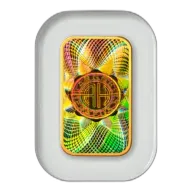
The critical distinction from other security-enhanced bars is that the Kinegram is not a sticker or applied hologram. It is embossed into the gold itself, created by sub-micron engravings (less than 0.0015 mm deep) in the bar's surface that reflect light in shifting colours and patterns when viewed from different angles. The optical effect is permanent and cannot wear off, peel away, or be transferred. It is part of the gold.
The 2g Kinebar contains 0.064 troy ounces of 999.9 fine gold. At 2026 gold prices, that represents approximately $215 in gold content. Premiums on bars this small are proportionally high across all brands, but the Kinebar's security premium is modest relative to competitors. The typical markup for the Kinegram feature is only $2-5 per ounce above a standard Argor-Heraeus bar, making it one of the cheapest security-enhanced gold products available at any weight.
Argor-Heraeus is one of Switzerland's four major precious metals refineries, processing approximately 400 tonnes of gold annually. The refinery holds LBMA Good Delivery and COMEX accreditation and is a subsidiary of the German Heraeus Group. All Kinebars are minted bars with smooth, polished finishes.
2g Kinebar Specifications
| Specification | Detail |
|---|---|
| Weight | 2 grams (0.064 troy ounces) |
| Purity | 999.9 fine gold (24 karat) |
| Manufacturer | Argor-Heraeus SA, Mendrisio, Switzerland |
| Format | Minted (struck) |
| Obverse | Argor-Heraeus logo, "Switzerland" origin, weight, purity, melter/assayer mark, serial number |
| Reverse | Kinegram holographic security element (full reverse coverage) |
| Edge | Smooth |
| Serialisation | Individually serial-numbered |
| Packaging | Tamper-evident blisterpack with assay card |
| Face value | None (not legal tender) |
| Accreditation | LBMA Good Delivery, COMEX |
Kinegram Security Technology
The Kinegram is a diffractive optical element created by engravings less than 0.0015 mm deep in the gold surface. These microscopic structures reflect light in ways that produce dynamic, shifting patterns and colours visible to the naked eye. The technology is described by OVD Kinegram AG as "exclusively provided to governments" for security applications; the Kinebar is an unusual commercial application of this government-grade technology. Because the Kinegram is created through physical surface topology rather than applied materials, it cannot be worn off, removed, or replicated using conventional means. The sub-micron engraving technology required to produce a genuine Kinegram is extremely difficult to duplicate.
Tax Position for the 2g Kinebar
The 2g Kinebar at 999.9 fineness from an LBMA-accredited refinery qualifies for investment gold tax treatment in all major markets.
United Kingdom
VAT-exempt as investment gold (995+ fineness). Subject to CGT on disposal, though at the typical value of a 2g bar, gains are very unlikely to trigger CGT liability in practice. Gold bars are not CGT-exempt; only UK legal tender coins like the Britannia and Sovereign carry that exemption.
United States
Argor-Heraeus is both LBMA and COMEX accredited, and the 999.9 purity exceeds the IRS minimum for self-directed IRA inclusion. The small bar size may present practical challenges for IRA custodians. Outside an IRA, gains are taxed at the collectibles rate of up to 28%. State sales tax varies, with roughly 35 states exempting bullion.
European Union and Switzerland
VAT-exempt across the EU under Directive 98/80/EC. In Switzerland (Argor-Heraeus's home market), investment gold carries no VAT. Germany exempts capital gains on gold after a 12-month holding period. The Kinebar is popular in the German gold market, where Argor-Heraeus's Heraeus Group parentage provides additional brand familiarity.
Canada
GST/HST-exempt on gold at 99.5%+ purity. RRSP-eligible when held through an approved custodian. Argor-Heraeus bars are available from Canadian dealers.
Australia, Singapore, and Hong Kong
Australia: GST-free on investment gold at 99.5%+ purity; subject to CGT on disposal. Singapore: GST-exempt under the Investment Precious Metals scheme; no capital gains tax. Hong Kong: no sales tax, no import duty, no CGT.
The Kinebar Since 1993
The Kinebar was introduced in December 1993 by Union Bank of Switzerland (UBS) through Argor-Heraeus, with retail sales beginning in 1994. The original launch included sizes from 1g to 1 oz. UBS owned Argor-Heraeus at the time, and the bank retains the Kinebar trademark to this day.
The concept was to apply government-grade security technology to an investment product. OVD Kinegram AG, the Swiss company behind the technology, had been supplying diffractive security elements for banknotes and official documents. Applying the same technology to a gold bar was a novel idea in 1993, and the Kinebar remains unique in that no other precious metals manufacturer uses Kinegram technology. The trademark exclusivity means the Kinebar cannot be replicated by competitors.
The original 1994 range (1g through 1 oz) covered the sizes most relevant to retail buyers. The 50g and 100g sizes were not added until 2012, eighteen years after launch. This gap suggests the smaller sizes (1g through 1 oz) are the primary market for the Kinebar concept, where the visual authentication feature adds the most relative value. At larger bar sizes, the per-ounce cost of the Kinegram becomes proportionally smaller, and buyers at those weights may prefer standard Argor-Heraeus bars or competing security approaches like PAMP's VeriScan.
The design layout has remained consistent since 1994. The obverse carries the Argor-Heraeus logo, weight, purity, and serial number. The reverse is dominated by the Kinegram pattern. There are no annual design changes; each size has a permanent, consistent appearance. The Kinegram pattern itself has been refined over the years as optical technology has advanced, but the format and layout are unchanged.
2g Kinebar vs Other Small Gold Bars
The 2g gold bar market is small and niche, with premiums running proportionally high across all brands. The Kinebar's distinguishing feature is its authentication technology, and the key question is whether that feature justifies any additional cost.
The 2g Credit Suisse Liberty is a direct competitor at the same weight. Both are manufactured in Switzerland, both are 999.9 fine, and both carry serial numbers with assay certification. The Credit Suisse bar features the Statue of Liberty design but has no holographic or digital authentication beyond its serial number. The Kinebar's Kinegram provides instant visual verification without equipment, which gives it a practical advantage for authentication. The Credit Suisse bar may appeal to buyers who prefer the Liberty design or who see collector value in the discontinued (post-UBS acquisition) Credit Suisse brand.
The 2.5g PAMP Suisse Fortuna is slightly heavier (2.5g vs 2g) and uses a fundamentally different authentication approach. PAMP's VeriScan scans the bar's microscopic surface topography against a database, requiring a smartphone app or scanner. The Kinebar's Kinegram is optically self-verifying, needing no equipment or database connection. For peer-to-peer transactions or situations where digital verification is impractical, the Kinebar has an edge. For buyers who prefer digital, database-backed verification, PAMP's VeriScan is more technologically comprehensive.
The premium for the Kinegram feature is modest. Argor-Heraeus typically charges only $2-5 per ounce above its standard (non-Kinegram) bars, making the Kinebar one of the least expensive security-enhanced gold products available. At the 2g size, this translates to a very small absolute premium for a genuinely useful authentication feature. For buyers seeking the cheapest 2g gold bar with no security enhancement, a standard Argor-Heraeus or generic LBMA bar will be the most cost-efficient choice.
2g Kinebar Gold Bar: frequently asked questions
-
The cheapest 2g Kinebar listed here is $302.32, around 10.2% over the $4,267.60 gold spot price. Small bars like the 2g carry a significantly higher fabrication premium per gram than larger sizes, because the minting and assay costs are spread over less metal.
-
A Kinebar is a minted gold bar produced by Argor-Heraeus in Switzerland that carries a Kinegram on its reverse. The Kinegram is a diffractive optical element embossed directly into the gold surface, not a sticker, producing shifting colours and patterns when tilted. The same technology secures banknotes and government documents. It allows instant visual authentication without any equipment.
-
The 2g Kinebar is a small minted bar weighing 2 g. At this weight it is a notably compact piece of gold, noticeably smaller than most other minted bars. It comes sealed in a blisterpack assay card, which adds to its handling size and helps protect the Kinegram surface and resale presentation.
-
Yes. Kinebars are typically supplied in a sealed tamper-evident blisterpack with an assay card showing the bar's weight, purity, metal content, and a matching serial number signed by an Argor-Heraeus certified assayer. The clear window allows the Kinegram to be viewed without opening the packaging, which is recommended to preserve resale value.