8 listings
Filters
| Product | /oz | Premium | Price | |
|---|---|---|---|---|

 Bullion Standard
|
$4,568.64 | +3.64% | $2,284.33 | View Deal |
 IDC Coin and Bullion
|
$4,689.28 | +6.38% | $2,344.65 | View Deal |
 Coins Online
|
$4,747.68 | +7.70% | $2,373.85 | View Deal |
 Golden Eagle Coins
|
$4,766.13 | +8.12% | $2,383.07 | View Deal |
|
20
BullionStar US
|
$4,808.50 | +9.08% | $2,404.26 | View Deal |
 Liberty Coin
|
$4,815.66 | +9.25% | $2,407.84 | View Deal |
| $4,828.35 | +9.53% | $2,414.17 | View Deal | |
 Golden Eagle Coins
|
$4,919.86 | +11.61% | $2,459.94 | View Deal |

Prices are fetched automatically and may not reflect current merchant prices. Currency conversions and tax treatment are approximate. Rankings are based solely on price. We are not a dealer and accept no responsibility for transactions with listed merchants. Past performance is not indicative of future results. This site does not provide investment advice. Full disclaimer
About the 1/2 oz Philharmonic Gold Coin
The 1/2 oz Gold Philharmonic
The 1/2 oz Gold Philharmonic from the Austrian Mint contains 15.552 grams of .9999 fine gold, matching the four-nines purity of the 1/2 oz Gold Maple Leaf and 1/2 oz Gold Britannia. First introduced in 1991, two years after the 1 oz debut, the half-ounce denomination was added alongside the 1/4 oz and 1/10 oz sizes to give European investors fractional access to the series.
The Philharmonic's market position among 1/2 oz gold coins rests on a combination of high purity and competitive pricing. It has historically carried among the lowest premiums of any major government-issued .9999 gold coin, particularly in European markets. The Austrian Mint's production volumes support this: between 1989 and 2012, it sold 14 million gold coins across all denominations, equivalent to roughly 329 tonnes of pure gold. The 1/2 oz denomination benefits from this deep production base through tighter bid-ask spreads and ready dealer availability across Europe.
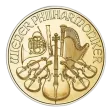
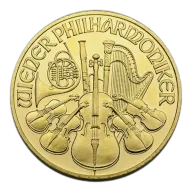
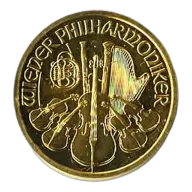
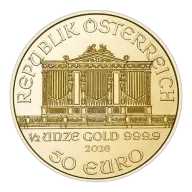
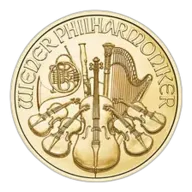
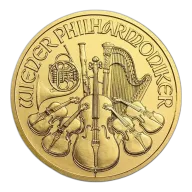
The coin's design celebrates the Vienna Philharmonic Orchestra, one of the world's most prestigious musical institutions. The obverse depicts the pipe organ of the Musikverein's Golden Hall in Vienna, built in 1870 and renowned for its acoustics. The reverse shows an ensemble of orchestral instruments, including a cello, four violins, a Vienna horn (specifically a Wiener Horn, distinct from a standard French horn), a bassoon, and a harp. Both sides were designed by Austrian Mint engraver Thomas Pesendorfer for the 1989 launch and have remained unchanged, with only the year-date and the 2002 switch from Austrian schilling to euro denominations as variations.
The EUR 50 face value makes the 1/2 oz Philharmonic legal tender in Austria, though not in other eurozone countries despite the euro denomination. This legal tender status qualifies it as VAT-exempt investment gold across the EU under Directive 98/80/EC. The coin lacks the advanced anti-counterfeiting features found on newer competitors; it relies on the complexity of its detailed instrument engraving and the Austrian Mint's sovereign guarantee rather than latent images, micro-text, or digital authentication systems.
1/2 oz Gold Philharmonic Dimensions and Details
| Specification | Value |
|---|---|
| Fine gold content | 15.552 g (1/2 troy oz) |
| Purity | .9999 (24 karat) |
| Diameter | 28.0 mm |
| Face value | EUR 50 (pre-2002: 1,000 Austrian schillings) |
| Edge | Reeded |
| Obverse | Pipe organ of the Musikverein Golden Hall |
| Reverse | Ensemble of Vienna Philharmonic instruments |
| Designer | Thomas Pesendorfer (1989) |
| Mint | Münze Österreich (Austrian Mint), Vienna |
| First year of issue | 1991 |
The 28 mm diameter sits between the 1/4 oz (22 mm) and 1 oz (37 mm) sizes, making it compact for storage while retaining enough visual area for the detailed instrument engraving on the reverse. The reeded edge is the coin's primary physical security feature, complemented by the precision of the Musikverein organ depiction and the finely rendered orchestral instruments on the reverse.
The Austrian Mint traces its lineage to 1194, when Duke Leopold V of Austria used 12 tonnes of silver from Richard the Lionheart's ransom to establish large-scale coin production in Vienna. This makes it one of the oldest continuously operating mints in the world. The Philharmonic was the gold coin series that first established the mint's modern reputation in the international bullion market, with the half-ounce denomination being part of the original 1991 fractional expansion alongside the 1/4 oz and 1/10 oz sizes.
The instruments depicted on the reverse include a cello at centre, flanked by four violins, with a Vienna horn (Wiener Horn), bassoon, and harp behind. The Vienna horn is a deliberate choice; it has a warmer, rounder tone than the standard French horn and is specifically associated with the Vienna Philharmonic Orchestra's historically informed performance practice.
Philharmonic Tax Treatment by Country
The 1/2 oz Gold Philharmonic qualifies as investment gold in every major bullion market, with the specifics varying by jurisdiction.
- Austria and the EU: VAT-exempt as an investment gold coin appearing on the EU's annual list of qualifying coins under Directive 98/80/EC. Silver Philharmonics are subject to local VAT rates, though some EU countries (notably Germany) apply the margin scheme (Differenzbesteuerung) for reduced effective taxation on silver coins. The Philharmonic is legal tender only in Austria.
- United Kingdom: Gold Philharmonics are VAT-exempt as recognised investment gold. They are not CGT-exempt because they are not UK legal tender. UK investors seeking CGT exemption at this weight should consider the 1/2 oz Gold Britannia, which is exempt as sterling legal tender. The current annual CGT allowance is £3,000.
- United States: IRA-eligible, as the .9999 purity exceeds the IRS minimum of .995 for gold in self-directed retirement accounts. Capital gains are taxed at the collectibles rate of up to 28%. State sales tax varies; roughly 35 states exempt bullion purchases.
- Canada: GST/HST-exempt at .9999 purity (exceeds the 99.5% threshold). Capital gains are taxed at the 50% inclusion rate. The Philharmonic is not eligible for RRSP accounts, as it is not issued by a Canadian mint.
- Australia: GST-free as investment-grade gold meeting the 99.5% purity threshold. Capital gains tax applies on disposal, with a 50% discount for holdings over 12 months.
- Singapore: GST-exempt under the Investment Precious Metals scheme for gold at 99.5%+ purity. No capital gains tax.
- Hong Kong: No sales tax, import duty, or capital gains tax on gold.
1/2 oz Philharmonic vs Maple Leaf, Britannia, and Krugerrand
At .9999 purity, the 1/2 oz Philharmonic competes directly with other four-nines half-ounce gold coins. The differences come down to premiums, security features, tax treatment, and secondary market depth.
The 1/2 oz Gold Maple Leaf matches the Philharmonic on purity at .9999. The Maple Leaf's advantage lies in its security technology: the Bullion DNA system allows individual coin-level digital authentication through an encrypted database, and MintShield (on silver) addresses tarnishing concerns. The Philharmonic has no comparable verification system. In North American markets, the Maple Leaf is more widely available and carries stronger dealer recognition. In European markets, particularly Austria and Germany, the Philharmonic benefits from being the local product.
The 1/2 oz Gold Britannia also matches .9999 purity and carries four visual security features from 2021 onwards: a latent image that shifts between a padlock and a trident, surface animation created with picosecond lasers, micro-text reading DECUS ET TUTAMEN, and heraldic tincture lines on Britannia's shield. For UK taxpayers, the Britannia's decisive advantage is CGT exemption as UK legal tender. The Philharmonic cannot match this. In pure premium terms, the Philharmonic often trades slightly below the Britannia in European markets.
The 1/2 oz Gold Krugerrand takes a fundamentally different approach. At .9167 purity (22 karat), its copper alloy produces a distinctive orange-gold colour and greater scratch resistance, but the coin still contains exactly 1/2 troy oz of fine gold with a heavier total weight of 16.965 g. The Krugerrand typically has the lowest premiums of any major half-ounce sovereign coin due to its massive cumulative production volume. Buyers who prioritise gold content per unit spent, with minimal premium overhead, will find the Krugerrand difficult to beat. Buyers who prefer four-nines purity, a face value, and European mint provenance will lean toward the Philharmonic.
The Philharmonic's cultural distinction matters for a certain buyer profile. The coin celebrates one of the world's great orchestras, and its detailed instrument engraving gives it an aesthetic character that differs from the national symbols (eagles, maple leaves, kangaroos) found on competing coins. For buyers who view their bullion as both an investment and an object worth looking at, this carries weight.
1/2 oz Philharmonic Gold Coin: frequently asked questions
-
The cheapest 1/2 oz gold Philharmonic on BullionFerret is $2,284.33. The coin contains half a troy ounce of 999.9 fine gold, so its metal value moves with the gold spot price at $4,408.10. The buy price will include a dealer premium above that spot value.
-
Dealers are currently charging 3.6% over spot for the 1/2 oz gold Philharmonic, with Bullion Standard offering the lowest available price on BullionFerret. Premiums on fractional coins like this half-ounce size are typically higher than on the full 1 oz coin, reflecting fixed production costs spread over less gold.
-
The gold Philharmonic is struck in 999.9 fine gold (24 carat). This meets the purity threshold for gold IRA inclusion in the US and qualifies as investment gold for VAT exemption under EU and UK rules.
-
The Philharmonic is produced by Austrian Mint (Münze Österreich), which has roots in Viennese coin production stretching back to the twelfth century. It has been issued annually since 1989, is denominated in euros, and is legal tender in Austria at a face value of €50 for the 1/2 oz size. The coin's consistent 999.9 fine purity and government backing give it broad recognition across European and global bullion markets.
-
BullionFerret currently tracks 7 dealers listing the 1/2 oz gold Philharmonic, covering 8 individual listings. Comparing across dealers on this page lets you see live prices and premiums side by side so you can find the best deal available right now.