39 listings
Filters
| Product | /oz | Premium | Price | |
|---|---|---|---|---|

 Camino Coin Company
|
$4,413.22 | +0.12% | $4,413.22 | View Deal |
 NYC Bullion
|
$4,425.39 | +0.39% | $4,425.39 | View Deal |
 Golden Eagle Coins
|
$4,452.75 | +1.01% | $4,452.75 | View Deal |
|
AN
Pacific Precious Metals
|
$4,455.75 | +1.08% | $4,455.75 | View Deal |
 Bullion Standard
|
$4,457.92 | +1.13% | $4,457.92 | View Deal |
 CGS Coins
|
$4,463.33 | +1.25% | $4,463.33 | View Deal |
 Copper State Coin
|
$4,468.85 | +1.38% | $4,468.85 | View Deal |
 IDC Coin and Bullion
|
$4,470.21 | +1.41% | $4,470.21 | View Deal |
 AU Capital Management
|
$4,482.38 | +1.69% | $4,482.38 | View Deal |
 Golden Eagle Coins
|
$4,482.75 | +1.69% | $4,482.75 | View Deal |
|
1
|
$4,487.12 | +1.79% | $4,487.12 | View Deal |
| $4,489.16 | +1.84% | $4,489.16 | View Deal | |
 Leif's Coins
|
$4,493.92 | +1.95% | $4,493.92 | View Deal |
 Golden Eagle Coins
|
$4,501.75 | +2.12% | $4,501.75 | View Deal |
 Golden Eagle Coins
|
$4,501.75 | +2.12% | $4,501.75 | View Deal |
 Coins Online
|
$4,511.81 | +2.35% | $4,511.81 | View Deal |
 Golden Eagle Coins
|
$4,517.75 | +2.49% | $4,517.75 | View Deal |
 Golden Eagle Coins
|
$4,517.75 | +2.49% | $4,517.75 | View Deal |
 Golden Eagle Coins
|
$4,517.75 | +2.49% | $4,517.75 | View Deal |
 Bullion Express
|
$4,518.91 | +2.51% | $4,518.91 | View Deal |
 Golden Eagle Coins
|
$4,537.75 | +2.94% | $4,537.75 | View Deal |
 Golden Eagle Coins
|
$4,537.75 | +2.94% | $4,537.75 | View Deal |
 Golden Eagle Coins
|
$4,542.75 | +3.05% | $4,542.75 | View Deal |
 Golden Eagle Coins
|
$4,567.75 | +3.62% | $4,567.75 | View Deal |
 Golden Eagle Coins
|
$4,567.75 | +3.62% | $4,567.75 | View Deal |
 Golden Eagle Coins
|
$4,567.75 | +3.62% | $4,567.75 | View Deal |
| $4,582.20 | +3.95% | $4,582.20 | View Deal | |
 Golden Eagle Coins
|
$4,592.75 | +4.19% | $4,592.75 | View Deal |
 Golden Eagle Coins
|
$4,601.41 | +4.39% | $4,601.41 | View Deal |
 Golden Eagle Coins
|
$4,617.75 | +4.76% | $4,617.75 | View Deal |


Prices are fetched automatically and may not reflect current merchant prices. Currency conversions and tax treatment are approximate. Rankings are based solely on price. We are not a dealer and accept no responsibility for transactions with listed merchants. Past performance is not indicative of future results. This site does not provide investment advice. Full disclaimer
About the 1 oz South African Mint Krugerrand Gold Coin
The Original 1oz Gold Bullion Coin
The 1 oz gold Krugerrand is the coin that created the modern bullion market. First struck in 1967, it was the world's first gold coin designed specifically for investment, and every major sovereign bullion coin since, from the Maple Leaf to the Britannia, was launched in response to its success. More than 60 million Krugerrands have been produced across all sizes, making it the most widely held gold bullion coin in the world by cumulative volume.
That production history translates directly into the Krugerrand's main practical advantage: the lowest premiums over spot of any major 1oz gold coin. The enormous existing supply and a deep, established secondary market mean dealers price it keenly in both directions, and every dealer worldwide buys and sells it without additional verification.
The coin is struck in 22-karat gold (91.67% fine) with a copper alloy that gives it a distinctive warm orange colour and makes it noticeably harder and more scratch-resistant than .999 coins. Each coin still contains exactly one troy ounce of fine gold; the copper simply brings the total weight up to 33.93 grams. For buyers who handle their coins rather than leaving them sealed in capsules, that durability matters.
The trade-offs are specific. The Krugerrand carries no modern anti-counterfeiting features, unlike the radial lines and micro-engraving on the 1oz gold Maple Leaf, and because it is South African rather than UK legal tender, it is not exempt from Capital Gains Tax for UK sellers. Buyers in the UK weighing the Krugerrand's lower purchase price against the CGT exemption on a 1oz gold Britannia should think about expected holding size; gains above the annual allowance are taxable on the Krugerrand but not on the Britannia. For most other markets, the Krugerrand's combination of rock-bottom premiums, universal recognition and physical toughness is hard to argue with.
1oz Gold Krugerrand Specifications
The 1 oz Krugerrand contains a full troy ounce (31.103g) of fine gold in a 22-karat alloy. The balance of the coin's 33.93g total weight is copper, added for hardness.
| Specification | Value |
|---|---|
| Fine gold content | 31.103 g (1 troy oz) |
| Total weight | 33.93 g |
| Purity | .9167 (22 karat) |
| Alloy | 8.33% copper |
| Diameter | 32.77 mm |
| Thickness | 2.84 mm |
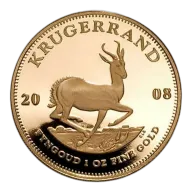
| Edge | Reeded, 180 serrations (220 on proofs) |
| Face value | None (legal tender at gold value) |
| First issued | 1967 |
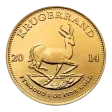
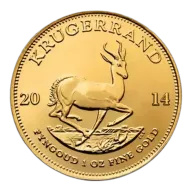
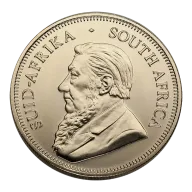
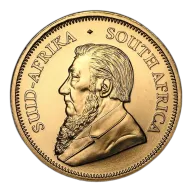
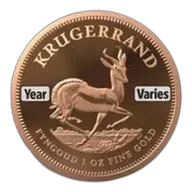
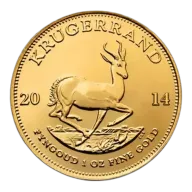
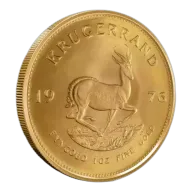
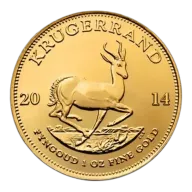
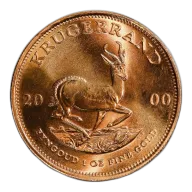
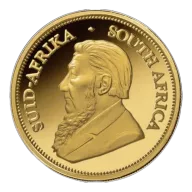
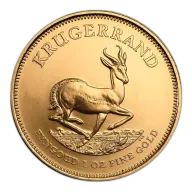
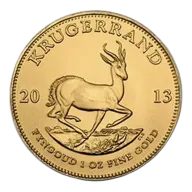
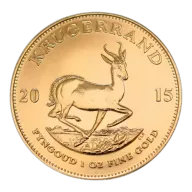
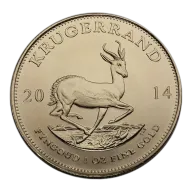
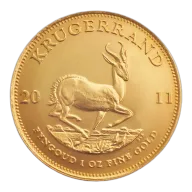
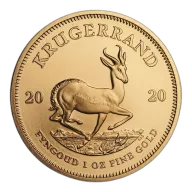
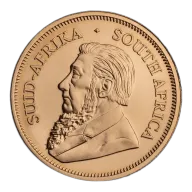
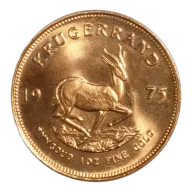
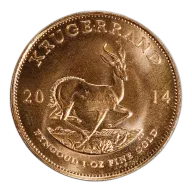
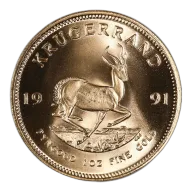
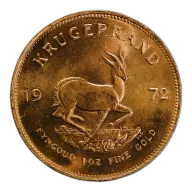
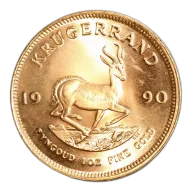
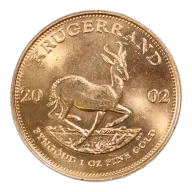
Unusually among bullion coins, the gold Krugerrand carries no face value. It is legal tender in South Africa at the value of its gold content, an arrangement similar to the British Sovereign. The obverse shows Paul Kruger's portrait by Otto Schultz; the reverse carries Coert Steynberg's springbok with the fine gold weight inscribed below. The different serration counts on bullion and proof strikes (180 versus 220) are one of the quickest ways to distinguish the two grades. Fractional Krugerrands at 1/2 oz, 1/4 oz and 1/10 oz were added in 1980 and share the same 22-karat composition.
Krugerrand Tax Treatment by Country
The gold Krugerrand qualifies as investment gold in most major jurisdictions, but its 22-karat purity and foreign legal tender status produce some important country-specific wrinkles.
- UK: VAT-free as investment gold. However, the Krugerrand is not CGT-exempt; only UK legal tender coins such as Britannias and Sovereigns escape Capital Gains Tax. Gains above the annual allowance (currently £3,000) are taxable at 18% or 24%. This is the single most important consideration for UK buyers comparing the Krugerrand with the Britannia.
- USA: No federal sales tax; most states exempt bullion, with some applying thresholds or taxing it. The Krugerrand is specifically approved as IRA-eligible. Long-term gains are taxed at the collectibles rate of up to 28%.
- Canada: GST/HST-exempt. The exemption tests the precious metal content, so the Krugerrand's full troy ounce of fine gold qualifies even though the coin itself is a 22-karat alloy.
- EU: Listed on the EU's annual register of qualifying investment gold coins, so 0% VAT across member states.
- Australia: GST-free as investment-grade gold.
- New Zealand: The exception. NZ's GST exemption requires gold of at least 99.5% purity, so 22-karat coins like the Krugerrand attract the full 15% GST. NZ buyers are better served by .9999 coins such as the 1oz gold Kangaroo.
- South Africa: Gold Krugerrands have been zero-rated for VAT since 1995. CGT applies on disposal, with 40% of the gain included in an individual's taxable income.
From 1967 to the World's Most Held Gold Coin
The Krugerrand was first struck on 3 July 1967, with an initial run of 40,000 bullion coins plus 10,000 proofs. The concept was new: a legal tender gold coin priced on its metal content and produced in unlimited quantities for investors rather than collectors. It arrived at a time when private gold ownership was still restricted in several Western countries (the US ban ran from 1933 to 1974), and it was marketed aggressively as the practical way for individuals to own gold.
The strategy worked emphatically. By 1980, the year fractional 1/2, 1/4 and 1/10 oz sizes were introduced, the Krugerrand accounted for more than 90% of the global gold coin market. The name combines Paul Kruger, president of the old South African Republic and the face on the obverse, with the rand, South Africa's currency unit.
Politics then reshaped the market the Krugerrand had built. Anti-apartheid sanctions, including a US import ban enacted in 1985 and lifted in 1991, opened the door for competitors. Canada had already launched the Maple Leaf in 1979 specifically to capture Krugerrand buyers worried about South African sanctions, and the American Eagle (1986) and Britannia (1987) followed during the ban years.
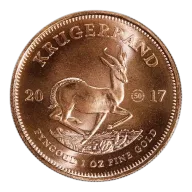
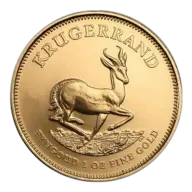
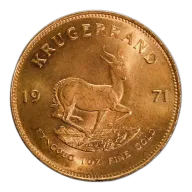
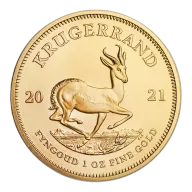
The design has barely changed in nearly six decades. Otto Schultz's Kruger portrait and Coert Steynberg's leaping springbok have appeared on every Krugerrand since 1967, making it one of the most stable designs in bullion coinage. By 2017, the coin's 50th anniversary, more than 53 million troy ounces of gold had been sold across over 60 million individual coins. That anniversary also brought the first silver Krugerrand and platinum Krugerrands, the first coins in the family to carry face values.
Krugerrand vs Britannia, Maple Leaf and Eagle
Against the Britannia, the choice mostly comes down to tax residency. The Britannia is .9999 gold with advanced laser-etched security features, and as UK legal tender it is CGT-exempt for UK sellers. The Krugerrand is cheaper to buy but its gains are taxable in the UK. For UK investors expecting meaningful gains, the Britannia's exemption often outweighs the Krugerrand's lower purchase price; outside the UK that advantage disappears and the Krugerrand's premium advantage stands.
The Canadian Maple Leaf is the security-feature counterpoint. It is .9999 fine with radial lines and micro-engraved anti-counterfeiting marks, while the Krugerrand relies on its reeded edge, high-relief design and well-documented weight and dimensions. The flip side is physical: the Maple's pure gold is soft and marks easily, whereas the Krugerrand's copper alloy makes it the more durable coin to handle. Both historically sit among the lowest-premium major 1oz coins.
The American Gold Eagle is the closest structural match: also 22-karat with a full ounce of fine gold, though alloyed with silver and copper rather than copper alone, and carrying a $50 face value where the Krugerrand has none. Both are IRA-eligible. The Eagle dominates its home US market and typically commands a slightly higher premium on the back of that demand; the Krugerrand is the more international coin.
One caution applies everywhere: precisely because it is so common, the Krugerrand is among the most counterfeited gold coins. Its tight, well-published weight and dimension tolerances are the primary authentication check, and buying from established dealers matters more than with lower-volume coins. Buyers who want fractional flexibility in the same series can pair the 1oz coin with the 1/4 oz Krugerrand.
1 oz South African Mint Krugerrand Gold Coin: frequently asked questions
-
The cheapest 1 oz Gold Krugerrand we currently track is $4,413.22, about 0.1% over the $4,408.10 gold spot price, from Camino Coin Company. Krugerrand prices move closely with the gold spot price, since each coin contains exactly one troy ounce of fine gold.
-
No. The 1 oz Gold Krugerrand is 22-carat (916.7 fine), alloyed with copper for added durability and its distinctive warm colour. Despite the alloy, each coin contains exactly one troy ounce of fine gold; the total weight is 33.93g rather than 31.1g. By contrast, coins such as the Canadian Maple Leaf are .9999 fine (24-carat).
-
Yes, fully legal. Krugerrands were subject to international sanctions during the apartheid era, with the US banning imports in 1985 and other countries following. Those restrictions were lifted in the early 1990s (the UK ban ended in 1993), and Krugerrands are now freely bought, sold, and imported in all countries this site covers.
-
Standard bullion Krugerrands of any year trade at roughly the same value, based on their gold content. Proof editions and special-anniversary releases (such as first-year 1967 coins and 50th-anniversary 2017 proofs) can attract numismatic premiums above the gold melt value, but those are collector pieces outside the scope of generic bullion comparison.
-
Krugerrands are South African legal tender, not UK legal tender, so they do not qualify for the CGT exemption that applies to UK coins such as Britannias and Sovereigns. UK sellers pay CGT at 18% or 24% on gains above the £3,000 annual allowance. US investors face a collectibles rate of up to 28%; in Canada, 50% of any gain is included in taxable income.