 Monument Metals


Prices are fetched automatically and may not reflect current merchant prices. Currency conversions and tax treatment are approximate. Rankings are based solely on price. We are not a dealer and accept no responsibility for transactions with listed merchants. Past performance is not indicative of future results. This site does not provide investment advice. Full disclaimer
About the 100 oz Dillon Gage Silver Bar
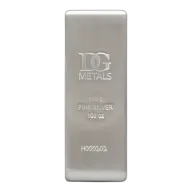
The 100 oz Dillon Gage Silver Bar
This bar contains 100 troy ounces (3,110.35 g, about 3.11 kg) of .999 fine silver. The 100 oz format is the traditional large bar of the North American silver trade, and it exists for one reason: premium efficiency. The fixed costs of manufacturing, assaying, and packaging are spread across a hundred ounces, compressing premiums to roughly 2 to 4 percent over spot, the lowest per-ounce premium of any standard retail silver bar size. By comparison, 1 oz bars often run 5 to 10 percent and 10 oz silver bars run roughly 3 to 5 percent.
The trade-off is indivisibility. A 100 oz bar sells as a single unit to a single buyer; there is no parcelling out the way a stack of coins allows. Dealers also typically weigh, measure, or assay secondary-market bars at this size before buying, an extra step that coins with known specifications avoid. For accumulators building positions of several hundred ounces, the premium savings outweigh those frictions; for occasional buyers or anyone likely to sell incrementally, smaller units fit better.
Physically, a 100 oz bar is compact for its value, roughly 140 x 80 x 25 mm depending on the maker, with a footprint comparable to a large smartphone but weighing close to 7 lbs. Bars at this weight ship individually, sometimes in protective sleeves or sealed packaging rather than tubes, and rectangular bars stack neatly in a safe, though multiples add weight quickly.
Tax Treatment of 100 oz Silver Bars by Country
Silver bars follow standard silver bullion tax rules; there is no legal tender status and no investment-gold style exemption in VAT countries.
- USA: The primary market for this format. No federal sales tax, and most states exempt bullion; in threshold states (California $2,000, New York and Massachusetts $1,000, Florida $500) a 100 oz bar comfortably clears the line. Long-term gains are taxed at the collectibles rate of up to 28%. Bars meeting the IRS .999 fineness requirement from accredited or ISO 9001 refiners are IRA-eligible.
- Canada: GST/HST exempt under the federal exemption for silver refined to 99.9% or higher in bar form. Capital gains taxed at the 50% inclusion rate. The 100 oz weight is a standard trade unit in the Canadian market as well.
- UK: 20% VAT on purchase and no CGT exemption. At this size the VAT hit is substantial in absolute terms, which is part of why the format is uncommon among UK retail buyers unless bars are held in bonded storage.
- EU: Full local VAT on new silver bars, 17% to 27% depending on country; European buyers generally favour metric kilo bars regardless.
- Australia: GST-free at 99.9% silver purity as investment-grade bullion; CGT applies with a 50% discount after 12 months.
- New Zealand: GST-exempt at 99.9% purity; no formal capital gains tax.
- Singapore and Hong Kong: No GST on qualifying investment silver in Singapore, no sales tax in Hong Kong, and no capital gains tax in either.
100 oz Bars vs Kilo Bars and Branded Alternatives
Within the 100 oz weight class, brand drives resale. Royal Canadian Mint bars are the government-mint benchmark at .9999 fine, serialised and LBMA Good Delivery listed, and command the tightest spreads. Discontinued Johnson Matthey and Engelhard bars trade with a collector premium on the secondary market, while Asahi, successor to Johnson Matthey's refining business, continues production. Bars from lesser-known producers price closer to generic and may face wider buyback discounts, with dealer buyback spreads for recognised brands typically running 1 to 3 percent below spot.
The closest size rival is the 1 kilo silver bar at 32.15 oz, roughly a third of the weight. Premiums between the two are similar, so the choice is mostly regional convention and transaction size: the 100 oz bar is the standard large format in North America, while kilo and metric bars dominate in Europe and Asia. Three kilo bars give nearly the same metal as one 100 oz bar with two extra chances to sell in parts.
Stepping further down, 10 oz bars give up roughly a point or two of premium in exchange for far easier incremental selling, and remain the most popular silver bar size overall. The 100 oz bar wins on pure cost per ounce; everything else about it is a concentration trade. Buyers who expect to exit in one transaction get the best deal in retail silver, while those who value flexibility pay slightly more for smaller units.
100 oz Dillon Gage Silver Bar: frequently asked questions
-
The cheapest 100 oz Dillon Gage silver bar we track is priced at $6,342.00, reflecting 100 oz of .999 fine silver at a spot price of $62.22. Prices move with the silver market, so check the comparison table for the current live figure.
-
Dillon Gage is a precious metals wholesaler and distributor that produces silver bars to .999 fine standard. Their bars are sold through specialist bullion dealers rather than directly to the public. The 100 oz size is a practical choice for investors wanting significant silver exposure in a single piece.
-
The current premium on the cheapest 100 oz Dillon Gage silver bar we track is around 1.9%, with the best price at $6,342.00 against a spot price of $62.22. Large 100 oz bars typically carry a lower percentage premium per ounce than smaller silver bars, making them cost-efficient for bulk silver purchases.