 Summit Bullion




Prices are fetched automatically and may not reflect current merchant prices. Currency conversions and tax treatment are approximate. Rankings are based solely on price. We are not a dealer and accept no responsibility for transactions with listed merchants. Past performance is not indicative of future results. This site does not provide investment advice. Full disclaimer
About the 10 oz Engelhard Silver Bar
A Collector-Premium Silver Bar from a Discontinued Refiner
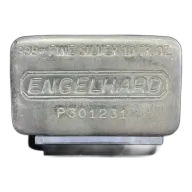
The 10 oz Engelhard silver bar is a .999 fine product from one of the most historically significant precious metals refiners in the world. Engelhard ceased retail bullion production in the mid-1980s and was acquired by BASF in 2006 for US$5 billion. No new bars have been produced since, making every surviving Engelhard bar a collector item that trades at a premium above its silver content.
Charles W. Engelhard Sr. founded the company in 1902 in Newark, New Jersey, and by the 1950s it had grown to become the world's largest precious metals smelter. Retail silver bar production ran from the late 1960s through approximately 1986, spanning the Hunt Brothers silver price spike of 1979-1980. A significant number of bars were melted during that spike when silver hit approximately $50/oz, making survivors rarer than the original production runs suggest.
The 10 oz size falls between the extremely collected 1 oz bars (over 40 documented varieties) and the institutional-scale 100 oz bars. At 19 active dealers, this is one of the most widely available Engelhard products on the secondary market. For buyers, the Engelhard bar represents a different proposition from a standard 10 oz silver bar: you pay above spot for the historical provenance and brand recognition, betting that collector demand will sustain or grow the premium over time.
Engelhard 10 oz Silver Bar Details
| Attribute | Value |
|---|---|
| Weight | 10 troy ounces (311.035 g) |
| Purity | .999 fine silver |
| Manufacturer | Engelhard (Newark, New Jersey) |
| Production era | Late 1960s to mid-1980s |
| Status | Discontinued (company acquired by BASF in 2006) |
| Legal tender | No |
| Serial number | Nearly all bars carry a unique serial number |
Production Variants
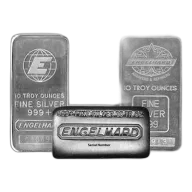
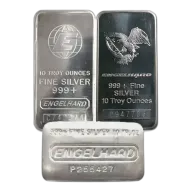
Engelhard produced bars using three methods: cast (poured into moulds), pressed, and extruded. The weight and purity are identical across methods; finish and appearance vary. Serial number formats evolved over the production years, with numerical-only sequences (5-6 digits) and letter-prefix systems (e.g. P, S, W, C prefixes for 100 oz bars). The 10 oz bars followed similar patterns to the broader range.
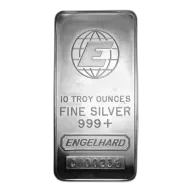
Unlike modern minted bars with consistent specifications, Engelhard bars vary in dimensions and profile across production eras. The AllEngelhard.com collector community maintains the definitive catalogue of varieties and is the standard reference for authentication. Genuine bars show consistent fonts and spacing for their specific production era, and the distinctive Engelhard hallmarks (the "E" mark and bull-and-bear logo for commercial bars) serve as primary identifiers.
Tax Treatment for Engelhard Silver Bars
Engelhard bars are .999 fine silver products from a private refiner. They carry no legal tender status. The standard silver bullion tax rules apply, with the additional consideration that any collector premium above melt value is part of the taxable gain or loss on disposal.
United States
Taxed as collectibles at up to 28% capital gains rate for long-term holdings. Short-term gains taxed as ordinary income. The .999 purity meets IRS Section 408(m) fineness requirements for silver in a self-directed IRA. Some dealers list Engelhard bars as IRA-eligible, though specific approval depends on the custodian. Sales tax is state-dependent, with approximately 35 states exempting investment-grade silver.
United Kingdom
Subject to 20% VAT on purchase. Not CGT-exempt (no legal tender status). In the UK, the collector premium paid on an Engelhard bar increases the cost basis but also increases the amount subject to VAT. The economics are unfavourable unless the buyer expects the collector premium itself to appreciate.
Canada
GST/HST exempt at 99.9% purity or above for silver in bar form. Coins with numismatic value above their metal content may face different treatment, but bars are straightforward. Capital gains subject to 50% inclusion rate.
EU
Standard VAT applies on silver bars in most EU jurisdictions. The margin scheme (Differenzbesteuerung in Germany) may apply to secondary-market bars, potentially reducing the effective VAT rate.
Australia, Singapore, Hong Kong
Australia exempts investment-grade silver at 99.9% purity from GST. Singapore exempts IPM silver at 99.9% purity from GST; no capital gains tax. Hong Kong has no sales tax or capital gains tax on bullion.
Engelhard: From Newark Smelter to Goldfinger's Namesake
The Engelhard story begins in 1902 when Charles W. Engelhard Sr. purchased the Charles F. Croselmire Company in Newark, New Jersey. He expanded through acquisitions: Baker & Co. (a platinum smelter) in 1904 and Hanovia Chemical and Manufacturing Company in 1905. His son, Charles Engelhard Jr., consolidated the family holdings into Engelhard Industries, Inc. in 1958 and listed the company on the New York Stock Exchange.
Charles Engelhard Jr. is widely cited as the inspiration for Ian Fleming's James Bond villain Auric Goldfinger. The connection was not coincidental: Engelhard Jr. was a prominent figure in the global gold trade, and his business practices in South African gold refining caught public attention during the era when Fleming was writing. The company processed gold for the US Treasury and was deeply involved in the refining of South African gold during the apartheid period.
Retail silver bar production peaked during the 1970s and early 1980s. The Hunt Brothers' attempt to corner the silver market in 1979-1980, which drove silver to approximately $50 per ounce before the COMEX changed its rules and the price collapsed, led to mass meltdowns of Engelhard bars. Owners sold their bars for scrap at those extraordinary prices, paradoxically increasing the long-term collector value of every bar that survived.
Engelhard exited the retail bullion market in the late 1980s to concentrate on industrial catalysts and specialty materials. BASF launched a hostile bid in 2006, acquiring the company for US$5 billion. Engelhard was renamed BASF Catalysts LLC on 1 August 2006. The retail bullion brand died, but the bars endure as some of the most collected precious metals products in the world. The AllEngelhard.com community maintains an exhaustive catalogue of every known variety, production era, and serial number format.
Engelhard vs Other 10 oz Silver Bars
The fundamental difference between an Engelhard bar and any currently produced 10 oz silver bar is that you pay a collector premium on an Engelhard. A standard 10 oz Asahi Refining bar or 10 oz RCM bar trades near spot plus a modest manufacturing premium. Engelhard bars typically carry an additional $5-20+ per ounce above spot for common varieties, with rare types commanding substantially more.
The closest historical parallel is the 10 oz Johnson Matthey bar. JM was the other major refiner producing retail silver bars in the same era, and both ceased retail production (JM's bullion arm was sold to Asahi in 2015). Engelhard bars generally command higher collector premiums than equivalent JM bars due to the greater variety of documented types and the Goldfinger cultural connection. Both are .999 fine with serial numbers, and both benefit from the finite-supply dynamic of a discontinued product.
Against modern LBMA-accredited bars from PAMP Suisse or Geiger Edelmetalle, the Engelhard offers historical provenance rather than contemporary security features. PAMP has VeriScan authentication; Geiger has UV-reactive coatings and reeded edges. The Engelhard relies on serial number verification and era-specific hallmark details. For buyers focused on silver weight per dollar, the collector premium on Engelhard bars is an inefficiency. For those who view bullion as part collectible, the Engelhard's place in precious metals history justifies the markup.
10 oz Engelhard Silver Bar: frequently asked questions
-
The cheapest 10 oz Engelhard silver bar tracked here is $640.56 from Summit Bullion, currently 3.1% over the silver spot price. Because these are discontinued secondary-market bars, availability varies and dealer prices tend to run higher than comparable modern silver bars.
-
Engelhard no longer produces retail bullion bars, making its bars a finite secondary-market supply. The brand built a strong reputation during the silver boom years, and a collector community now tracks individual design varieties and production runs. That collector demand, combined with limited supply, pushes premiums above those of newly minted generic silver bars.
-
Engelhard ceased retail bullion bar production after exiting the precious metals market. The company was subsequently acquired by the German chemical group BASF, and the Engelhard brand no longer operates as an independent precious metals producer. No new investment bars have been produced since the business was wound down.
-
Genuine Engelhard 10 oz silver bars carry a clear ".999 Fine Silver" stamp alongside the Engelhard name and a serial number. Weight should match 10 troy ounces. For higher-value pieces, professional third-party grading and encapsulation by a recognised coin grading service can provide additional authentication and attribution.