 Bullion Standard





Prices are fetched automatically and may not reflect current merchant prices. Currency conversions and tax treatment are approximate. Rankings are based solely on price. We are not a dealer and accept no responsibility for transactions with listed merchants. Past performance is not indicative of future results. This site does not provide investment advice. Full disclaimer
About the 10 oz Engelhard Bar Silver Bar
The Engelhard Silver Bars Series at 10 Ounces
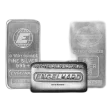
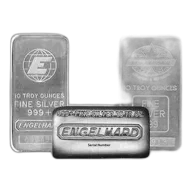
The 10 oz Engelhard Silver Bars series bar is a specific product line from the Engelhard range, distinct from the general Engelhard-branded bars that appear across multiple categorisations. All Engelhard silver bars are .999 fine and were produced at the company's Newark, New Jersey facility between the late 1960s and mid-1980s. No new production has occurred since Engelhard exited the retail bullion market and was subsequently acquired by BASF in 2006.
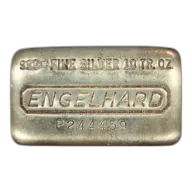
At 13 active dealers, this specific series listing reflects the strong secondary-market availability for Engelhard 10 oz bars. The 10 oz size balances collectibility with practical bullion value. Engelhard produced bars from 1 oz through 1,000 oz, but the 10 oz format is substantial enough to carry meaningful silver content while remaining accessible to individual collectors. Each bar carries a unique serial number, which serves as the primary authentication marker and connects to the extensive variety cataloguing maintained by the AllEngelhard.com collector community.
The collector premium on Engelhard bars is driven by finite supply. The Hunt Brothers' attempted silver corner in 1979-1980 drove silver to approximately $50/oz, prompting widespread meltdowns of Engelhard bars. Every bar that survived that period represents a diminishing stock that cannot be replenished. This premium sits on top of the silver content value, creating a dual value proposition: metal value plus collector scarcity.
Engelhard Silver Bars 10 oz Specifications
| Attribute | Value |
|---|---|
| Weight | 10 troy ounces (311.035 g) |
| Purity | .999 fine silver |
| Manufacturer | Engelhard (Newark, New Jersey) |
| Production period | Late 1960s to mid-1980s |
| Current status | Discontinued |
| Legal tender | No |
| Serial number | Yes (unique to each bar) |
Production Methods and Variants
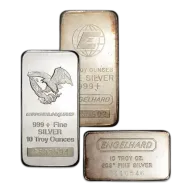
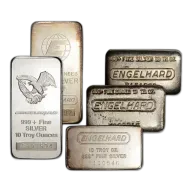
Engelhard produced silver bars using three distinct methods: cast (poured into moulds, producing a rougher, more organic finish), pressed, and extruded. All methods yield the same .999 purity and stated weight, but the surface texture, edge profiles, and overall dimensions vary between production methods and eras.
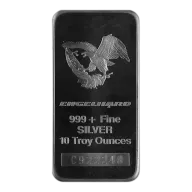
The Engelhard hallmark system evolved over the company's production history. Early bars (late 1960s) used minimalist elongated octagon hallmarks. The 1970s introduced the bull-and-bear commercial logo. The 1981-1986 era featured portrait-orientation bars with the distinctive "E" globe logo in various sizes and positions. The final 1986 production run used an Eagle logo design. Serial number formats progressed from numerical-only sequences to letter-prefix systems.
For verification, collectors reference the definitive variety guides on AllEngelhard.com, checking serial number format, font consistency, hallmark placement, and edge finishing against documented examples for each specific production era. Counterfeits typically fail on font details and edge quality.
Tax Considerations for Engelhard Silver Bars
Engelhard bars carry the same base tax treatment as any .999 silver bar, with the added consideration that the collector premium above melt value forms part of the cost basis and potential taxable gain.
United States
Capital gains taxed at the collectibles rate of up to 28% for holdings over one year. The .999 purity meets IRS fineness requirements for self-directed precious metals IRAs. Engelhard's historical reputation as a major US refiner supports IRA eligibility, though custodian approval is always required. Sales tax varies by state, with approximately 35 states exempting investment bullion.
United Kingdom
Silver bars carry 20% VAT on purchase. No CGT exemption (not UK legal tender). The collector premium inflates the VAT-inclusive acquisition cost, which compounds the unfavourable tax position for UK buyers of secondary-market silver bars.
EU
Silver bars attract standard VAT across EU member states. Germany's margin scheme (Differenzbesteuerung) may apply to secondary-market silver bars, potentially reducing the effective tax rate compared to full VAT on new products. This is relevant for Engelhard bars, which are by definition secondary-market products.
Canada, Australia, New Zealand
Canada exempts silver at 99.9% purity from GST/HST. Australia exempts investment-grade silver at 99.9% from GST. New Zealand exempts fine silver at 99.9% from GST. The .999 purity qualifies in all three jurisdictions.
Singapore and Hong Kong
Singapore's IPM exemption covers silver bars at 99.9% purity. Hong Kong has no sales tax or capital gains tax.
Engelhard Silver Bars vs Other Vintage and Modern 10 oz Bars
The primary comparison is with 10 oz Johnson Matthey bars, the other major discontinued refiner brand from the same production era. Both are .999 fine with serial numbers. JM exited retail bullion differently, selling its refining operations to Asahi in 2015 rather than ceasing bullion production decades earlier. Engelhard bars generally command a higher collector premium than JM equivalents due to the greater diversity of documented varieties (40+ for the 1 oz alone) and the cultural connection to the Goldfinger story. Charles Engelhard Jr. is widely cited as the inspiration for Ian Fleming's villain.
Against modern production from the same lineage, the 10 oz Asahi Refining bar is effectively the spiritual successor. Asahi acquired Johnson Matthey's refining operations and the Salt Lake City facility's LBMA accreditation. A modern Asahi bar trades near spot, offering .999 silver without any collector premium. The Engelhard's value proposition is the opposite: you pay above spot for a piece of bullion history that cannot be replicated.
Compared to premium contemporary bars like the 10 oz Geiger Original with its UV coatings, reeded edges, and security features, the Engelhard relies entirely on provenance rather than technology for its premium. The Geiger appeals to buyers who want modern security on their silver; the Engelhard appeals to those who value the tangible connection to a company that was once the world's largest precious metals smelter.
10 oz Engelhard Bar Silver Bar: frequently asked questions
-
The cheapest 10 oz Engelhard silver bar tracked here is $711.91, currently 5.3% over the silver spot price of $67.63. Because Engelhard bars are no longer produced, their price reflects both the silver content and a collector premium above melt value. Compare live offers from Bullion Standard and other dealers above.
-
Engelhard ceased retail silver bar production by the late 1980s and was absorbed by BASF in 2006, so no new bars enter the market. Demand comes from collectors drawn to the brand's historical significance and the variety of documented types. Many bars were melted during the 1979-1980 silver price spike, making survivors scarcer than total production figures suggest. That combination of fixed supply and collector demand pushes prices above melt value.
-
Engelhard bars are among the most counterfeited silver products. Key checks: verify the bar weighs 311 grams on a precision scale; test with a rare-earth magnet (silver is not magnetic); check font details and serial number format against the AllEngelhard.com catalogue for the specific variety. The distinctive hallmarks, edge finishing, and spacing of stampings are era-specific. When in doubt, an acid test or XRF analysis confirms silver content.
-
No. Engelhard exited the retail bullion market in the late 1980s to focus on industrial catalysts. BASF acquired the company in 2006 and renamed it BASF Catalysts LLC. All Engelhard silver bars on the market today are secondary-market pieces, typically changing hands through dealers, auctions, and private sales.
-
Nearly all Engelhard bars carry a unique serial number, though two known 1 oz varieties were made without one. For 100 oz bars, letter prefixes such as P, S, W, and C appear before the numeric digits and indicate production runs or series within the manufacturing period. The AllEngelhard.com catalogue documents the serial formats for each size and variety, making it the standard reference for verifying authenticity and identifying production era.