 Bullion Standard
5 listings
Filters





Prices are fetched automatically and may not reflect current merchant prices. Currency conversions and tax treatment are approximate. Rankings are based solely on price. We are not a dealer and accept no responsibility for transactions with listed merchants. Past performance is not indicative of future results. This site does not provide investment advice. Full disclaimer
About the 1 oz Johnson Matthey Silver Bar
A Legacy Refinery Bar That Still Commands Respect
The 1 oz Johnson Matthey Silver Bar carries 999 fine silver from one of the most historically significant refineries in the precious metals industry. Johnson Matthey's involvement with precious metals dates back to the 1850s, and the company was one of the original five members of the London Gold Fix when it began in 1919. Their bars carry a pedigree that few other refineries can match.
Johnson Matthey sold its gold and silver refining operations to Asahi Refining in 2015, making these bars a discontinued product. No new JM silver bars are being produced. Every 1 oz Johnson Matthey bar on the market today is secondary-market stock, which gives it a different character from actively minted products. The JM hallmark has become a marker of a specific era in refining history, and some buyers pay a modest premium above melt for that provenance.
For practical investment purposes, a JM bar contains exactly the same amount of silver as any other 1 oz 999 bar. The metal is the metal. The premium above melt that JM bars sometimes command reflects collector interest and brand nostalgia rather than any metallurgical advantage. Buyers whose sole concern is accumulating silver weight at the lowest cost may find better value in actively produced bars from Asahi Refining (which inherited JM's facilities) or other current manufacturers.
That said, Johnson Matthey bars remain highly liquid. Every dealer recognises the JM hallmark, and buyback is straightforward. The LBMA accreditation that JM held during its refining years means these bars meet the standard that underpins the global bullion trade.
1 oz Johnson Matthey Silver Bar Details
| Attribute | Detail |
|---|---|
| Weight | 1 troy ounce (31.1035 grams) |
| Purity | 999 fine silver |
| Manufacturer | Johnson Matthey (UK/Canada/US) |
| Status | Discontinued (sold to Asahi Refining, 2015) |
| LBMA Accredited | Yes (during production period) |
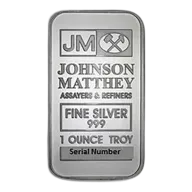
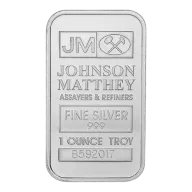
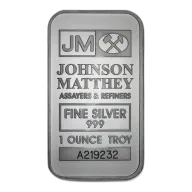
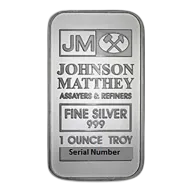
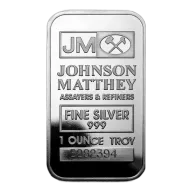
| Hallmark | JM logo with weight and purity stamps |
| Serial Number | Some bars individually serialised; varies by production run |
Johnson Matthey produced silver bars across a range of sizes during its active refining period, from 1 oz through to 100 oz and institutional formats. The 1 oz bar was one of the most widely distributed retail products. Variations exist in packaging and design across different production eras, which adds to the collector interest.
Tax Treatment for Johnson Matthey Silver Bars
The tax treatment of JM bars is identical to all other non-legal-tender silver bars. Being a discontinued product does not change the tax position in any jurisdiction.
- United Kingdom: 20% VAT on purchase. Not CGT-exempt. Silver bars carry the full VAT burden on entry with no relief on disposal gains. UK buyers seeking any CGT advantage on silver should look to legal tender coins such as the Silver Britannia.
- United States: No federal sales tax. State sales tax varies; most states exempt bullion. Capital gains at the 28% collectibles rate. JM bars meeting 999 purity from an LBMA-accredited source are accepted for precious metals IRAs by most custodians.
- Canada: GST/HST exempt at 99.9%+ purity. JM's Canadian refining heritage makes these bars particularly well-known among Canadian dealers.
- Australia: GST-free for investment-grade silver at 99.9% purity.
- Singapore: GST-exempt under the IPM scheme for 999 silver bars from LBMA-accredited refiners. No capital gains tax.
- Hong Kong: No sales tax, duties, or capital gains tax.
- South Africa: 15% VAT on all silver products.
From London Gold Fix Founder to Asahi Acquisition
Johnson Matthey was founded in London in 1817 as an assaying and refining firm. By the mid-19th century, it had established itself as one of the premier precious metals refiners in the world. The firm was one of the original five members of the London Gold Fix, the benchmark pricing mechanism established in 1919 at the offices of N M Rothschild and Sons. Being a Gold Fix member meant JM was among the institutions that set the global reference price for gold twice daily for nearly a century.
JM's refining operations expanded through the 20th century to include facilities in Canada and the United States. The company became an LBMA-accredited refiner, and its hallmark on a bar became a recognised mark of quality across global bullion markets. JM produced bars in gold, silver, platinum, and palladium across retail and institutional sizes.
In 2015, Johnson Matthey made the strategic decision to exit precious metals refining to focus on its automotive catalysts and speciality chemicals businesses. Asahi Holdings, a Japanese precious metals recycler and refiner, acquired JM's gold and silver refining operations in North America. The Salt Lake City and Brampton refineries continued operating under the Asahi Refining name, and Asahi obtained its own LBMA accreditation.
The exit from refining ended new production of JM-branded bullion bars, but the existing stock continues to circulate on the secondary market. Bars from certain production eras and with original packaging or assay certificates occasionally command premiums above the standard melt-plus-fabrication value. JM's Engelhard-era contemporaries (Engelhard ceased refining even earlier) have seen stronger collector premiums, partly because the Engelhard name triggers more aggressive nostalgia among American collectors.
Johnson Matthey vs Asahi, Engelhard, and Current Producers
The most natural comparison is with Asahi Refining bars, since Asahi acquired JM's refineries and continues production from the same facilities. Asahi bars are typically cheaper because they are actively produced with no scarcity premium. For pure investment purposes, an Asahi bar from the former JM facility delivers the same silver content at a lower cost.
Engelhard is the closest parallel as a legacy refinery brand. Engelhard bars generally command higher collector premiums than JM, particularly in the US market where Engelhard's name recognition among vintage bar collectors is stronger. Both brands are discontinued, and both trade above melt, but the Engelhard premium tends to be more pronounced.
Against current producers like Valcambi, PAMP Suisse, and Heraeus, JM bars lack the modern security features (Veriscan, serialised assay cards) that these refineries incorporate into their products. For buyers who want authentication technology built into the bar itself, a current-production Swiss or German refinery bar offers advantages that a vintage JM bar cannot. For buyers who value provenance and history, the JM hallmark carries weight that newer brands have not yet matched.
In terms of resale, JM bars are universally recognised and accepted by dealers worldwide. The LBMA accreditation that JM held during production ensures that any dealer familiar with the bullion market will buy back a JM bar at competitive rates. The collector premium on resale is modest but real, particularly for bars with original documentation.
1 oz Johnson Matthey Silver Bar: frequently asked questions
-
The cheapest 1oz Johnson Matthey silver bar tracked on this page is $71.77, available from Bullion Standard. That works out to around 6.1% over the $67.63 silver spot price. Because these bars are no longer in production, prices reflect secondary-market supply and may vary more than for currently minted bars.
-
No. Johnson Matthey sold its precious metals refining and fabrication business in 2015, ending production of its bullion bars. Any 1oz Johnson Matthey silver bar available today is pre-owned secondary-market stock from before that date.
-
Johnson Matthey bars carry a collector following because the brand exited production in 2015, making them a retired product. Certain older vintages, particularly those accompanied by an original assay card, can trade at a small premium above silver melt value. Most generic 1oz Johnson Matthey bars, however, trade close to spot, valued primarily for their silver content rather than as numismatic pieces.
-
Johnson Matthey bars carry a stamped serial number, but there is no public database for serial number lookups. The serial is useful as an authenticity indicator when combined with the bar's physical markings: the Johnson Matthey hallmark, the troy weight stamp, and the 999 fine silver stamp. For additional assurance, a reputable dealer or independent assay service can verify the bar.
-
Genuine .999 fine silver is non-magnetic: a strong magnet will slide slowly across the surface due to the Lenz effect rather than stick. Check the bar for the Johnson Matthey hallmark, the 1 troy oz weight marking, and the 999 fine silver stamp. Weigh and measure the bar against published specifications, and purchase from an established dealer to reduce counterfeit risk.