194 listings
Filters
| Product | /oz | Premium | Price | |
|---|---|---|---|---|

 SD Bullion
|
$84.74 | +37.43% | $84.74 | View Deal |
 SD Bullion
|
$84.90 | +37.43% | $84.90 | View Deal |
 SD Bullion
|
$84.90 | +37.43% | $84.90 | View Deal |
 Golden Eagle Coins
|
$85.06 | +37.58% | $85.06 | View Deal |
 Golden Eagle Coins
|
$85.06 | +37.58% | $85.06 | View Deal |
 Golden Eagle Coins
|
$85.06 | +37.58% | $85.06 | View Deal |
 Golden Eagle Coins
|
$85.17 | +37.64% | $85.17 | View Deal |
 SD Bullion
|
$85.04 | +37.66% | $85.04 | View Deal |
 Golden Eagle Coins
|
$85.21 | +37.70% | $85.21 | View Deal |
 Golden Eagle Coins
|
$85.21 | +37.70% | $85.21 | View Deal |
 SD Bullion
|
$85.08 | +37.73% | $85.08 | View Deal |
 SD Bullion
|
$86.08 | +39.34% | $86.08 | View Deal |
 Pinehurst Coins
|
$86.71 | +40.62% | $86.71 | View Deal |
 Golden Eagle Coins
|
$87.21 | +40.94% | $87.21 | View Deal |
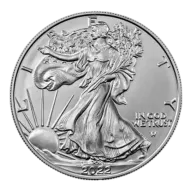
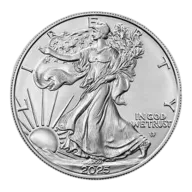
Prices are fetched automatically and may not reflect current merchant prices. Currency conversions and tax treatment are approximate. Rankings are based solely on price. We are not a dealer and accept no responsibility for transactions with listed merchants. Past performance is not indicative of future results. This site does not provide investment advice. Full disclaimer
About the 1 oz American Silver Eagle Silver Coin
The 1 oz American Silver Eagle
The American Silver Eagle is the official silver bullion coin of the United States, first struck on 29 October 1986 at the San Francisco Mint and released on 24 November that year. It is the world's most popular silver bullion coin by a wide margin, with cumulative production exceeding 673 million coins through 2024. One hundred and thirty-five dealers currently list it, more than any other silver coin on this site.
The programme originated from Senator James A. McClure's plan to convert Defense National Stockpile silver into coins rather than selling it in bulk, which would have depressed silver prices. The Liberty Coin Act of 1985 authorised the US Mint to produce the coin, and production has continued without interruption for nearly four decades. Annual mintage has ranged from 4.67 million (1995) to 47 million (2015), scaling with demand.
The Silver Eagle's combination of government-backed weight and purity guarantee, deep liquidity, IRA eligibility, and iconic design makes it the default choice for US-based silver investors. Its premiums are the highest of any standard sovereign silver coin, typically 20-30% above spot, but this cost is partially recouped at resale through the coin's consistently strong buyback demand. For buyers outside the United States, lower-premium alternatives like the 1 oz Canadian Maple Leaf or 1 oz Austrian Philharmonic offer more silver per dollar without the domestic US demand premium.
American Silver Eagle Specifications and Security
| Attribute | Value |
|---|---|
| Weight | 31.103 g (1 troy oz) |
| Diameter | 40.6 mm (1.598 in) |
| Thickness | 2.98 mm |
| Purity | .999 fine silver |
| Face value | $1 USD |
| Edge | Reeded (anti-counterfeiting notch from 2021) |
| Composition | Pure silver (not alloyed) |
The Type II redesign in 2021 introduced an anti-counterfeiting reed pattern on the edge: one reed is intentionally omitted, creating a small gap whose position changes annually. This was the first time the US Mint applied this technique to the Silver Eagle, and it allows year-specific authentication that was not possible with the original reeded edge. The position shifted between 2021, 2022, and 2023 issues.
Mint marks identify the production facility: P (Philadelphia), W (West Point), and S (San Francisco). West Point handles the majority of bullion production. San Francisco struck the very first Silver Eagles in 1986, and Philadelphia was pressed into emergency service in April 2020 when COVID-19 shutdowns at West Point forced a temporary production shift. Those 240,000 Philadelphia-struck coins from 8-20 April 2020 are certified as "Emergency Issues" and carry collector premiums.
Standard packaging is tubes of 20 coins and monster boxes of 500 (25 tubes of 20). A monster box weighs approximately 16 kg (35 lbs). The monster box is the wholesale unit for dealer-to-dealer transactions and typically commands the lowest per-coin premium.
American Silver Eagle Tax Treatment
The Silver Eagle is US legal tender at a face value of $1. Its tax treatment depends entirely on the buyer's jurisdiction.
- United States: IRA-eligible. The Silver Eagle meets the .999 purity threshold required by IRS Section 408(m) for precious metals in Individual Retirement Accounts. Within an IRA, gains are tax-deferred (Traditional) or tax-free (Roth). Outside retirement accounts, physical silver is classified as a collectible and taxed at a maximum 28% federal rate for long-term holdings (over one year). Short-term gains are taxed as ordinary income. The Net Investment Income Tax (3.8%) may apply on top. Silver Eagles have no 1099-B reporting trigger, unlike Gold Eagles which trigger reporting at 25+ coins per transaction. State sales tax varies: approximately 35 states exempt bullion, with threshold-based exemptions in California ($2,000), Florida ($500), Louisiana ($1,000), Massachusetts ($1,000), and New York ($1,000).
- United Kingdom: Subject to 20% VAT on purchase. Not CGT-exempt (not UK legal tender). The Silver Britannia is the tax-advantaged alternative for UK buyers, offering CGT exemption that the Silver Eagle lacks.
- Canada: GST/HST exempt at .999 purity. Not eligible for RRSP (not issued by a Canadian mint).
- Australia: GST-free as investment-grade silver at 99.9% purity. Subject to CGT with a 50% discount for holdings over 12 months.
- EU: Silver subject to local VAT rates. Margin scheme may reduce effective VAT on secondary market purchases in Germany, Netherlands, and Spain.
- Singapore: GST-exempt as Investment Precious Metal at 99.9%+ purity.
- Hong Kong: No sales tax, no import duty, no capital gains tax.
- New Zealand: GST-exempt for silver at 99.9%+ purity. No capital gains tax.
- South Africa: Subject to 15% VAT. No exemption for foreign silver coins.
From the Defense Stockpile to 673 Million Coins
The Silver Eagle programme grew out of a practical problem. The US Government held a large strategic silver stockpile under the Defense National Stockpile Act, and Congress needed a way to dispose of it without flooding the silver market and crashing prices. Senator James A. McClure of Idaho, a state with significant silver mining interests, championed the idea of converting the stockpile into retail bullion coins. The Liberty Coin Act of 1985 made it law.
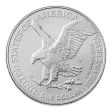
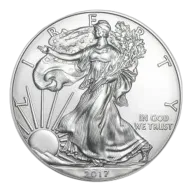
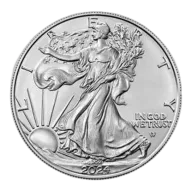
The coin's obverse uses Adolph A. Weinman's Walking Liberty design, originally created for the 1916-1947 half dollar. Weinman's Lady Liberty, striding toward the sun with the American flag draped across her shoulders, is one of the most celebrated coin designs in US numismatic history. The 2021 Type II enhancement restored Weinman's original "AW" artist mark, which had been omitted from the bullion coin for 35 years.
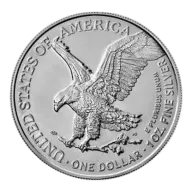
The original reverse, designed by John Mercanti (the 12th Chief Engraver of the US Mint), featured a heraldic eagle with shield, olive branch, and arrows. Mercanti's design appeared on every Silver Eagle from 1986 to 2021, making it the most reproduced coin image in history. The Type II reverse by Emily Damstra depicts a more naturalistic eagle landing on a branch, departing from the heraldic tradition.
Production has scaled dramatically with demand. The coin hit 47 million units in 2015, its all-time peak. During the 2008-2009 financial crisis and the 2020-2021 COVID period, demand exceeded supply, forcing the US Mint into allocation programmes where authorised purchasers received rationed quantities. 2009 was the only year no proof or uncirculated versions were produced; all minting capacity was devoted to bullion to meet recession-driven demand.
The 2021 transition year produced both Type I and Type II coins, creating a natural collecting milestone. Type I coins from 2021 are sought by collectors as the final year of Mercanti's 35-year-old reverse design. The staggered production schedule (Type I in the first half, Type II in the second) created a supply pinch that drove secondary market premiums sharply higher for both variants.
Privy mark variants were introduced in 2024 (star design) and 2025 (eagle design), each with a 500,000 mintage cap. These limited editions add a collecting layer to a programme that had previously relied on year-date variation for numismatic interest.
Silver Eagle vs Maple Leaf, Britannia, and Philharmonic
The Silver Eagle's competitors are the other major sovereign mint silver coins. Each offers a different balance of premium, purity, security, and tax treatment.
The 1 oz Canadian Maple Leaf is .9999 fine (four nines vs the Eagle's three), carries MintShield anti-tarnish technology and Bullion DNA micro-engraving for dealer verification, and trades at premiums roughly 5-10 percentage points below the Eagle. The Maple Leaf delivers more silver per dollar spent. For Canadian buyers, it is also RRSP-eligible through approved dealers, an advantage the Eagle does not carry in Canada. The Eagle's counter-argument is its unmatched liquidity in the US market: it commands the highest buyback prices of any silver coin from American dealers.
The 1 oz Silver Britannia is .999 fine and carries CGT exemption in the UK as legal tender, a decisive advantage for UK-based holders. The Royal Mint has added advanced security features including tincture lines, micro-text, and surface animation from 2021, arguably surpassing the Eagle's edge-notch feature in sophistication. For UK buyers, the Britannia is the rational choice: it offers a tax benefit the Eagle cannot match and typically costs less to acquire.
The 1 oz Austrian Philharmonic has the simplest value proposition: it is consistently among the cheapest government silver coins to buy, with premiums in the 12-18% range. It carries .999 purity and a EUR 1.50 face value. For buyers across all jurisdictions who are focused solely on accumulating the most silver for their budget, the Philharmonic is hard to beat.
Perth Mint products like the 1 oz Kookaburra and 1 oz Lunar add annual design changes and capped mintages, giving them collector appeal that the Eagle's static obverse design does not offer. Their premiums fall between the Philharmonic and the Eagle.
The Eagle's premium is ultimately a function of its dominance in the US market. American dealers pay more for Eagles on buyback because their customers want Eagles. That circular demand reinforces both the purchase premium and the resale value. Buyers outside the United States pay the same premium without the domestic demand support, which makes lower-premium alternatives more compelling for international stackers.
1 oz American Silver Eagle Silver Coin: frequently asked questions
-
The cheapest 1 oz American Silver Eagle listed on our comparison is $62.67, around 1.6% over the silver spot price. That offer currently comes from Ploutos Gold & Silver. Compare all available dealers in the table above.
-
Yes. Silver Eagles consistently carry a premium over the $61.83 silver spot price, currently around 1.6%. The premium reflects minting costs, the US Mint's authorised-purchaser distribution model, and strong collector and investor demand in the US market. Premiums tend to rise further during periods of high demand or supply constraints.
-
Each American Silver Eagle contains exactly 1 troy ounce of silver (31.1035 grams) at .999 fine purity (99.9% silver). The coin is struck in pure silver rather than an alloy, unlike some other government bullion coins. Its $1 USD face value makes it legal tender, though the silver content far exceeds that face value.
-
The 2021 redesign changed the reverse. The Type 1 reverse (1986-2021), designed by John Mercanti, showed a heraldic eagle with shield, olive branch, and arrows. The Type 2 reverse (2021 onwards), designed by Emily Damstra, depicts a naturalistic eagle landing on a branch. The silver content, purity, and weight are identical across both types. The Type 2 also introduced an anti-counterfeiting edge feature: one reed is intentionally omitted, with the position changing annually.
-
In the US, profits from selling Silver Eagles are subject to capital gains tax, treated as collectibles at a maximum federal rate of 28% for long-term gains, though Silver Eagles held in an IRA defer that tax. In the UK, silver coins that are not UK legal tender are subject to Capital Gains Tax at 18% or 24% depending on your income band, after the annual exempt amount of £3,000.