 Golden State Mint


Prices are fetched automatically and may not reflect current merchant prices. Currency conversions and tax treatment are approximate. Rankings are based solely on price. We are not a dealer and accept no responsibility for transactions with listed merchants. Past performance is not indicative of future results. This site does not provide investment advice. Full disclaimer
About the 5 oz Incuse Indian Silver Round
The 5 oz Incuse Indian Silver Round
The 5 oz Incuse Indian from Golden State Mint is a .999 fine silver round that uses one of the most unusual minting techniques in the bullion market. The term "incuse" refers to the design being sunken below the flat surface of the round, the opposite of the raised relief found on virtually every other coin and round. The flat field sits above the design elements, creating a distinctive visual effect and providing a practical benefit: the recessed artwork is shielded from direct contact when rounds are stacked or handled, reducing surface wear.
The design pays tribute to the US $2.50 Quarter Eagle and $5 Half Eagle Indian Head gold coins minted from 1908 to 1929. Those coins were the only incuse-design federal coins ever produced in the United States, commissioned during Theodore Roosevelt's presidency as part of his campaign to beautify American coinage. Sculptor Bela Lyon Pratt created the design, while William Sturgis Bigelow conceived the incuse concept. The coins were controversial at launch, with critics including the Mint's own chief engraver Charles Barber opposing them, and the American Numismatic Association's journal calling them "a triumph of mediocrity." They are now highly collectible.
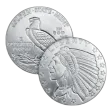
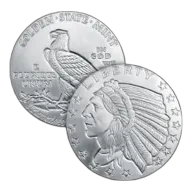
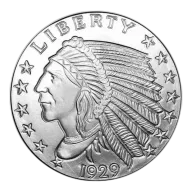
Golden State Mint's interpretation features a Native American chief in a feathered headdress on the obverse, with "LIBERTY" above and stars framing the portrait. The reverse shows a standing eagle with "IN GOD WE TRUST" and "E PLURIBUS UNUM" inscriptions, plus the "GOLDEN STATE MINT" hallmark. The design is a tribute rather than an exact replica: inscriptions differ from the original federal coins, replacing government markings with the GSM name. At 5 oz, the incuse detailing is substantially more pronounced than on the 1 oz version, making it one of the more visually striking private mint rounds at this weight.
5 oz Incuse Indian Specifications
| Attribute | Value |
|---|---|
| Weight | 5 troy oz (155.517 g) |
| Purity | .999 fine silver |
| Manufacturer | Golden State Mint |
| Edge | Reeded |
| Face value | None (private mint round) |
| Year/date | None (undated, continuous production) |
| Mintage | Unlimited |
The Incuse Indian series spans six silver sizes from 1/10 oz to 5 oz, plus gold rounds in 1/10 oz and 1 oz (.9999 fine), and copper rounds in multiple sizes. The silver version uses .999 fineness across all weights. The gold rounds use .9999 fineness, exceeding the IRS minimum for gold IRA eligibility.
Available Sizes
| Size | Metal | Purity |
|---|---|---|
| 1/10 oz | Silver | .999 |
| 1/4 oz | Silver | .999 |
| 1/2 oz | Silver | .999 |
| 1 oz | Silver | .999 |
| 2 oz | Silver | .999 |
| 5 oz | Silver | .999 |
| 1/10 oz | Gold | .9999 |
| 1 oz | Gold | .9999 |
Authentication relies on weight verification, dimensional checks, and the GSM hallmark. The incuse (recessed) design is itself somewhat harder to counterfeit than standard raised-relief designs, since the sunken impression requires different tooling and technique to produce accurately. No serial numbers, assay cards, or electronic verification features are included.
Incuse Indian Tax Treatment
The Incuse Indian is a private mint round with no legal tender status. Its tax treatment follows standard silver bullion rules.
- United States: Golden State Mint lists the Incuse Indian as IRA-approved. The .999 silver purity meets the IRS Section 408(m) threshold, though acceptance depends on the specific custodian. Capital gains are taxed at the collectibles rate of up to 28% for long-term holdings. Sales tax varies by state, with roughly 35 states exempting investment bullion.
- United Kingdom: Silver bullion carries 20% VAT on purchase. No CGT exemption applies, as the product has no legal tender status. Gains on disposal are subject to CGT at the individual's rate (18% or 24%), less the annual £3,000 allowance.
- Canada: GST/HST exempt at .999 purity. Capital gains taxed at a 50% inclusion rate.
- Australia: GST-free at 99.9%+ purity as investment-grade silver.
- Singapore: GST-exempt as qualifying Investment Precious Metals (silver at 99.9%+). No capital gains tax applies.
- Hong Kong: No sales tax, import duty, or capital gains tax on precious metals.
From Presidential Controversy to Private Mint Tribute
The original Indian Head incuse gold coins emerged from Theodore Roosevelt's determination to elevate the artistry of American coinage. In 1907, Roosevelt engaged sculptor Augustus Saint-Gaudens to redesign the double eagle ($20) and eagle ($10) gold coins, producing what many consider the finest US coin designs ever struck. For the smaller denominations ($2.50 and $5), the commission went to Bela Lyon Pratt, a student of Saint-Gaudens, with a radical directive: the design would be incuse, sitting below the coin's surface rather than rising above it.
The reaction was hostile. Critics argued that dirt and germs would collect in the recesses and spread disease (this never materialised). Charles Barber, the Mint's chief engraver who had been bypassed for the commission, actively opposed the design. The numismatic community was divided. Production ran from 1908 to 1929, making these the only incuse coins in US federal history. Time vindicated the design: both denominations are now prized by collectors, with the formerly derided design considered ahead of its time.
Golden State Mint's tribute preserves the essential elements of Pratt's design while adapting them for a modern bullion format. The original coins were small (the $2.50 Quarter Eagle weighed just 4.18 grams of 21.6 karat gold). GSM's 5 oz silver round scales the design dramatically, allowing the incuse technique to be appreciated at a size Pratt never worked at. The sunken relief is more pronounced and the design details more legible at 155 grams than they ever were on the tiny originals.
Incuse Indian vs Other 5 oz Silver Rounds
The 5 oz Aztec Calendar, also from Golden State Mint, is the most natural comparison. Both are .999 silver GSM rounds at the same weight with comparable premiums and the same manufacturer backing. The difference is purely visual and tactile: the Aztec Calendar uses standard raised relief with a Mesoamerican design, while the Incuse Indian uses sunken relief with an early American design. The incuse technique provides slightly better wear protection for stacked or handled rounds, since the design sits below the rim. The Aztec Calendar's intricate Sun Stone artwork may appeal more to buyers who value complex visual detail.
The 5 oz Scottsdale Stacker addresses the handling/wear protection issue differently, using a patented interlocking mechanism to prevent rounds from shifting against each other. The Incuse Indian protects its design through recessed relief; the Stacker protects through mechanical interlocking. Both approaches work, but the Stacker adds the additional benefit of stable, non-sliding stacks. The Incuse Indian counters with a more historically significant and visually distinctive design.
Against the 5 oz Sunshine Eagle, the Incuse Indian lacks the MintMark SI anti-counterfeiting feature that Sunshine Minting includes on all its products. For buyers who value in-hand authentication capability, the Sunshine round has a clear advantage. The Incuse Indian's appeal is design-driven rather than security-driven, competing on the uniqueness of the incuse technique and the historical connection to Roosevelt-era coinage.
Compared to generic 5 oz rounds with no brand or design distinction, the Incuse Indian commands a small premium for the GSM name and the distinctive incuse format. At resale, branded GSM rounds typically sell at slightly tighter spreads than unbranded generics, reflecting the manufacturer recognition. For buyers who will eventually sell to a US dealer, the brand premium is partially recoverable.
5 oz Incuse Indian Silver Round: frequently asked questions
-
The cheapest 5oz Incuse Indian silver round we track is $361.03, about 6.8% over the $67.63 silver spot price. Because it contains five troy ounces of .999 fine silver, the metal value is simply five times the spot price per troy ounce, with the dealer's premium added on top.
-
Incuse means the design is pressed into the surface rather than raised above it. On a standard coin or round, images stand in relief (above the flat field); on an incuse piece, the images sit below it. The style pays tribute to the original 1908 US $2.50 and $5 Indian Head gold coins designed by Bela Lyon Pratt, which remain the only incuse federal coins the US Mint ever issued.
-
Yes. The 5oz Incuse Indian round is 999 fine silver with a total weight of 5 oz (five troy ounces). Golden State Mint stamps the exact weight and purity on each round. It is a private-mint bullion round with no face value or legal-tender status.
-
Start with weight and dimensions: a genuine 5oz silver round weighs approximately 155.52g. Silver is not magnetic, so a strong magnet will not stick; if it does, the piece contains significant base metal. A high-pitched ring when tapped (the "ping" test) is consistent with silver. For certainty, buy from an established bullion dealer rather than private sellers, and consider professional assay testing for large purchases.