4 products · 6 deals
Filters




Prices are fetched automatically and may not reflect current merchant prices. Currency conversions and tax treatment are approximate. Rankings are based solely on price. We are not a dealer and accept no responsibility for transactions with listed merchants. Past performance is not indicative of future results. This site does not provide investment advice. Full disclaimer
About the Australian Nugget Gold
Perth Mint's Original Gold Bullion Coin (1986 to 1989)
The Australian Nugget was introduced in 1986 by Gold Corporation (trading as The Perth Mint), wholly owned by the Government of Western Australia. It was one of the first major gold bullion coins struck in .9999 fine gold (24 karat), matching the purity of the Canadian Maple Leaf and exceeding the 22-karat fineness of both the Krugerrand and the American Gold Eagle.
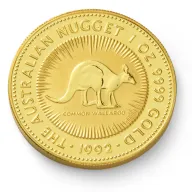
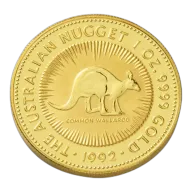
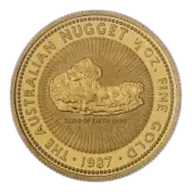
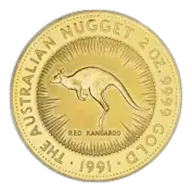
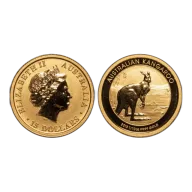
The original coins were named for their depictions of famous Australian gold nuggets on the reverse. Each denomination featured a different historically significant nugget, from the Welcome Stranger (the largest alluvial gold nugget ever found, at 2,316 troy ounces) to the Little Hero. In 1989, market feedback indicated that a kangaroo was more internationally recognisable as a symbol of Australia than images of gold nuggets, and the reverse design transitioned to kangaroo imagery. The series became informally known as the "Gold Kangaroo" from this point, though the official "Australian Nugget" name persisted.
The 1986 to 1989 nugget-design coins occupy a unique niche. They are genuine bullion coins with full gold weight and legal tender status, but their limited years of production and distinctive imagery give them numismatic appeal beyond their metal content. For collectors, these early years represent the origin of Perth Mint's gold bullion programme. For bullion buyers, the .9999 purity and Australian dollar face values make them functionally identical to the kangaroo-design coins that followed.
The original coins featured two innovations unusual for bullion at the time: a "two-tone" frosted design effect (achieved by selective frosting of the design against a mirror-like background) and individual hard plastic encapsulation. Most bullion coins in 1986 were sold loose; Perth Mint's decision to encapsulate each coin protected against contact marks and preserved uncirculated condition.
Australian Nugget Denominations and Dimensions
| Size | Weight | Diameter | Thickness | Face Value |
|---|---|---|---|---|
| 1/20 oz | 1.555g | 14.1 mm | 1.4 mm | A$5 |
| 1/10 oz | 3.111g | 16.1 mm | 1.3 mm | A$15 |
| 1/4 oz | 7.776g | 20.1 mm | 2.1 mm | A$25 |
| 1/2 oz | 15.553g | 25.1 mm | 2.5 mm | A$50 |
| 1 oz | 31.103g | 32.1 mm | 2.65 mm | A$100 |
| 2 oz | 62.21g | 40.4 mm | 3.35 mm | A$200 |
All coins are .9999 fine gold with a reeded edge. The obverse carries the portrait of the reigning monarch at the time of issue: Queen Elizabeth II by Raphael Maklouf (third portrait) for 1986 to 1998 issues.
Nugget Designs by Year
The 1 oz coins featured these nuggets:
- 1986: Welcome Stranger, discovered in Moliagul, Victoria, 1869. At 2,316 troy ounces (72.02 kg), it remains the largest alluvial gold nugget ever found.
- 1986 (1/2 oz): Hand of Faith, discovered in Kingower, Victoria, 1980. Found just 30 cm below the surface by a metal detectorist, it weighed 875 troy ounces (27.21 kg) and was sold to the Golden Nugget Casino in Las Vegas, where it remains on display.
- 1986 (1/4 oz): Golden Eagle, weighing 1,135 troy ounces (35.3 kg), found at Larkinsville, Western Australia, in January 1931.
- 1986 (1/10 oz): Little Hero, weighing 10.5 kg, discovered in the Coongan River, Western Australia, in 1890.
The larger denominations (2 oz, 10 oz, 1 kg) were added from 1991, after the series had already transitioned to kangaroo designs.
Australian Nugget Tax Treatment by Country
The Australian Nugget is legal tender in Australia with face values denominated in Australian dollars. The .9999 gold purity qualifies it for investment gold tax exemptions across all major markets.
Australia
GST-exempt as investment gold at 99.5%+ purity. Perth Mint coins are government-backed (Government of Western Australia), giving them the strongest possible domestic provenance. Capital gains on disposal are assessable income, with no exemption for coins (Australia has no CGT-exempt coin category equivalent to the UK). Individuals who hold for more than 12 months qualify for a 50% CGT discount.
United States
IRA-eligible. The .9999 purity exceeds the IRS Section 408(m) requirement of 99.5% for gold. No federal sales tax. State sales tax exemptions apply in roughly 35 states, with several others offering exemptions above threshold amounts. Capital gains are taxed at the collectibles rate of up to 28%.
United Kingdom
VAT-exempt as investment gold at .9999 purity. Not UK legal tender, so subject to CGT above the annual exempt amount. UK buyers who prioritise CGT exemption should look at the gold Britannia or gold Sovereign.
European Union
VAT-exempt as investment gold under Directive 98/80/EC. The coin's legal tender status and .9999 purity place it firmly within the directive's scope.
Singapore and Hong Kong
Singapore exempts qualifying gold coins under the Investment Precious Metals scheme. The .9999 purity and Perth Mint origin place the Nugget on the MAS-approved list. Hong Kong has no sales tax, import duty, or CGT. The 24-karat purity is particularly valued in Asian gold markets.
Canada
GST/HST-exempt for investment gold coins at 99.5%+ purity.
The Nuggets on the Coins
The Australian Nugget series drew directly from Australia's gold rush heritage. The nuggets depicted on the 1986 to 1989 coins are among the most famous gold discoveries in history.
The Welcome Stranger, featured on the 1 oz coin, was found on 5 February 1869 at Moliagul, Victoria, by John Deason and Richard Oates. At a gross weight of 2,316 troy ounces (72.02 kg), it remains the largest alluvial gold nugget ever found. It was too large to be weighed on conventional scales and had to be broken into three pieces at a local blacksmith's anvil before it could be assayed. The discovery triggered a rush to the Moliagul area, though no comparable finds followed.
The Hand of Faith, on the 1/2 oz coin, has a more modern story. It was discovered on 26 September 1980 in Kingower, Victoria, by Kevin Hillier using a metal detector, lying just 30 centimetres below the surface. At 875 troy ounces (27.21 kg), it is the largest gold nugget ever found with a metal detector. Hillier sold it to the Golden Nugget Casino in Las Vegas, where it has been on display in the lobby ever since.
Perth Mint itself was founded in 1899 as a branch of the Royal Mint during the Western Australian gold rush. The decision to create a gold bullion coin programme in 1986 placed Australia in direct competition with Canada (Maple Leaf, launched 1979) and South Africa (Krugerrand, launched 1967). The .9999 purity was a deliberate competitive statement, matching the Maple Leaf at its highest specification and exceeding the 22-karat Krugerrand and the American Gold Eagle (launched the same year at .9167 fineness).
The switch to kangaroo imagery in 1989 was a pragmatic marketing decision. Gold nuggets, whatever their historical significance within Australia, did not resonate internationally the way a kangaroo did. The Perth Mint has periodically released retrospective "Nugget" editions, such as the 2023 "Pride of Australia Nugget" bullion coin, acknowledging the enduring collector interest in the original designs.
Australian Nugget vs Maple Leaf, Gold Eagle, and Panda
The Canadian Gold Maple Leaf is the closest competitor. Both are .9999 fine gold, both are sovereign legal tender, and both were conceived as competitors to the 22-karat Krugerrand. The Maple Leaf launched seven years earlier (1979) and had established global market dominance by the time the Nugget appeared. In later years, the Royal Canadian Mint added micro-engraved security features (Bullion DNA) that give the Maple Leaf a clear authentication advantage. For sheer market liquidity, the Maple Leaf is the safer choice.
The American Gold Eagle, launched in the same year as the Nugget (1986), took a different approach: 22-karat gold (.9167 fine) with copper and silver alloying for durability. The Eagle's actual gold content (AGW) is one troy ounce per 1 oz coin, same as the Nugget, but the coin is slightly heavier due to the alloy metals. The Eagle dominates the US market; the Nugget dominates the Australian market. In other jurisdictions, both compete on equal terms.
The Chinese Gold Panda shares the Nugget's distinction of featuring annually changing designs, something that sets both apart from the fixed-design Maple Leaf, Britannia, and Eagle. The Panda is .999 fine (three nines vs the Nugget's four), but both appeal to collectors who value design variety alongside bullion value.
The 1986 to 1989 nugget-design coins have a specific collector premium over later kangaroo-design coins. Lower mintages during these early years (the series was still building market share) and the distinctive nugget imagery create a dual value proposition: bullion content plus numismatic scarcity. Later kangaroo-design coins trade closer to spot with standard bullion premiums.
Australian Nugget Gold: frequently asked questions
-
Australian Nugget coin prices track the gold market directly. Dealers add a premium above the prevailing spot price to cover minting and distribution. We compare prices across 4 dealers on this page. The premium over spot varies by coin size and dealer, so the comparison table is the fastest way to find the best current offer.
-
Australian Nugget gold coins are struck from .9999 fine gold (24 carat), meaning they are 99.99% pure. This four-nines standard applies to all sizes in the series, from 1/20 oz up to 1 kg.
-
The Australian Nugget is a government-issued bullion coin series produced by the Perth Mint (owned by the State of Western Australia), first released in 1986. It is a minted, .9999 fine gold legal-tender coin, not a raw gold specimen. Natural gold nuggets are unrefined mineral formations found in the ground; their purity varies and they carry no face value. The early Nugget coins (1986-1989) depicted famous natural gold nuggets, which is where the series name comes from.
-
The series launched in 1986 with reverse designs depicting famous Australian gold nuggets. In 1990 the Perth Mint switched to annual kangaroo designs, responding to market feedback that a kangaroo was more internationally recognisable as an Australian symbol. The underlying coin (weight, purity, legal tender status) remained unchanged. Both names remain in circulation: dealers and collectors use "Nugget" for the 1986-1989 era and "Kangaroo" for 1990 onward, though the series is the same continuous programme.