7 products · 21 deals
Filters
| Product | /oz | Premium | Price | |
|---|---|---|---|---|
| $4,603.49 | +5.94% |
$2,301.75
£1,725
|
View Deal | |

3 deals
|
$4,610.18 | +5.99% |
$2,305.10
A$3,238
|
Compare |
| $4,629.91 | +6.28% |
$2,314.96
S$2,959
|
Compare | |

5 deals
|
$4,629.78 | +6.55% |
$2,314.90
£1,735
|
Compare |

8 deals
|
$4,683.88 | +7.79% |
$2,341.93
£1,755
|
Compare |
| $4,780.18 | +9.90% |
$2,390.10
A$3,357
|
View Deal | |
| $4,987.11 | +14.77% |
$2,493.56
£1,869
|
View Deal |






Prices are fetched automatically and may not reflect current merchant prices. Currency conversions and tax treatment are approximate. Rankings are based solely on price. We are not a dealer and accept no responsibility for transactions with listed merchants. Past performance is not indicative of future results. This site does not provide investment advice. Full disclaimer
About 1/2 oz Gold Bars
The 1/2 oz Gold Bar: A Niche Weight in Bar Form
A 1/2 oz gold bar contains 15.5517 grams of gold, the largest fractional gold weight below a full ounce. In coin form this is a mainstream denomination produced by every major sovereign mint. In bar form it is genuinely niche: some private mints produce 1/2 oz bars, but the weight sits awkwardly between the metric sizes (10g and 20g) that dominate bar production worldwide, so the product range is thinner than the coin equivalent.
Who buys it anyway? Bars exist for one reason: they are the cheapest way to own gold. Gold bars carry the lowest premiums of any gold form, because they skip the legal tender status, sovereign branding and more complex minting that push coin prices up. A buyer who wants roughly half an ounce of gold and does not care about face values or CGT treatment can get more metal per dollar in a 1/2 oz Fortuna bar or generic bar than in a 1/2oz gold coin from a government mint.
The tradeoff runs along two lines. Against 1/2 oz coins, the bar gives up brand recognition and, for UK buyers, tax efficiency: gold bars are VAT-exempt on purchase like coins, but they are never CGT-exempt, a privilege reserved for UK legal tender coins such as the 1/2 oz Britannia. Against larger bars, the 1/2 oz gives up premium efficiency, since the percentage over spot falls steadily as bar weight rises towards the 1 oz, 100g and kilo sizes.
Format matters at this weight. Most 1/2 oz bars are minted rather than cast: cut from rolled gold sheet, polished, and sealed in a tamper-evident assay card carrying the bar's serial number, weight, purity and the refiner's hallmark, though cast options exist from refiners such as ABC. Standard purity is 999.9 fine, which keeps these bars inside the investment-gold definitions that make them sales-tax-free in the UK, EU, Canada, Australia, New Zealand and Singapore. The half-ounce bar suits a buyer stepping down from the 1oz gold bar on budget grounds while staying in the lowest-premium form of gold available.
Premiums on 1/2 oz Gold Bars
Gold bar premiums scale inversely with weight. At the extremes of the retail range, 1g bars can cost 15-25% over spot while 1kg bars get down to 1-2%. The commonly quoted reference points in between: 1 oz minted bars typically carry 1-4% over spot (cast bars 1-3%), and 100g bars run 2-4%. A 1/2 oz bar at 15.55g sits between the small-bar and 1 oz points on that curve, so buyers should expect to pay a somewhat higher percentage than they would for a 1 oz bar from the same refiner, with the exact gap varying by brand and dealer.
The comparison that matters most at this weight is against the coin alternative. A 1/2 oz gold coin such as the American Gold Eagle typically carries a 5-8% premium over spot. Bars undercut coins at every weight because of simpler production and the absence of legal tender overheads, which is precisely the half-ounce bar's pitch: the same gold content as the coin, at a smaller markup. For a buyer in a jurisdiction with no tax distinction between bars and coins, such as Singapore or Hong Kong, that arithmetic is the whole decision.
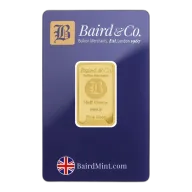
Within the weight class, two familiar levers move the price. Minted bars cost more than cast bars of the same weight, since the polished finish and assay card packaging add production cost. And branding adds a margin: PAMP Suisse Fortuna bars command a modest premium over generic refiner bars on the strength of the design and name recognition. Our dealer data shows the 1/2 oz Fortuna is actually the most widely stocked product at this weight, ahead of generic bars, so the brand premium can be compared directly across many listings.
One caution cuts against chasing the absolute lowest price. Generic or non-LBMA bars price closest to melt, but they may be harder to resell and can require assay testing at the buyer's expense before a dealer accepts them. On a bar of this size the saving from going generic is small in dollar terms, while a sticky resale costs real money, so the premium gap between generic and LBMA-accredited product is often worth paying.
1/2 oz Gold Bars by Refiner
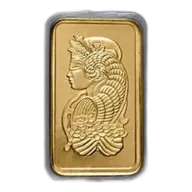
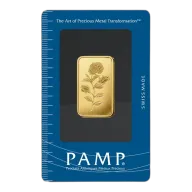
Because bars at this weight are a niche product, the range is driven by a few refiners rather than the broad catalogue you find at 1 oz. The standout is the PAMP Suisse Fortuna, the iconic design PAMP produces across sizes from 1g to 1kg. In our dealer listings the 1/2 oz Fortuna gold bar is the most widely stocked named product at this weight. PAMP is an LBMA-accredited Swiss refiner and its minted bars ship in sealed assay cards with VeriScan verification technology.
Generic 1/2 oz gold bars are the next most common listing. These are unbranded or assorted-refiner bars sold on weight and purity alone, priced closest to melt. They suit buyers maximising gold per dollar, with the caveat that bars from non-LBMA refiners have lower liquidity and may need assay testing before a dealer will buy them back.
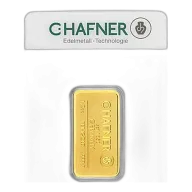
The remaining names in our listings cover the familiar quality spectrum. Valcambi and Argor-Heraeus are both LBMA-accredited Swiss houses; Valcambi is known for its clean minimalist design, and Argor-Heraeus, accredited since 1961, uses kinebar holographic security on its bars. ABC cast bars offer the rougher poured format at this weight, typically the cheapest route into half-ounce gold. Smaller and regional makers, including Rosa, Holy Land Mint, Intrinsic Tender and C.Hafner, also appear, along with secondary-market Engelhard bars from the era before that brand left retail production.
Choosing among them is the standard bar decision compressed into a small package. LBMA names (PAMP, Valcambi, Argor-Heraeus) carry universal recognition and resell anywhere without question; generic and cast bars cost less upfront and resell on their assay. Since all standard bars at this weight are 999.9 fine, purity does not differentiate them, and all qualify as investment gold for VAT and GST exemptions in the UK, EU, Canada, Australia, New Zealand and Singapore. The practical advice is to compare the same bar across dealers first, because the spread between listings for an identical product is often wider than the premium gap between brands.
Resale and Storage for Half-Ounce Gold Bars
The liquidity picture at 1/2 oz splits cleanly by brand. Bars from LBMA-accredited refiners in sealed assay cards are accepted by dealers globally; the accreditation and the intact tamper-evident packaging do the authentication work, so a sealed PAMP or Valcambi half-ounce bar sells as easily as bars at any other small weight. Generic or non-LBMA bars are saleable but slower: a dealer may require assay testing at the seller's expense before paying full value, which eats into the lower premium that made the generic bar attractive in the first place.
The cardinal rule of bar ownership applies with full force here: do not break the assay card seal. A bar removed from its card may need re-assaying before resale, and the value lost typically exceeds anything gained by handling the bar directly. Store the cards flat rather than on edge, as the cards themselves are fragile even though they protect the bar inside from contact damage.
Against the coin alternative at the same weight, bars give up some resale ease. Half-ounce sovereign coins rank second only to 1 oz in gold coin liquidity, with tight bid-ask spreads, and bars in general carry slightly wider buy-sell spreads than well-known sovereign mint coins at retail because coins have stronger brand recognition and a standardised appearance. The bar buyer accepts a slightly wider spread in exchange for the lower purchase premium; whether that trade pays off depends mostly on holding period and on choosing a recognised refiner.
Storage is trivial. A 15.55g minted bar in its assay card is a flat, thin object that stacks efficiently, and gold bars offer the most compact value-to-space ratio of any form of gold. Any home safe or deposit box accommodates a meaningful holding of half-ounce bars with room to spare. Cast bars, being less uniform in shape, stack slightly less neatly than carded minted bars. One handling note for unpackaged bars: gold is soft, so bars stored loose against each other pick up surface scratches that reduce resale appeal, another argument for leaving minted bars in their cards.
1/2 oz Gold Bars: frequently asked questions
-
The melt value of a half-ounce gold bar is half the current spot price of $4,408.10 per troy oz. Actual bar prices from 20 dealers across 27 listings trade above that melt value, with the premium varying by brand and quantity. The premiums tab on this page shows the live range so you can compare dealers directly.
-
A half-ounce gold bar weighs 1/2 oz (15.55 grams). The troy ounce used in precious metals equals 31.1035 grams, making a half troy ounce 15.5518 grams. This differs from a standard avoirdupois half-ounce (14.17 grams), so always confirm whether a bar is measured in troy or avoirdupois ounces when comparing weights.
-
LBMA-accredited brands are accepted by bullion dealers worldwide at or near spot, making them straightforward to resell. Less-recognised brands may attract wider buy-sell spreads or be refused by some dealers. At the half-ounce size the resale advantage of a recognised brand is meaningful enough to factor into your buying decision.
-
Purchase reporting rules vary. In the UK, there is no requirement to report a purchase to HMRC, but gains on disposal are subject to CGT at 18% or 24% above the £3,000 annual allowance. In Canada, 50% of any disposal gain counts as taxable income. Check your local rules before buying.
- 1/2 oz ABC Cast Bar Gold Bar
- 1/2 oz Ainslie Gold Bar
- 1/2 oz Argor-Heraeus Gold Bar
- 1/2 oz Baird Cast Bar Gold Bar
- 1/2 oz C.Hafner Gold Bar
- 1/2 oz Engelhard Gold Bar
- 1/2 oz Fortuna Gold Bar
- 1/2 oz Go Gold Bar
- 1/2 oz Gold Bar
- 1/2 oz Gold Bullion Australia Gold Bar
- 1/2 oz Intrinsic Tender Gold Bar
- 1/2 oz New Zealand Mint Gold Bar
- 1/2 oz PAMP Suisse Gold Bar
- 1/2 oz Rosa Gold Bar
- 1/2 oz Sunshine Minting Gold Bar
- 1/2 oz Themis Gold Bar
- Pre-Owned 1/2 oz Fortuna Gold Bar
- Pre-Owned 1/2 oz PAMP Suisse Gold Bar
- Pre-Owned 1/2 oz Perth Mint Gold Bar