
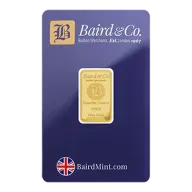

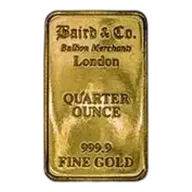
Prices are fetched automatically and may not reflect current merchant prices. Currency conversions and tax treatment are approximate. Rankings are based solely on price. We are not a dealer and accept no responsibility for transactions with listed merchants. Past performance is not indicative of future results. This site does not provide investment advice. Full disclaimer
About 1/4 oz Gold Bars
1/4oz Gold Bars: A Niche Size in the Bar Market
A 1/4 troy ounce gold bar contains 7.7758 grams of fine gold. It sits in the middle of the fractional gold range, above 1/10oz and below 1/2oz, but in bar form it is an unusual choice. Some private mints produce 1/4oz gold bars, yet they remain a niche product, and bars at this weight carry premiums similar to the coins that dominate the quarter-ounce market. The usual argument for choosing gold bars over coins, lower premiums for the same metal, weakens considerably at this size.
Standard retail gold bars are struck or cast at 999.9 purity, and the common retail ladder runs 1g, 5g, 10g, 20g, 50g, 100g, 250g, 500g and 1kg alongside the 1oz and 10oz imperial sizes. The quarter-ounce weight falls outside that standard ladder, which is part of why so few refiners bother with it. Buyers who want gold at roughly this outlay are usually choosing between a 1/4oz sovereign-mint coin and the closest metric bar sizes instead.
Tax treatment still favours bars on purchase in many markets. Investment gold bars at 995+ purity are VAT-exempt in the UK and EU, GST-free in Australia, Canada, New Zealand and Singapore at the relevant purity thresholds, and free of any sales tax in Hong Kong. The UK adds a wrinkle on the way out: bars are not CGT-exempt, because only UK legal tender coins qualify. Gains above the £3,000 annual allowance are taxable at 18-24%, which is why UK buyers at this price point often prefer the CGT-exempt 1/4oz gold Britannia or the similarly priced Gold Sovereign over a bar.
Quarter-Ounce Premiums Against the Rest of the Weight Scale
Gold bars normally carry the lowest premiums of any gold form: typically 1-4% over spot for 1oz minted bars, 1-3% for cast bars, around 2-4% for 100g bars and 1-2% for 1kg bars. That advantage scales inversely with size, and it collapses at the small end, where 1g bars can run 15-25% over spot. The 1/4oz size sits in this unfavourable zone. Bars at this weight carry premiums similar to coins, so the structural discount that draws buyers to bars in the first place largely disappears.
For context on what coin-level premiums mean at this weight: 1/4oz gold coins such as the American Gold Eagle run roughly 7-12% over spot, against 3-5% for 1oz coins and 10-18% for 1/10oz coins. The quarter-ounce weight occupies a middle ground, meaningfully cheaper per ounce than tenth-ounce pieces while keeping the outlay per item to roughly half that of a 1/2oz piece. A buyer paying coin-like premiums on a 1/4oz bar gets none of the resale recognition a sovereign-mint coin brings, which is the core problem with the format.
The practical conclusion runs in two directions. Buyers prioritising premium efficiency should move up the bar ladder, where a 1oz gold bar at 1-4% over spot costs far less per ounce of gold; at larger allocations the gap compounds, since a $100,000 position in bars rather than coins can save $2,000-4,000 in premiums. Buyers committed to the quarter-ounce outlay for budget reasons should weigh the bar against 1/4oz gold coins, which cost about the same over spot but resell more easily.
What Is Actually Available at 1/4oz
The quarter-ounce bar market is thin. Some private mints produce 1/4oz gold bars, but no major refiner treats it as a core size, and the recognised names in gold bars, PAMP Suisse, Valcambi, Argor-Heraeus, Heraeus, Perth Mint, Royal Canadian Mint and Metalor, built their reputations on the standard gram-denominated and 1oz ladder. Where small bars from these refiners do appear, expect minted rather than cast production: minted bars are cut from rolled gold sheet, polished, and usually sealed in tamper-evident assay cards carrying the bar's serial number, weight, purity and the refiner's hallmark.
The coin side of the quarter-ounce market is the opposite story. Every major world mint produces a 1/4oz coin in its flagship series, making it the most popular fractional size by number of product variants. The line-up includes the 1/4oz American Gold Eagle with its $10 face value, the £25-denominated Gold Britannia, the Canadian Gold Maple Leaf, the South African Krugerrand, the Austrian Philharmonic and the Australian Kangaroo, with the Chinese Gold Panda's 8g coin as the closest metric equivalent.
Two adjacent products are worth knowing at this price point. The British Gold Sovereign contains 7.32g of 22k gold, 0.2354oz of fine gold, close to but not the same as a quarter-ounce piece, and it trades with its own pricing dynamics. For UK buyers it shares the CGT exemption with the Britannia. The other adjacent option is simply the nearest standard bar weight: 5g and 10g bars bracket the 7.78g quarter-ounce, and both sit on the normal refiner ladder with full assay-card packaging and wider dealer support.
Selling On a Quarter-Ounce Bar
Liquidity at the quarter-ounce weight is good in general terms, ranked below 1oz and 1/2oz but above 1/10oz, and most dealers readily purchase 1/4oz pieces at reasonable premiums to spot. The qualifier for bars is brand. Bars from LBMA-accredited refiners in sealed assay cards are widely accepted, but generic or unbranded bars and bars from non-LBMA refiners have lower liquidity and may need assay testing at the buyer's expense before a sale completes. Since the 1/4oz bar market is dominated by private mints rather than the big accredited refiners, that caveat applies more often here than at standard weights.
Bars also carry slightly wider buy-sell spreads than well-known sovereign mint coins at the retail level, because coins have stronger brand recognition and a standardised appearance. At a weight where the 1/4oz gold Maple Leaf and its peers are stocked by every major mint's dealer network, a niche bar is the harder asset to move. Keep any assay card sealed: breaking the seal reduces resale value because the bar may then need re-assaying.
Storage is the format's strong suit. Minted bars in assay cards are flat, thin and stack efficiently, and small gold of any kind takes almost no space; for comparison, a 1/4oz gold coin is about 22mm across, roughly the size of a UK 1 penny coin, and a full tube of 25 such coins weighs around 194g. Assay cards protect the bar from contact damage but are themselves fragile, so store them flat rather than standing on edge. There is no tube or box convention for bars at this weight; quantity packaging conventions, like the Royal Mint's 25-coin tubes for the 1/4oz Britannia, belong to the coin side of the market.
1/4 oz Gold Bars: frequently asked questions
-
A 1/4 troy oz gold bar contains 1/4 oz of fine gold, so its melt value moves directly with the gold spot price of $4,408.10 per troy ounce. Divide spot by four to get the approximate gold value. Dealers will add a fabrication premium on top, which you can compare across listings on this page.
-
A 1/4 troy oz gold bar weighs 7.7759 g. A full troy ounce is 31.1035 grams, so one quarter is 7.7759 grams. Troy ounces are the standard unit for precious metals and are slightly heavier than the avoirdupois ounces used for everyday goods.
-
Yes. Smaller bars cost more to manufacture per ounce because setup, assay, and packaging costs are spread over less metal. A 1/4 oz bar typically carries a noticeably higher percentage premium above spot than a 1 oz bar from the same maker. The trade-off is that smaller denominations are easier to sell in portions.
-
Yes. BullionFerret currently lists 8 1/4 oz gold bar products from 8 dealers. This weight is available both as minted bars from refiners and as fractional versions of major government coin programmes, giving buyers a range of options to compare on this page.
-
Buying gold generally does not itself trigger a reporting obligation, but rules vary by country. In the UK, gains above the £3,000 annual exemption must be declared when you sell. Capital gains on gold in the US are taxed at up to 28%. In Canada, 50% of any gain is included in taxable income. Check local rules for any cash-transaction reporting thresholds that apply at point of purchase.