 Galaxy Coins


Prices are fetched automatically and may not reflect current merchant prices. Currency conversions and tax treatment are approximate. Rankings are based solely on price. We are not a dealer and accept no responsibility for transactions with listed merchants. Past performance is not indicative of future results. This site does not provide investment advice. Full disclaimer
About the 10g CPG Gold Bar
The 10g CPG Gold Bar
The 10g CPG gold bar is a .9999 fine gold bar in one of the standard metric weights. Ten grams is 0.3215 troy oz, slightly more gold than a 1/4 oz coin, at a price point of roughly $1,000-$1,100 that makes it a meaningful but accessible single purchase. The weight belongs to the gram-denominated bar series (1g, 2.5g, 5g, 10g, 20g, 50g and upward) that is native to European and Asian markets, where metric gold is the standard rather than the troy ounce.
The economics of the size are worth understanding before buying. Typical 10g bar premiums run 8-12% over spot, similar to 5g bars and 1/10 oz coins. That is a clear improvement on the very high premiums of 1g and 5g pieces, but the per-gram efficiency has not yet reached the step-change that occurs at 50g, where premiums drop to 3-6%. The jump from 10g to 50g is the single biggest premium improvement in the gram bar range, so buyers planning to accumulate seriously often treat 10g as a stepping stone rather than a destination weight.
Regionally, the format's popularity varies. In Germany, Austria, and Switzerland, 10g is a regular-purchase gold size carried by every dealer; in India, the UAE, and Turkey, banks and jewellers sell 10g bars extensively as savings vehicles and gifts. In the US and UK, where troy-ounce denominations dominate, buyers at this price point more commonly reach for a 1/4 oz sovereign coin instead, making metric gold bars like this a more deliberate choice.
CPG 10g Gold Bar Specifications
| Attribute | Value |
|---|---|
| Weight | 10 grams (0.3215 troy oz) |
| Purity | .9999 fine gold |
| Form | Bar |
| Brand | CPG |
| Legal tender | No (private bar, no face value) |
The .9999 fineness is the four-nines standard for retail gold bars, above the 995 minimum that defines investment gold for VAT purposes in the UK and EU and above the 99.5% threshold used by the GST exemptions in Canada, Australia, and New Zealand.
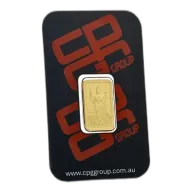
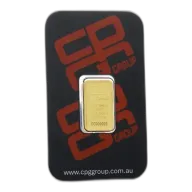
Physically, a 10g gold bar measures approximately 24 x 14 mm, and bars at this weight are typically produced as minted bars sealed in assay cards, which bring the package up to roughly credit-card size. Multiple carded bars stack flat for efficient storage in a small safe or deposit box. The assay card matters beyond convenience: tamper-evident packaging from the refiner provides chain-of-custody assurance, and a bar removed from its card may need re-assaying before resale, which adds cost and friction. Whatever the brand, keeping the seal intact is the single most important thing an owner can do to protect resale value at this size.
Tax Treatment of a 10g Gold Bar
At .9999 fineness the bar qualifies as investment gold in every jurisdiction that defines one, but as a bar it never picks up the coin-specific exemptions.
- United Kingdom: VAT-exempt as investment gold (995+ fineness). No CGT exemption, since that applies only to UK legal tender coins; gains above the £3,000 annual allowance are taxed at 18-24%.
- European Union: VAT-exempt across all member states under the Investment Gold Directive. Germany adds a notable sweetener: gains on gold held over 12 months are tax-free.
- United States: No federal sales tax; around 35 states exempt bullion. Note the threshold states: at roughly $1,000-$1,100, a single 10g bar sits near the $1,000 exemption lines in New York, Massachusetts, and Louisiana, and below California's $2,000 threshold. Long-term gains are taxed at the collectibles rate of up to 28%. IRA eligibility requires 99.5%+ purity from an accredited refiner with approved depository storage.
- Canada and Australia: GST/HST-free and GST-free respectively at the 99.5% gold purity threshold.
- New Zealand: GST-exempt at 99.5%+ purity; no capital gains tax.
- Singapore and Hong Kong: GST-exempt in Singapore for qualifying investment gold; Hong Kong levies no sales tax or duty. Neither taxes capital gains.
10g Bars vs 1/4 oz Coins and Other Gram Weights
The most direct rival is the 1/4 oz sovereign gold coin, because both cost roughly $1,000-$1,100. The trade is gold content against liquidity: a 1/4 oz Eagle, Britannia, or Maple Leaf contains 7.78g of gold versus the bar's 10g, so the bar buys more metal for similar money, but quarter-ounce sovereign coins typically carry a lower percentage premium and stronger brand recognition, particularly in the US and UK where the ounce system dominates. For buyers in those markets, 1/4 oz gold coins often provide the better resale path; in metric markets the bar is the conventional choice.
Within the gram bar ladder, the 10g weight competes against the established refiner names that produce it: PAMP Suisse (the Fortuna design), Valcambi, Perth Mint, Argor-Heraeus, Heraeus, and the Royal Mint all offer 10g minted bars sealed in serialised assay cards. Recognised LBMA-accredited brands in sealed cards enjoy good liquidity and moderate buyback premiums, better than 1g or 5g bars though worse than 50g or 100g, while bars from outside that circle may face wider spreads.
The other comparison is vertical. Stepping up to the 20g gold bar improves the premium to roughly 4-8%, and the 50g bar drops it to 3-6%. Buyers who can stretch their budget capture most of the gram-bar premium benefit at those larger sizes, leaving 10g best suited to regular smaller purchases, gifting, and markets where the weight is a traditional savings denomination.
10g CPG Gold Bar: frequently asked questions
-
The cheapest 10g CPG gold bar tracked today is $1,419.00 from Galaxy Coins, around 3.5% over spot. The bar contains 10 grams of 999.9 fine gold. Use the comparison table to see all current dealer prices and stock availability.
-
CPG gold bars carry a 999.9 fineness mark and are sold by multiple bullion dealers. We do not have a confirmed source identifying the full name or background of the CPG refinery. For current accreditation details, check the LBMA Good Delivery list or an equivalent regional registry directly.
-
Yes, smaller bars like 10g typically carry a higher 3.5% per gram than 1oz or kilogram bars. Fabrication, packaging, and assay costs are largely fixed per bar regardless of size, so they represent a larger share of the cost per gram on smaller denominations. Buyers prioritising lower premiums generally get better value by moving to 1oz or larger bars.
-
Check any accompanying assay documentation against the bar's markings and confirm the 999.9 fineness stamp is present. If you are buying second-hand or documentation is missing, an XRF (X-ray fluorescence) assay from a professional bullion dealer or refiner is the reliable method of independent verification for small gold bars.