 BGASC
BGASC
1 listing
Filters
| Product | /oz | Premium | Price | |
|---|---|---|---|---|
| $4,910.66 | +18.43% | $1,578.78 | View Deal |

Prices are fetched automatically and may not reflect current merchant prices. Currency conversions and tax treatment are approximate. Rankings are based solely on price. We are not a dealer and accept no responsibility for transactions with listed merchants. Past performance is not indicative of future results. This site does not provide investment advice. Full disclaimer
About the 10g Lion of Judah Gold Bar
Holy Land Mint Lion of Judah: Heritage in Gold
The 10g Lion of Judah gold bar is produced by The Holy Land Mint, the trade name of Israel Coins and Medals Corp. (ICMC). This company was established in 1958 by Israel's first Prime Minister, David Ben-Gurion, originally to commemorate national and historic events of the State of Israel. It was privatised in 2008 and purchased by G.R.A.S Inc., shifting from a government commemorative coin producer to a commercial bullion and numismatic company under the Holy Land Mint brand.
The bar is struck at 9999 fineness (four nines) and belongs to a limited-edition series, with each gold denomination restricted to 7,777 pieces. The number is significant in Jewish tradition, where 7 carries deep symbolic weight: the seven days of creation, the seven branches of the menorah, and numerous other references throughout the Torah. The lion design itself is drawn from an 8th-century BCE seal discovered at Megiddo, an archaeological site in northern Israel, in 1908. The original seal belonged to Shema, a servant of King Jeroboam II, making the source design nearly 3,000 years old.
Each bar is sealed in a tamper-evident assay card with a digital verification element on the reverse and matching serial numbers on both the bar and the card. The Lion of Judah is described as the first design in a planned ongoing bar series, suggesting that future designs will follow while this inaugural design becomes a fixed edition.
The bar occupies a hybrid position between investment bullion and collector piece. The 999.9 purity and standard metric weight make it functionally identical to investment bars from LBMA-accredited refiners, but the limited mintage and cultural significance add collector appeal. The Holy Land Mint is not on the LBMA Good Delivery list, which limits the bar's international liquidity compared to products from LBMA-accredited sources. Demand is strongest among buyers with a connection to Jewish or Christian heritage, particularly in the United States and Israel.
10g Lion of Judah Gold Bar Specifications
| Attribute | Detail |
|---|---|
| Weight | 10 grams (0.3215 troy oz) |
| Purity | 999.9 (24 karat) |
| Dimensions | 15.8 x 25.8 x 1.6 mm |
| Mintage | 7,777 pieces |
| Manufacturer | The Holy Land Mint / ICMC (Israel) |
| Founded | 1958 (privatised 2008) |
| Accreditation | Not LBMA Good Delivery |
| Packaging | Tamper-evident assay card with digital verification |
| Serial number | Engraved on bar, matching assay card |
| Edge | Smooth |
| Legal tender | No (investment bar, not Bank of Israel coin) |
Design
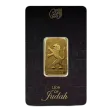
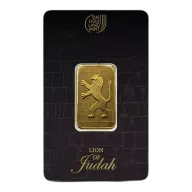
The obverse depicts the Lion of Judah rearing on its hind legs in left-profile relief, set against the background of the Walls of the Old City of Jerusalem. The design connects to the biblical reference in Genesis 49:9 ("Judah is a lion's whelp") and the Christian reference in Revelation 5:5 ("the Lion of the tribe of Judah"). The specific lion is based on the ancient Megiddo seal, an 8th-century BCE artefact that is one of the most important archaeological finds in Israeli history. The original seal is housed at the Istanbul Archaeological Museum, having been taken during the Ottoman period, adding a layer of historical complexity to the design's provenance.
The reverse carries the Holy Land Mint emblem in portrait orientation, with hallmarks in the centre and a unique serial number at the bottom, alongside weight and purity. The digital verification element on the assay card provides an additional authentication layer. The Lion of Judah is described as the first design in an ongoing series, suggesting periodic new designs will join the programme.
Tax Treatment for the 10g Lion of Judah Gold Bar
At 999.9 purity, the bar qualifies as investment gold across all major tax jurisdictions. The limited mintage and cultural design do not affect its tax classification; investment gold is defined by purity and form, not by aesthetic content or mintage limits.
Purchase Tax
- United States (primary market): No federal sales tax. State exemptions vary; approximately 35 states exempt investment gold from sales tax. IRA eligibility is uncertain: the bar meets the 99.5% purity threshold required by IRS Section 408(m), but the Holy Land Mint is not LBMA-accredited or COMEX/NYMEX-approved. Most IRA custodians require one of these accreditations, so buyers should verify eligibility with their specific custodian before purchasing.
- United Kingdom: VAT-exempt as investment gold (995+ fineness). Subject to CGT on disposal; only UK legal tender coins are CGT-exempt. The annual CGT allowance is 3,000 GBP.
- European Union: VAT-exempt under EU Directive 98/80/EC for investment gold at 995+ purity.
- Canada: GST/HST exempt at 99.5%+ purity. RRSP eligibility depends on the custodian's acceptance of non-LBMA products.
- Australia: GST-free as investment-grade gold at 99.5%+ purity.
- Singapore: GST-exempt under the IPM scheme for gold at 99.5%+ purity. No capital gains tax.
- Hong Kong: No sales tax, no duties, no capital gains tax.
- Israel: Investment gold purchased directly from ICMC in Israel may be subject to Israeli VAT (17%), depending on the purchasing channel and buyer's residency status. International buyers ordering from the ICMC website should check the applicable terms.
Lion of Judah vs Standard 10g Gold Bars
The Lion of Judah's limited mintage of 7,777 pieces per denomination places it in a different category from open-mintage investment bars. A 10g PAMP Fortuna bar or 10g Valcambi bar will typically cost less and offer broader international resale liquidity backed by LBMA Good Delivery accreditation. For buyers purchasing purely for gold content and investment efficiency, the established Swiss bars are the practical choice.
Among culturally or religiously significant gold bars at this weight, the Lion of Judah competes with PAMP Suisse's themed range. PAMP produces bars for multiple traditions: the 10g Eid Mubarak bar for Islamic celebrations, the 10g Ka'Bah Mecca bar for the Hajj pilgrimage, the 10g Buddha bar for Buddhist traditions, and PAMP's 10g Am Yisrael Chai bar for the Jewish community. PAMP has the advantage of LBMA Good Delivery accreditation and broader global brand recognition, but the Lion of Judah draws on a 3,000-year-old archaeological source for its design, giving it a historical depth that modern commemorative designs do not match.
The 7,777-piece mintage limit creates a potential collector premium above the gold content value over time. If the series develops a following among collectors, earlier designs may trade above their melt value. This is speculative; the bar is too new to have established a secondary market track record. Buyers should treat any potential numismatic premium as a bonus rather than a reason to pay significantly over spot price for a non-LBMA product.