 BGASC
BGASC


 Groupe Conqueror
Prices are fetched automatically and may not reflect current merchant prices. Currency conversions and tax treatment are approximate. Rankings are based solely on price. We are not a dealer and accept no responsibility for transactions with listed merchants. Past performance is not indicative of future results. This site does not provide investment advice. Full disclaimer
About the 1 oz Lion of Judah Gold Bar
The 1 oz Lion of Judah Gold Bar
The Lion of Judah is the flagship denomination in an investment bar series from The Holy Land Mint, the trade name of Israel Coins and Medals Corp. (ICMC), the only major bullion producer in the Middle East. The bar contains one troy ounce of .9999 fine gold and is limited to 7,777 pieces, a cap likely chosen for the significance of the number seven in Jewish tradition. That mintage is far lower than mainstream refiner bars, which makes this a hybrid bullion and collector product rather than a pure stacking unit.
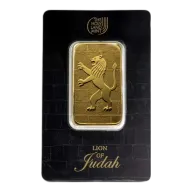
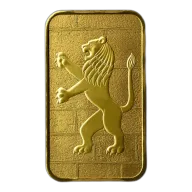
The design is the draw. The obverse shows the Lion of Judah rearing in left profile against the Walls of the Old City of Jerusalem, the symbol of the Tribe of Judah and of Jerusalem itself. The specific lion is modelled on an 8th-century BCE Israelite seal discovered at Megiddo in 1908, connecting the bar to nearly 3,000 years of heritage, with biblical resonance for both Jewish buyers (Genesis 49:9) and Christian buyers (Revelation 5:5).
Security packaging is comprehensive for the category: each bar is sealed in a tamper-evident assay card with a security film, a digital verification code on the reverse, and a serial number engraved on the bar that matches the card, comparable in approach to PAMP's Veriscan. Premiums run above generic 1 oz gold bars because of the limited mintage and collector appeal, but below comparable PAMP products.
Lion of Judah Gold Bar Specifications
| Attribute | Value |
|---|---|
| Weight | 1 troy oz (31.1 g) |
| Purity | .9999 fine gold |
| Dimensions | 24.1 x 41.1 x 2.1 mm |
| Edge | Smooth |
| Mintage | 7,777 pieces |
| Packaging | Tamper-evident assay card with digital verification |
| Serialisation | Serial number on bar, matching the assay card |
The reverse carries the Holy Land Mint emblem in portrait orientation with hallmarks, the serial number, and the weight and purity statements. The gold series spans five denominations, each capped at 7,777 pieces: 1 g, 2.5 g, 5 g, 10 g, and this 1 oz bar, with the smaller sizes offering the same design at lower entry points. A 1 oz Lion of Judah silver bar in .999 silver completes the range. One caveat for institutional-minded buyers: the Holy Land Mint is not on the LBMA Good Delivery List, so the bars rely on their assay certification rather than LBMA accreditation.
Lion of Judah Tax Treatment by Country
At .9999 fineness, the bar qualifies as investment gold in every major jurisdiction, but as a bar (not legal tender) it misses the coin-specific exemptions.
- UK: VAT-exempt as investment gold (995+ purity). It is not CGT-exempt, since that exemption is reserved for UK legal tender coins; gains above the £3,000 annual allowance are taxable.
- USA: The primary market. No federal sales tax; most states exempt bullion. Long-term gains are taxed at the collectibles rate of up to 28%. IRA eligibility requires bars from LBMA/COMEX/NYMEX-accredited refiners, which the non-LBMA Holy Land Mint does not satisfy, so buyers should not assume IRA placement.
- EU: VAT-exempt as investment gold across all member states under Directive 98/80/EC. In Germany, gains are tax-free after a 12-month hold.
- Canada: GST/HST exempt at 99.5%+ gold purity in bar form; capital gains taxed at the 50% inclusion rate.
- Australia and New Zealand: GST-free in both at the 99.5% gold threshold; Australia applies CGT with a 50% discount after 12 months, New Zealand has no formal capital gains tax.
- Israel: Investment gold may be subject to Israeli VAT at 17% unless purchased through specific tax-advantaged channels; terms differ for residents buying direct from ICMC.
- Singapore and Hong Kong: No GST on qualifying investment gold in Singapore, no sales tax in Hong Kong, and no capital gains tax in either.
From Ben-Gurion's Mint to the Megiddo Lion
Israel Coins and Medals Corp. was established in 1958 by David Ben-Gurion, Israel's first Prime Minister, to commemorate national and historic events of the young state. For half a century it operated as a government institution before being privatised in 2008 and purchased by G.R.A.S Inc., shifting from official commemorative producer to a commercial bullion and numismatic company under the Holy Land Mint brand. It still holds exclusive distribution rights for Bank of Israel commemorative coins, a legacy of its origins that ordinary private mints cannot claim.
The lion on the bar has an older story. It is based on a seal unearthed at Megiddo, the archaeological site in northern Israel, in 1908, dating to the 8th century BCE and belonging to Shema, a servant of King Jeroboam II. The seal is one of the most important finds in Israeli archaeology, though with a twist of provenance: it is housed at the Istanbul Archaeological Museum, having been taken during the Ottoman period, not in Israel. Setting the lion against the Walls of the Old City of Jerusalem ties the design to the symbol of the Tribe of Judah and of Jerusalem.
The Lion of Judah is described as the first design in an ongoing bar series, suggesting periodic design changes are planned. Worth noting for clarity: these are investment bars, not legal tender. Israel's legal tender bullion coins are the separate Jerusalem of Gold series with NIS face values, also handled by the Holy Land Mint but a distinct product line.
Lion of Judah vs PAMP, Perth Mint, and Valcambi
The benchmark at this weight is the PAMP Suisse Lady Fortuna, the global standard for premium 1 oz gold bars. PAMP wins on recognition, dealer network breadth, LBMA accreditation, and Veriscan authentication. The Lion of Judah competes on design and cultural significance, and despite its 7,777-piece cap it typically prices below comparable PAMP products, an unusual combination of lower mintage and lower premium.
Perth Mint bars bring government backing from Western Australia, much higher production volumes, and lower premiums; they are the efficiency choice with no cultural theme. Valcambi matches the .9999 purity and packaging quality with wider availability. All three rivals are LBMA-accredited where the Holy Land Mint is not, which matters for resale breadth: LBMA bars enjoy universal dealer recognition internationally, while a non-LBMA bar leans on its assay card, serial matching, and digital verification, and on the niche demand that follows it.
That demand is the real differentiator. The bar's audience includes buyers with a connection to Israel or to Jewish and Christian heritage, a market segment the Swiss refiners do not address at all, and the limited mintage gives it collector dynamics generic bars lack. For a buyer optimising purely for gold per dollar and exit flexibility, a 1 oz PAMP Suisse gold bar or Perth Mint bar is the safer pick. For one who wants meaning in the metal with serious security packaging, the Lion of Judah has no direct substitute.
1 oz Lion of Judah Gold Bar: frequently asked questions
-
The cheapest price tracked on this page is $4,490.22, around 8.3% over the $4,188.30 gold spot price. BGASC is currently the lowest-priced dealer. The bar contains one troy ounce of 999.9 fine gold; its metal value moves directly with the gold spot price.
-
The Lion of Judah is an investment bar series from The Holy Land Mint, the trade name of Israel Coins and Medals Corp. (ICMC). The lion depicted is drawn from an ancient 8th-century BCE seal discovered at Megiddo, Israel, connecting the design to nearly 3,000 years of Jewish heritage. Each denomination is limited to 7,777 pieces, a number with significance in Jewish tradition. The series is available in gold and silver across multiple weights.
-
This page lists 2 dealers offering the 1 oz Lion of Judah gold bar. The best price is $4,490.22 from BGASC. Use the table above to compare premiums side by side and find the lowest total cost in your currency.
-
The bar weighs 1 troy ounce (31.1 g) and is struck in 999.9 fine gold. It is produced by The Holy Land Mint (Israel Coins and Medals Corp.) and supplied in a tamper-evident assay card with a unique serial number and digital verification code on the reverse. These bars are investment bars, not legal tender, and carry no face value.