 BGASC
BGASC
1 listing
Filters
| Product | /oz | Premium | Price | |
|---|---|---|---|---|
| $5,106.40 | +23.15% | $410.42 | View Deal |

Prices are fetched automatically and may not reflect current merchant prices. Currency conversions and tax treatment are approximate. Rankings are based solely on price. We are not a dealer and accept no responsibility for transactions with listed merchants. Past performance is not indicative of future results. This site does not provide investment advice. Full disclaimer
About the 2.5g Lion of Judah Gold Bar
A Limited-Mintage Biblical Gold Bar from Israel
The 2.5g Holy Land Mint Lion of Judah gold bar is a 999.9 fine minted bar produced by The Holy Land Mint, the trade name of Israel Coins and Medals Corp. (ICMC). Each gold denomination in the Lion of Judah series is limited to 7,777 pieces, a number with deep significance in Jewish tradition. This mintage cap positions the bar as a hybrid between standard investment bullion and a limited-edition collectible.
ICMC was established in 1958 by Israel's first Prime Minister, David Ben-Gurion, originally as a government institution to commemorate national and historic events. It was privatised in 2008 and purchased by G.R.A.S Inc., but retains exclusive distribution rights for Bank of Israel commemorative coins. The Lion of Judah bars are the mint's investment bullion product line, separate from its numismatic offerings.
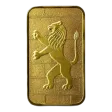
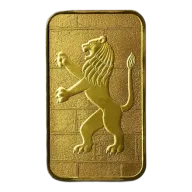
The lion depicted on the obverse is drawn from an 8th-century BCE seal discovered at Megiddo (the biblical Armageddon site) in 1908. The seal belonged to Shema, a servant of King Jeroboam II of Israel, and is one of the most important archaeological finds in Israeli history. The original seal is housed at the Istanbul Archaeological Museum, taken there during the Ottoman period. Using this nearly 3,000-year-old design connects the bar to the symbol of the Tribe of Judah and of Jerusalem, referenced in Genesis 49:9 and Revelation 5:5.
At 2.5g, this bar contains roughly $265 worth of gold at current prices. The limited mintage may support some premium above generic bars over time, though the Holy Land Mint lacks the LBMA accreditation that ensures universal buyback acceptance at major dealers. Each bar comes sealed in a tamper-evident assay card with a digital verification element and serial number matching between the bar and card.
Tax Treatment of the 2.5g Lion of Judah Gold Bar
As a 999.9 fine gold bar, this product qualifies for investment gold exemptions in most major markets. The bar is not legal tender in any jurisdiction; it is an investment bar produced by a private mint.
United Kingdom
Investment gold bars at 995+ purity are VAT-exempt. Subject to Capital Gains Tax on disposal at 18% (basic rate) or 24% (higher rate) on gains above the £3,000 annual allowance. Not CGT-exempt, as that benefit applies only to UK legal tender coins. Eligible for SIPP pension inclusion.
United States
No federal sales tax. State exemptions vary. Long-term capital gains taxed at up to 28% (collectibles rate). The bar's 999.9 purity exceeds the 99.5% IRA threshold, but IRA inclusion typically requires bars from LBMA-accredited refiners. The Holy Land Mint is not on the LBMA Good Delivery List, which may affect acceptance by some IRA custodians. Buyers should verify eligibility with their specific custodian before purchasing for IRA purposes.
Israel
Investment gold may be subject to Israeli VAT (17%) depending on the purchase channel. Israeli residents buying directly from ICMC may face different terms than international buyers.
Other Jurisdictions
- EU: VAT-exempt as investment gold (995+ purity) under Directive 98/80/EC
- Canada: GST/HST exempt at 99.5%+ purity
- Australia: GST-free for investment-grade gold at 99.5%+ purity
- Singapore: GST-exempt under the Investment Precious Metals scheme
- Hong Kong: No sales tax, no import duty, no capital gains tax
- UAE: Zero VAT on investment gold
The Megiddo Seal and the Holy Land Mint
The Lion of Judah design draws on nearly three millennia of history. The source image is an ancient Israelite seal discovered at Megiddo in 1908, dating to approximately 750 BCE. The seal is inscribed with the name Shema and identifies him as a servant of Jeroboam (King Jeroboam II of Israel, who reigned circa 786-746 BCE). The roaring lion carved into the jasper seal is one of the finest examples of ancient Near Eastern glyptic art, and the seal itself is classified among the most significant archaeological discoveries from the biblical period in Israel.
The lion as a symbol of the Tribe of Judah predates even this seal, rooted in the blessing of Jacob in Genesis 49:9: "Judah is a lion's whelp." The Lion of Judah became the symbol of the Davidic line and, later, of the city of Jerusalem. It appears in the Christian tradition in Revelation 5:5 as a title for Christ. The symbol was adopted by the Ethiopian Solomonic dynasty and featured prominently on the flag of Ethiopia until 1974. Rastafarian tradition also venerates the Lion of Judah as a symbol of Haile Selassie.
The Holy Land Mint itself has an unusual origin for a bullion producer. Founded in 1958 by David Ben-Gurion, Israel's first Prime Minister, ICMC served as a government institution for decades before privatisation in 2008. The company still holds the exclusive contract to distribute Bank of Israel commemorative coins, maintaining a formal connection to the state even as a private enterprise. The Lion of Judah series is described as the first design in a planned ongoing programme, suggesting annual or periodic design changes may follow.
Lion of Judah vs Other 2.5g Gold Bars
The Lion of Judah bar competes in two markets simultaneously: as an investment bar valued for its gold content, and as a limited-edition collectible valued for its cultural significance and low mintage. The comparison depends on which of these dimensions matters more to the buyer.
As Investment Bullion
For pure metal accumulation, bars from LBMA Good Delivery refiners offer better value. The 2.5g PAMP Fortuna provides Veriscan authentication, the deepest secondary market, and global buyback acceptance guaranteed by LBMA accreditation. The 2.5g IGR bar offers LBMA Good Delivery accreditation at a lower premium. Both deliver more straightforward liquidity than the Lion of Judah, which lacks LBMA accreditation and depends on dealer recognition of the Holy Land Mint brand for buyback.
As a Cultural/Collectible Product
The 7,777-piece mintage limit per denomination is substantially lower than any standard bullion product. For comparison, PAMP Fortuna bars have no mintage limit, and even themed series like the PAMP Lunar are produced in larger quantities. The biblical provenance of the Megiddo lion design, the Ben-Gurion founding of ICMC, and the bar's resonance with Jewish and Christian traditions give it a cultural dimension that commodity bars cannot match. The primary market for this appeal is the US, where availability through major dealers (APMEX, JM Bullion, GovMint, BGASC) is strongest.
Against PAMP Lunar
The 2.5g PAMP Lunar is the nearest equivalent as a themed collectible bar. Both combine 999.9 gold with cultural artwork and collector appeal. PAMP has stronger LBMA credentials, Veriscan technology, and broader dealer distribution. The Lion of Judah has a lower mintage and deeper historical roots. Both carry premiums above generic bars, with the premium justified by design and scarcity rather than metal content alone.