 BGASC
BGASC
1 listing
Filters
| Product | /oz | Premium | Price | |
|---|---|---|---|---|
| $5,094.42 | +22.36% | $818.93 | View Deal |

Prices are fetched automatically and may not reflect current merchant prices. Currency conversions and tax treatment are approximate. Rankings are based solely on price. We are not a dealer and accept no responsibility for transactions with listed merchants. Past performance is not indicative of future results. This site does not provide investment advice. Full disclaimer
About the 5g Lion of Judah Gold Bar
The 5g Lion of Judah Gold Bar
The Lion of Judah is the investment bar series of The Holy Land Mint, the trade name of Israel Coins and Medals Corp. (ICMC), and the 5g size is one of five gold denominations running from 1g to 1 oz. Every gold denomination is capped at 7,777 pieces, a figure rooted in the significance of the number seven in Jewish tradition, which makes this a hybrid of bullion bar and limited-mintage collectible rather than an open-ended production run. The bars are .9999 fine gold, sealed in tamper-evident assay cards, and are minted bars rather than legal tender; ICMC's Bank of Israel coins are a separate product line.
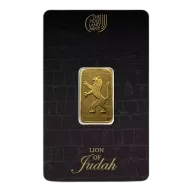
The design carries unusual provenance for a bullion product. The rearing lion is based on an ancient Israelite seal discovered at Megiddo in 1908, dating to the 8th century BCE and belonging to Shema, servant of King Jeroboam II, set against the Walls of the Old City of Jerusalem. The lion is the symbol of the Tribe of Judah and of Jerusalem, referenced in Genesis 49:9 and Revelation 5:5, which gives the bar a deliberate appeal to both Jewish and Christian buyers. ICMC itself was established in 1958 by David Ben-Gurion, Israel's first Prime Minister, as a government commemorative institution, and was privatised in 2008.
At 5g (0.1607 troy oz), the bar occupies the small-gold bracket where premiums run roughly 8-12% over spot, a step more efficient than 1g bars but well above the cost of 1oz gold bars. Buyers here are typically making a gift, an entry-level gold purchase, or a heritage-driven choice rather than optimising cost per gram; the fixed 7,777 mintage and the cultural theme are the differentiators that generic 5g bars from the Swiss refiners cannot offer.
5g Lion of Judah Specifications and Security
| Specification | Value |
|---|---|
| Weight | 5g (0.1607 troy oz) |
| Purity | .9999 fine gold |
| Dimensions | 13.9 x 23.1 x 1.1mm |
| Edge | Smooth |
| Mintage | 7,777 |
| Format | Minted bar in sealed assay card |
| Producer | The Holy Land Mint (Israel Coins and Medals Corp.) |
| Legal tender | No |
The obverse shows the Lion of Judah in left-profile relief against Jerusalem's Old City walls; the reverse carries the Holy Land Mint emblem with hallmarks, weight and purity markings, and an engraved serial number unique to each bar. Security is comprehensive for a bar of this size: the serial number on the bar matches the number printed on the assay card, the card's security film shows visible evidence of tampering, and a digital verification code on the back of the card lets buyers confirm authenticity online, measures comparable to PAMP's Veriscan or the Argor-Heraeus KineBar approach.
One fact worth knowing before resale: the Holy Land Mint is not on the LBMA Good Delivery List. The .9999 purity and assay certification are genuine, but some dealers price non-LBMA bars more cautiously than Swiss-refined equivalents, so keeping the assay card sealed and intact matters even more than usual. In its card the bar is roughly credit-card sized and stores flat.
Tax Treatment of the 5g Lion of Judah
At .9999 fineness, the bar qualifies as investment gold in every jurisdiction that defines one, so purchase taxes are zero across the major markets. The points of difference are CGT treatment and the bar's home market.
- UK: VAT-exempt as investment gold (995+ fineness), but as a bar it is CGT-liable on sale; only UK legal tender coins escape Capital Gains Tax. Availability is limited, so UK buyers may need specialist dealers or direct import.
- EU: VAT-exempt as investment gold across member states. Germany's rule that gains on gold held over a year are tax-free applies to bars as well as coins.
- US: No federal sales tax, and most states exempt bullion, though several use thresholds (Florida exempts above $500, New York and Louisiana above $1,000, California above $2,000), which a single 5g bar may sit below depending on the gold price. The US is the series' primary market, with strong demand from Christian and Jewish communities. Long-term gains are taxed at the collectibles rate of up to 28%.
- Israel: Investment gold may be subject to Israeli VAT at 17% unless purchased through specific tax-advantaged channels; terms differ for Israeli residents buying directly from ICMC.
- Canada, Australia, New Zealand: GST/HST-free and GST-free respectively as gold above the 99.5% purity threshold each country applies.
- Singapore and Hong Kong: Singapore exempts qualifying investment gold from GST and levies no capital gains tax; Hong Kong has no sales tax, duty, or CGT at all.
Lion of Judah 5g vs Swiss Bars and Fractional Coins
Every major LBMA-accredited refiner produces a 5g gold bar, so the direct competition is crowded: PAMP Suisse's Fortuna, Valcambi, Argor-Heraeus, Heraeus, Perth Mint, and the Royal Mint all offer the weight in assay cards. The Swiss bars hold the structural advantages, with LBMA accreditation, wider dealer networks, and universal buyback acceptance; a 5g PAMP Suisse gold bar is the recognisability benchmark at this size. The Lion of Judah competes on what they lack: a 7,777-piece fixed mintage where the majors run open production, an archaeologically sourced design with religious resonance, and the standing of the only major bullion producer in the Middle East. Its premiums sit above generic bars on mintage and collector appeal but below comparable PAMP products.
The other comparison is against fractional sovereign coins. A 5g bar costs roughly the same as a 1/10 oz gold coin, and a 1/10 oz Eagle, Britannia, or Maple Leaf generally offers better liquidity and brand recognition for that money, with the coin's legal tender status adding CGT exemption for UK buyers in the Britannia's case. The bar's counterargument is purity (.9999 against the Eagle's 22 carat) and the assay-card packaging.
Within the Lion of Judah range itself, the usual small-gold mathematics apply: the 10g and 1 oz bars spread manufacturing overhead across more metal, so the per-gram premium falls as the bar grows, with the 1oz Lion of Judah gold bar the efficient pick for buyers committed to the design. The 5g suits gifting and first purchases; serious accumulation is cheaper per gram further up the range.
5g Lion of Judah Gold Bar: frequently asked questions
-
The cheapest price we track today is $818.93. The bar contains 5 grams of .9999 fine gold, so its value closely follows the gold spot rate of $4,188.30 per troy ounce. The gold content works out to roughly 0.1608 troy ounces, giving a straightforward relationship between this bar's price and the daily spot fix.
-
The Holy Land Mint is the trade name of Israel Coins and Medals Corp. (ICMC), an Israeli precious metals producer established in 1958 by Israel's first Prime Minister, David Ben-Gurion, to commemorate national and historic events. ICMC was privatised in 2008. It holds the exclusive rights to distribute Bank of Israel commemorative coins and also produces investment bullion bars, including the Lion of Judah series, from its base in Israel.
-
The Lion of Judah is a symbol rooted in both Jewish and biblical tradition, representing the tribe of Judah and the lineage of King David. The specific lion depicted on Holy Land Mint bars is drawn from an ancient Israelite seal discovered at Megiddo, dating to the 8th century BCE. The obverse shows the lion rearing against the backdrop of the Walls of the Old City of Jerusalem, connecting the investment product to a significant archaeological find.