1 listing
Filters
| Product | /oz | Premium | Price | |
|---|---|---|---|---|

 A1mint
Out of Stock
A1mint
Out of Stock
|
$4,526.49 | +5.88% |
$145,529.22
£107,970
|
View Deal |
Prices are fetched automatically and may not reflect current merchant prices. Currency conversions and tax treatment are approximate. Rankings are based solely on price. We are not a dealer and accept no responsibility for transactions with listed merchants. Past performance is not indicative of future results. This site does not provide investment advice. Full disclaimer
About the 1 Kilo Baird Cast Bar Gold Bar
The UK's Only LBMA-Accredited Refinery in Kilo Format
The 1 Kilo Baird Gold Bar is produced by Baird & Co., the UK's largest and only LBMA-accredited gold refinery. Founded in 1967 by Tony Baird as a numismatic coin business, the company expanded into refining in 1979 and achieved LBMA membership in 2000. The refinery operates from a 30,000 square foot high-security facility in Beckton, East London, and has been an official Royal Mint Partner since 2016.
At 999.9 fine gold, the kilo bar is the largest standard minted bar in the Baird range. For UK investors specifically, Baird bars offer something no Swiss or German competitor can match: the gold is refined on British soil, from raw material to finished product under one roof. This domestic provenance appeals to buyers who prefer a fully UK supply chain, particularly for pension-eligible gold where HMRC-compliant custody is a consideration.
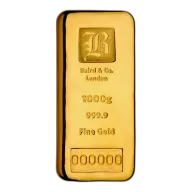
Baird produces both minted and cast kilo bars. Minted bars have a smooth, precision-stamped finish with the Baird & Co. hallmark, weight, fineness, and unique serial number. Cast bars have a rougher, hand-poured appearance and sometimes carry slightly lower premiums, though the gold content and purity are identical.
The kilo format targets serious investors deploying significant capital. Premiums on kilo bars run 1 to 2 percent over spot, making them the most cost-efficient way to buy physical gold. Compared to 1oz gold bars at 2 to 4 percent premiums, the savings on a $100,000 allocation are meaningful. The trade-off is that a single bar of this value cannot be partially liquidated and the buyer pool at resale is narrower than for smaller denominations.
Baird & Co. 1 Kilo Gold Bar Details
| Attribute | Detail |
|---|---|
| Weight | 1,000 grams (32.1507 troy ounces) |
| Purity | 999.9 fine gold (24 karat) |
| Manufacturer | Baird & Co. |
| Country of origin | United Kingdom (Beckton, East London) |
| LBMA accredited | Yes (since 2000) |
| Available formats | Minted and cast |
| Serial number | Yes (unique per bar) |
| Legal tender | No (bar, not coin) |
Security and Authentication
Each Baird kilo bar carries a unique serial number and the Baird & Co. hallmark confirming origin from an LBMA-accredited refinery. Smaller minted bars ship in tamper-evident assay card packaging, though kilo bars are typically supplied with an accompanying assay certificate rather than sealed card packaging. Unlike PAMP Suisse kilo bars which offer Veriscan digital authentication, Baird relies on traditional serial number verification and LBMA provenance records.
Baird produces both minted and cast variants at the kilo weight. Minted bars are precision-cut from rolled gold sheet, stamped, and polished, producing a smooth reflective finish. Cast bars are formed by pouring molten gold into moulds, resulting in a rougher, more organic texture with natural surface variations. Both carry identical purity and gold content. The minted format aligns with Baird's standard bar line; the cast format appeals to buyers who prefer the traditional poured appearance and potentially lower premium.
Baird Gold Bar Tax Position by Country
United Kingdom
Gold bars at 995+ purity are VAT-exempt as investment gold. Baird bars at 999.9 comfortably exceed this threshold. Gold bars are subject to CGT on disposal, since they carry no legal tender status. Gains above the £3,000 annual exempt amount are taxable at the individual's marginal rate. For UK investors with significant gains, this CGT liability can outweigh the premium savings compared to CGT-exempt legal tender coins like the 1oz Gold Britannia.
Baird gold bars are SIPP and SSAS eligible. HMRC requires minimum 995 fineness for pension-held gold (Baird bars at 999.9 qualify). The gold must be stored with an approved custodian. Baird & Co. offers its own vault storage at its Beckton facility, insured by Lloyd's of London, making it one of the few manufacturers that provides an end-to-end pension gold solution. Gold held within a SIPP is not subject to CGT.
United States
No federal sales tax. State tax varies by jurisdiction, with approximately 35 states exempting bullion. Capital gains taxed at up to 28% (collectibles rate). Baird bars at 999.9 purity meet IRS requirements for self-directed precious metals IRA inclusion (minimum 99.5%).
European Union
VAT-exempt as investment gold (995+ purity) under the EU Investment Gold Directive. CGT varies by country: Germany exempts after 12 months, Belgium has no CGT.
Singapore
Baird & Co. maintains a branch in Singapore (established 2013). Investment-grade gold is GST-exempt under Singapore's Investment Precious Metals scheme. No capital gains tax applies.
Canada and Australia
GST/HST-exempt in Canada and GST-free in Australia for gold at 99.5%+ purity.
Baird Kilo Bar vs Other 1kg Gold Bars
The 1kg gold bar market is dominated by Swiss refiners, with PAMP Suisse, Valcambi, and Argor-Heraeus commanding the largest share of international trade. The Heraeus kilo bar from Germany is also widely available. All share 999.9 purity and LBMA accreditation, so the practical differences are in brand recognition, packaging, security technology, and regional availability.
Baird's primary differentiator is UK provenance. For British investors, buying a Baird bar means the gold was refined in London. The Royal Mint kilo bar is also UK-produced, but the Royal Mint is primarily a coin mint that sources refined gold rather than operating its own refinery. Baird refines from raw material on-site. The Royal Mint carries stronger brand recognition and may command slightly higher premiums for that reason.
Against PAMP Suisse, Baird bars lack digital authentication technology. PAMP's Veriscan system allows each bar to be verified via smartphone app by scanning the bar's unique surface topology. Baird bars rely on traditional serial numbers and LBMA provenance. For buyers who prioritise authentication technology or plan to resell in Asian or Middle Eastern markets where PAMP has stronger brand recognition, the Swiss option may be preferable.
Against Metalor kilo bars, premiums are generally comparable. Metalor is a major Swiss refiner (founded 1852) popular with institutional buyers and pension schemes. Both are LBMA-accredited with equivalent purity. The choice between the two often comes down to regional preference: Baird for UK-focused buyers, Metalor for those seeking Swiss provenance.
For buyers whose primary concern is cost per gram, generic kilo gold bars from LBMA-accredited refiners offer the lowest premiums. The metal content is identical; the premium difference pays for brand specificity and potentially stronger resale recognition.
1 Kilo Baird Cast Bar Gold Bar: frequently asked questions
-
Cast bars are made by pouring molten gold into a mould, producing a rougher, more organic surface texture with natural variations. Minted bars are precision-cut from a rolled sheet and then stamped, giving a smooth, reflective finish and typically a sealed assay card. Both types carry identical purity and metal content; cast bars often carry slightly lower premiums because they are cheaper to produce.
-
The bar is 999.9 fine gold (four nines, 24 carat). This exceeds the HMRC minimum of 99.5% required for UK pension scheme (SIPP and SSAS) eligibility, and meets the EU Investment Gold Directive threshold for VAT exemption. Every bar carries the Baird & Co. hallmark, weight, fineness, and a unique serial number.
-
Baird & Co is a London-based precious metals company founded in 1967, with a refinery in Beckton, East London. They have been an LBMA member since 2000 and are an Official Royal Mint Partner. Gold is refined and bars are produced at their Beckton facility. The company also has an international branch in Singapore, established in 2013.