7 products · 30 deals
Filters
| Product | /oz | Premium | Price | |
|---|---|---|---|---|

7 deals
|
$4,429.91 | +1.95% |
$35,606.19
£26,683
|
Compare |
| $4,450.61 | +2.41% |
$35,772.54
€31,215
|
View Deal | |

14 deals
|
$4,465.36 | +2.76% |
$35,888.04
£26,894
|
Compare |
| $4,470.06 | +2.77% |
$35,928.89
A$50,462
|
View Deal | |
| $4,478.68 | +3.05% |
$35,998.17
€31,412
|
View Deal | |

2 deals
|
$4,484.06 | +3.20% |
$36,041.41
£27,009
|
Compare |

4 deals
|
$4,502.63 | +3.62% |
$36,190.68
£27,121
|
Compare |



Prices are fetched automatically and may not reflect current merchant prices. Currency conversions and tax treatment are approximate. Rankings are based solely on price. We are not a dealer and accept no responsibility for transactions with listed merchants. Past performance is not indicative of future results. This site does not provide investment advice. Full disclaimer
About 250g Gold Bars
The Quarter-Kilo: Where Retail Meets Institutional Pricing
A 250g gold bar contains 8.038 troy ounces of gold, placing it firmly in the territory of serious private investment. At current gold prices of approximately $3,300 per troy ounce, a single bar is worth around $26,500. This is not an entry-level purchase; buyers at this weight have typically already accumulated smaller bars or coins and are consolidating their position into fewer, more premium-efficient units.
The economic case for 250g bars is straightforward. Premiums at this weight are approximately 2-4% over spot, a meaningful step down from 100g gold bars (4-6%) and approaching the low premiums of 500g and kilo bars. The 250g bar is often cited as the sweet spot for private wealth preservation: it delivers institutional-grade premiums without requiring the roughly $50,000+ commitment of a 500g bar or the $100,000+ commitment of a kilo. A buyer allocating $100,000 to physical gold can acquire four 250g bars, maintaining some divisibility while capturing most of the premium advantage of larger sizes.
The weight is native to the European metric gold bar tradition. In Germany, Switzerland, Austria, and the broader EU, gram-denominated bars are the standard, and 250g is a well-established denomination stocked by banks, specialist dealers, and institutional precious metals houses. In the US, UK, and Australian markets, where troy-ounce bars dominate, the 250g weight is available but less commonly encountered. The nearest troy-ounce equivalent is the 10 oz bar (311g), which is a more natural fit for buyers in those markets.
Almost all 250g gold bars are produced at .9999 fineness (24 karat), qualifying for investment gold tax exemptions in every major jurisdiction. Both cast and minted versions are available, with cast bars carrying slightly lower premiums due to their simpler manufacturing process.
Premium Economics at 250g
The 250g weight occupies a favourable position on the premium curve. Below it, premiums rise steeply: a 1 oz gold bar typically carries 3-5% premiums, a 100g gold bar around 2-4%, while the 250g bar sits at approximately 2-3%. Above it, the savings continue but with diminishing returns: 500g bars and kilo bars compress premiums further, but the difference between a 250g bar and a kilo bar is smaller than the difference between a 1 oz bar and a 250g bar.
Cast bars at 250g typically trade at lower premiums than minted bars of the same weight. A cast bar is poured into a mould and has a rougher, more organic surface; a minted bar is cut from rolled gold sheet, polished, and stamped with precision detail. The premium difference reflects manufacturing cost, not gold content. Both contain exactly 250.00 grams of .9999 fine gold. For buyers focused purely on metal acquisition cost, cast bars at this weight offer the most efficient entry point. For buyers who value precise presentation and sealed assay-card packaging, minted bars justify their slight premium through easier resale and chain-of-custody documentation.
Buyback spreads from dealers are tight for 250g bars from LBMA-accredited refiners, typically 1-2% below spot for sealed, properly documented bars. The spread is comparable to 100g bars and tighter than for fractional-ounce bars, where dealer overhead per transaction is a larger percentage of the bar's value. This tight spread means the total round-trip cost (buy premium plus sell discount) is among the lowest available in the retail gold market.
Major 250g Gold Bar Options
The 250g weight is produced by virtually every LBMA-accredited refiner, giving buyers a wide selection. The differences between brands at this weight are in premium, security features, and regional liquidity.
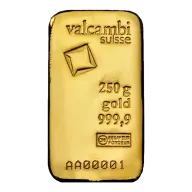
The 250g Valcambi bar is consistently among the most available and competitively priced options. Valcambi, based in Balerna, Switzerland, is one of the world's largest gold refiners and holds LBMA Good Delivery accreditation. Their cast bars at 250g offer a clean, Swiss-branded product at the low end of the branded premium range.
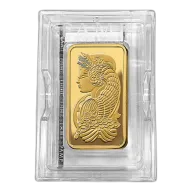
The 250g PAMP Suisse Fortuna bar carries a higher premium due to the Lady Fortuna design and PAMP's premium brand positioning. PAMP offers both cast and minted versions at this weight. The minted Fortuna bar comes sealed in a larger-format assay package with VeriScan digital authentication. For buyers who plan to hold and resell internationally, the PAMP name provides the broadest dealer recognition.
The 250g Heraeus bar is popular in the German-speaking European market. As an LBMA Good Delivery accredited German refiner, Heraeus bars are the home-market default in Germany, Austria, and Switzerland. Cast bars from Heraeus at 250g are a standard offering from European dealers.
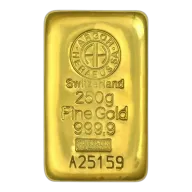
The 250g Argor-Heraeus bar offers the Kinebar holographic security feature on its minted bars. Argor-Heraeus, based in Mendrisio, Switzerland, has held LBMA accreditation since 1961 and is one of the oldest continuous gold refiners.
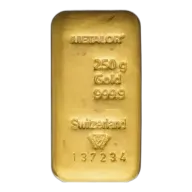
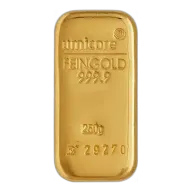
The 250g Umicore bar comes from the Belgian refinery with LBMA accreditation, popular across Western Europe. The 250g Metalor bar is another major Swiss refiner option, known for institutional-grade products with competitive premiums. Both offer cost-effective LBMA-branded alternatives to the higher-premium design bars.
For buyers seeking the absolute lowest premium, generic 250g gold bars (unbranded or from lesser-known LBMA refiners) are available from many dealers. These bars meet the same .9999 purity standard but trade closer to spot, with the trade-off of potentially wider buy-sell spreads at resale if the refiner is not widely recognised.
Resale and Storage at 250g
A 250g gold bar from an LBMA-accredited refiner in its original sealed packaging is globally liquid. Any major bullion dealer will buy it back without requiring re-assaying, and the transaction is straightforward. The limiting factor is not acceptance but buyer pool size: fewer individuals buy at the $26,500+ price point than at the popular 1 oz level, so a dealer may take slightly longer to match a buyer, depending on market conditions.
In European markets (particularly Germany, Switzerland, and the UK), 250g bars are a standard wholesale and retail denomination with strong dealer liquidity. In the US, the 10 oz bar (311g) is a more natural fit for the troy-ounce market, and US dealers may offer marginally wider spreads on 250g bars than on a 10 oz equivalent. In Asia-Pacific (Singapore, Hong Kong), 250g bars are well recognised alongside the metric range from the major Swiss refiners.
Breaking an assay card seal or removing a bar from its original packaging reduces resale value. For 250g bars specifically, this is a non-trivial concern: re-assaying a bar of this size may cost $50-100 or more, and the buyer may discount the bar further to compensate for the verification overhead. Best practice is to keep sealed bars intact throughout the holding period.
Storage Considerations
A 250g gold bar is compact for its value. A single bar is roughly the size of a small smartphone and fits easily in a personal safe, safe deposit box, or allocated vault. At approximately $26,500 per bar, the value density is extraordinarily high, making vault storage cost-effective on a per-dollar basis. Many European dealers offer allocated vault storage with insurance, and for bars at this value, professional storage is worth considering over home storage, particularly for multiple bars.
The authentication risk for larger bars is worth noting. Gold bars above 100g face a higher counterfeiting risk from tungsten-core substitution (tungsten's density of 19.25 g/cm3 is close enough to gold's 19.32 g/cm3 to pass simple weight checks). For secondary-market 250g bars not in sealed assay packaging, ultrasonic testing is the most reliable non-destructive authentication method. Buying from authorised dealers in sealed packaging eliminates this concern entirely.
250g Gold Bars: frequently asked questions
-
The raw gold value of a 250g bar is 250 divided by 31.1035 (roughly 8.04 troy oz) multiplied by $4,408.10 per troy oz. Retail prices from the 22 dealers stocking this weight across 36 listings will be higher, as they include a fabrication and dealer premium above the melt value.
-
A 250g gold bar weighs approximately 8.04 troy ounces. Physical dimensions vary by refiner and bar type: minted bars are flat and rectangular with a uniform thickness, while cast bars of the same weight tend to be chunkier and less uniform in shape. The actual size depends on the specific product and manufacturer.
-
Generally, yes. The fabrication cost per bar is largely fixed regardless of size, so it represents a smaller fraction of the metal value as weight increases. A 250g bar typically carries a lower percentage premium over spot per gram than a 1g or 10g bar, making it a more cost-efficient way to buy gold in quantity.
-
Rules differ by country. In the UK, there is no purchase reporting obligation, though gains on disposal must be declared for CGT purposes. In the US, dealers may be required to report certain large cash transactions above set thresholds. In Canada, 50% of any gain is taxable income. Check the rules in your jurisdiction before buying.
- 250g ABC Cast Bar Gold Bar
- 250g Ainslie Gold Bar
- 250g Argor-Heraeus Gold Bar
- 250g Austrian Mint Gold Bar
- 250g C.Hafner Gold Bar
- 250g Degussa Gold Bar
- 250g Fortuna Gold Bar
- 250g Gold Bar
- 250g Gold Bullion Australia Gold Bar
- 250g Heraeus Gold Bar
- 250g Metalor Gold Bar
- 250g PAMP Suisse Gold Bar
- 250g UBS Gold Bar
- 250g Umicore Gold Bar
- 250g Valcambi Gold Bar
- Pre-Owned 250g Baird & Co. Gold Bar
- Pre-Owned 250g Degussa Gold Bar
- Pre-Owned 250g Gold Bar
- Pre-Owned 250g Heraeus Gold Bar
- Pre-Owned 250g Metalor Gold Bar
- Pre-Owned 250g Swiss Bank Corporation Gold Bar