5 products · 25 deals
Filters

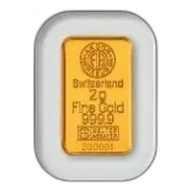

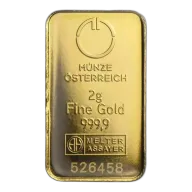

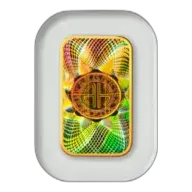


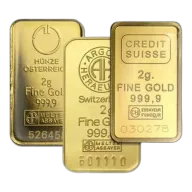
Prices are fetched automatically and may not reflect current merchant prices. Currency conversions and tax treatment are approximate. Rankings are based solely on price. We are not a dealer and accept no responsibility for transactions with listed merchants. Past performance is not indicative of future results. This site does not provide investment advice. Full disclaimer
About 2g Gold Bars
The 2 Gram Gold Bar: A Niche Denomination
A 2-gram gold bar contains 0.0643 troy ounces of gold, placing it firmly in the fractional category. At current gold prices, the metal content of a 2g bar is roughly equivalent to a modest restaurant meal, making it one of the most affordable ways to own refined gold from a major refiner. The standard purity is 99.99% (.9999 fine), and bars are sold in sealed assay cards from the manufacturer.
The 2g denomination sits in an unusual position within the metric gold bar range. The standard progression runs 1g, 2.5g, 5g, 10g, 20g, and up. The 2-gram bar falls between established steps and is produced by fewer refiners than its neighbours. This matters because fewer producers means less competition, which tends to keep premiums marginally higher than similarly sized alternatives. Buyers choosing between a 2g and a 2.5g gold bar will often find the 2.5g more widely available and priced more competitively per gram.
The primary market for 2-gram gold is Turkey and the Middle East, where round gram denominations align with local gold-buying customs. Istanbul Gold Refinery produces 2g bars specifically for this market. In Western markets (US, UK, Canada, Australia), the denomination is uncommon. Buyers in those regions typically choose 1g bars for gifting or novelty, or step up to 2.5g or 5g for fractional investment.
Roughly 20 different product groups exist at this weight, spanning major refiners including Argor-Heraeus, C.Hafner, Credit Suisse, Metalor, and the Argor-Heraeus Kinebar with its holographic security feature.
Premium Characteristics at 2 Grams
Premiums on 2g gold bars are high relative to larger denominations, consistent with the general rule that smaller bars cost more per gram to fabricate, package, and distribute. A 2g bar will typically carry a premium several times larger (as a percentage of spot) than a 1oz gold bar from the same refiner.
The 2g sits in a range where small differences in denomination have a disproportionate effect on premiums. Moving up to a 2.5g bar often costs only a fraction more in total but spreads the fabrication cost over 25% more gold, reducing the per-gram premium. Moving down to a 1g bar increases the per-gram premium further, but 1g bars benefit from higher production volumes and stronger demand as gifts and novelty items, which keeps premiums competitive at that size.
Brand premiums also apply. A 2g bar from PAMP Suisse, with its Lady Fortuna design and Veriscan technology, commands a higher premium than a 2g bar from a less recognisable LBMA refiner. The 2g Kinebar from Argor-Heraeus adds a modest premium for its holographic Kinegram security feature, typically just a few dollars above the standard Argor-Heraeus bar at this weight.
Buyback prices from dealers are generally at or near spot for bars from recognised LBMA refiners in original sealed packaging. Breaking the assay card seal before selling may reduce the price offered, as the bar would then need re-verification. The buy-sell spread on a 2g bar is wider in percentage terms than on larger bars, which is one reason this denomination is better suited to long-term holding than frequent trading.
Key Products at 2 Grams
The most widely available 2g gold bars come from Swiss and German LBMA-accredited refiners. Each bar is 99.99% fine gold in a sealed assay card, but they differ in design, security features, and brand recognition.
The 2g Argor-Heraeus bar is among the most commonly stocked at this weight. Argor-Heraeus, based in Mendrisio, Switzerland, has been LBMA-accredited since 1961 and serves as one of only seven LBMA referees globally. Their standard (Classic) bar carries a minimalist design with serial number and assay certification. For buyers who want additional security, the 2g Kinebar adds a Kinegram, a holographic optical element embossed directly into the gold surface using the same technology that secures banknotes. The Kinebar premium over the standard bar is small.
The 2g C.Hafner bar comes from Germany's oldest family-owned precious metals refinery, founded in 1850 in Pforzheim. C.Hafner is distinctive for using exclusively recycled secondary materials with no primary mining input. Their bars are LBMA Good Delivery certified (since 2013) and come in proprietary CertiCard tamper-evident packaging.
Credit Suisse 2g bars are manufactured by Valcambi SA in Switzerland. Credit Suisse gold bars first appeared in 1979, and the brand carries strong recognition globally. Following UBS's acquisition of Credit Suisse in 2023-2024, the long-term continuation of Credit Suisse branding on new bars is uncertain, though existing bars remain standard investment-grade bullion.
Other options include bars from Austrian Mint, Metalor, Scottsdale Mint, Perth Mint, and Sunshine Minting. For buyers focused purely on cost per gram, a generic 2g gold bar from an unspecified LBMA refiner will carry the lowest premium.
Resale and Storage at 2 Grams
Liquidity on a 2g gold bar is moderate. Any established bullion dealer will buy a 2g bar from a recognised LBMA refiner (PAMP, Argor-Heraeus, Valcambi, Heraeus, Metalor, C.Hafner) in its original sealed assay card. The complication is that 2g is a non-standard denomination: dealers may not have it listed in their active buyback inventories, which can mean a slightly longer processing time or a marginally wider spread compared to standard denominations like 1g, 2.5g, or 5g.
The absolute value of a 2g bar is low enough that selling a single bar in isolation is often uneconomical when factoring in shipping and insurance costs. Sellers typically combine 2g bars with other items in a single shipment, or sell through a local dealer in person. This is a practical consideration for anyone buying 2g bars as a savings vehicle rather than a one-time purchase.
Storage is straightforward. The assay card is credit-card sized, and the gold bar within it is a tiny rectangle. Dozens of 2g bars can fit in a small safe deposit box or home safe. There are no special handling requirements beyond keeping the assay card sealed and protected from physical damage. The sealed packaging protects the bar from contact with other metals or surfaces that could mark the soft gold.
For comparison, a single 1oz gold bar stores roughly 15.5 times the gold value in approximately the same physical footprint (the assay card is slightly larger). Buyers who do not need the granularity of 2-gram increments will find larger bars far more efficient in terms of premium paid per unit of gold and resale convenience.
2g Gold Bars: frequently asked questions
-
The melt value of a 2g gold bar is 2 divided by 31.1035 (0.0643 troy oz) multiplied by $4,408.10 per troy oz. The retail price you pay will be above that because small bars carry a higher per-gram fabrication premium than larger bars. Compare live dealer prices in the listing table for the actual buy price.
-
A 2g gold bar is very compact, as you would expect for just two grams of metal. Minted bars are flat and rectangular, and most come sealed in an assay card or blister pack that is somewhat larger than the bar itself. Cast bars of the same weight are chunkier and less uniform in shape.
-
Several LBMA-accredited refiners produce 2g gold bars, typically packaged with an individual assay certificate confirming weight and purity. Buying from an accredited refiner means the bar will be accepted without re-assay by most dealers and banks when you sell.
- 2g Argor-Heraeus Gold Bar
- 2g Bullion Works SA Gold Bar
- 2g C.Hafner Gold Bar
- 2g Credit Suisse Gold Bar
- 2g Credit Suisse Liberty Gold Bar
- 2g Engelhard Bar Gold Bar
- 2g Gold Bar
- 2g Johnson Matthey Gold Bar
- 2g Kinebar Gold Bar
- 2g Metalor Gold Bar
- 2g PAMP Suisse Gold Bar
- 2g Perth Mint Gold Bar
- 2g Royal Canadian Mint Gold Bar
- 2g Sunshine Minting Gold Bar
- 2g Swiss Kantonalbank Gold Bar
- 2g UBS Gold Bar
- 2g Valcambi Gold Bar
- Pre-Owned 2g Gold Bar