1 listing
Filters
| Product | /oz | Premium | Price | |
|---|---|---|---|---|

 Suisse Gold
Out of Stock
Suisse Gold
Out of Stock
|
$4,542.98 | +4.54% |
$73,031.96
€63,728
|
View Deal |
Prices are fetched automatically and may not reflect current merchant prices. Currency conversions and tax treatment are approximate. Rankings are based solely on price. We are not a dealer and accept no responsibility for transactions with listed merchants. Past performance is not indicative of future results. This site does not provide investment advice. Full disclaimer
About the 500g Austrian Mint Gold Bar
Half-Kilo Gold from Europe's Oldest Mint
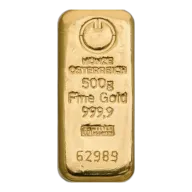
The 500g Austrian Mint Gold Bar is a cast bar produced by Munze Osterreich (the Austrian Mint), one of the oldest continuously operating mints in the world. The Austrian Mint traces its origins to 1194, when Duke Leopold V of Austria used the ransom silver paid for King Richard the Lionheart to establish large-scale coin production in Vienna. That eight-century heritage gives the mint an institutional weight that few competitors can match.
The bar contains 500 grams (16.075 troy ounces) of 999.9 fine gold. At half a kilogram, it represents a substantial investment, positioned between the more commonly traded 250g and 1 kilo sizes in the metric weight hierarchy. The 500g denomination is a sweet spot in the metric bar market: close to institutional-level premium efficiency, but at roughly half the capital outlay of a kilo bar. This makes it accessible to serious private investors who find a full kilo too concentrated in a single piece.
The cast format distinguishes this bar from the Austrian Mint's more famous minted products, such as the Gold Philharmonic coin series. Cast bars are produced by pouring molten gold into a mould, giving each bar a slightly different surface texture and the traditional hand-poured appearance that many bullion buyers prefer. Cast bars also carry modestly lower premiums than minted bars of equivalent weight, since the production process is simpler and less labour-intensive.
The Austrian Mint is an LBMA-accredited refiner, giving its bars universal recognition in international bullion markets. For European buyers, particularly those in Germany, Austria, and Switzerland where metric gold bars are the standard investment format, the Austrian Mint brand carries strong domestic recognition alongside its LBMA credentials.
500g Austrian Mint Gold Bar Technical Details
| Attribute | Detail |
|---|---|
| Weight | 500 g (16.075 troy oz) |
| Purity | 999.9 fine gold (24 karat) |
| Manufacturer | Munze Osterreich (Austrian Mint) |
| Type | Cast bar |
| Accreditation | LBMA-accredited refiner |
| Serial Number | Individually serialised |
| Assay | Assay certificate included |
| Face Value | None (not legal tender) |
The 999.9 purity exceeds the LBMA Good Delivery minimum of 995 fine and comfortably meets all international thresholds for tax-exempt investment gold. The Austrian Mint's gold bars carry the mint's hallmark, a weight and fineness stamp, and a unique serial number that allows individual bar tracking through the supply chain.
The Austrian Mint has operated continuously since 1194 and is a subsidiary of the Austrian National Bank (Oesterreichische Nationalbank). This government ownership provides an implicit sovereign guarantee behind the mint's products, though the bars themselves are not legal tender and carry no face value. The mint is best known internationally for the Vienna Philharmonic coin series, launched in 1989, which has been the world's best-selling gold coin in several years since.
Tax Treatment of the 500g Austrian Mint Gold Bar
This bar qualifies as investment gold under all major tax frameworks, thanks to its 999.9 purity and production by an LBMA-accredited refiner.
European Union
VAT-exempt under the EU Investment Gold Directive (Council Directive 98/80/EC), which exempts gold bars at 995+ fine from VAT across all member states. As an Austrian product, the bar is produced within the EU and trades freely across borders without attracting import duties or additional VAT.
United Kingdom
VAT-exempt on purchase. Gold bars at 995+ purity are zero-rated for VAT. Capital gains tax applies on disposal, as bars lack legal tender status. The annual CGT exempt amount is £3,000. For UK investors seeking CGT-free gold, legal tender coins such as Britannias and Sovereigns are the alternative, though they carry higher premiums at equivalent weights. Gold bars held in a SIPP pension wrapper are exempt from CGT.
United States
IRA-eligible. The 999.9 purity exceeds the IRS Section 408(m) minimum of 99.5%, and the Austrian Mint holds LBMA accreditation. Bars must be stored with an approved custodian. Federal capital gains on gold bars are taxed at the 28% collectibles rate for long-term holdings. State sales tax varies by state.
Austria and Germany
Investment gold is VAT-exempt across the EU. In Germany specifically, gold held for more than one year is exempt from capital gains tax entirely, making gold bars the most tax-efficient precious metals investment for German residents willing to hold. Austria applies a 27.5% flat tax on capital gains from precious metals with no holding-period exemption.
Australia and Canada
GST-free in Australia (gold at 99.5%+) and GST/HST exempt in Canada (gold at 99.5%+).
Singapore and Hong Kong
Singapore exempts investment precious metals from GST. Hong Kong has no sales tax, import duty, or capital gains tax on gold.
Austrian Mint 500g vs Swiss and German Competitors
The 500g gold bar market is dominated by European refiners. The Austrian Mint competes directly with Heraeus, PAMP Suisse, Valcambi, Argor-Heraeus, and Umicore at this weight. All share 999.9 fine purity and LBMA accreditation, so the practical differences come down to brand premiums, regional availability, and security features.
PAMP Suisse bars command the highest premiums among Swiss refiners, driven by the Fortuna design's brand recognition and VeriScan digital authentication. For a 500g bar, the premium gap between PAMP and the Austrian Mint is meaningful in absolute terms, given the high base value. Buyers who prioritise gold content per dollar over brand prestige will find the Austrian Mint more cost-effective.
Heraeus is the Austrian Mint's closest competitor in the German-speaking market. Both are well-established brands with deep recognition in Germany, Austria, and Switzerland. Heraeus bars are produced in Hanau, Germany, and carry comparable premiums. The choice between them often comes down to dealer availability and personal preference rather than any functional difference.
The 500g Baird & Co. Gold Bar offers a UK-manufactured alternative. Baird is the only LBMA-accredited gold refinery based in the UK, which appeals to British investors who value domestic provenance. Premiums on Baird bars are generally competitive with Continental European producers.
Compared to stepping down to a 250g gold bar, the 500g denomination delivers better premium efficiency per gram, with the premium compression from 250g to 500g being one of the more significant jumps in the metric bar range. The trade-off is double the capital commitment and reduced divisibility. For investors who may need to liquidate portions of their position, two 250g bars provide better flexibility than one 500g bar at a modest aggregate premium penalty.
500g Austrian Mint Gold Bar: frequently asked questions
-
The Austrian Mint 500g bar is 999.9 fine gold, equivalent to 24 carat. This is the highest purity standard for investment gold bars.