5 products · 15 deals
Filters

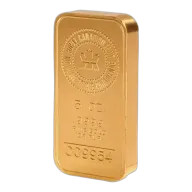

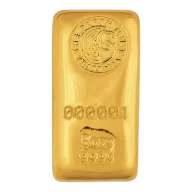

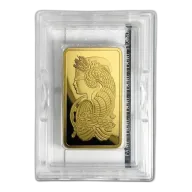

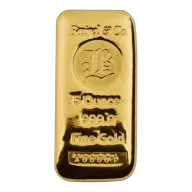

Prices are fetched automatically and may not reflect current merchant prices. Currency conversions and tax treatment are approximate. Rankings are based solely on price. We are not a dealer and accept no responsibility for transactions with listed merchants. Past performance is not indicative of future results. This site does not provide investment advice. Full disclaimer
About 5 oz Gold Bars
A High-Value Step Between 1 oz and 10 oz Gold
A 5 oz gold bar contains 155.517 grams of gold, which at 2026 prices makes it a $15,000-plus purchase. That figure shapes the whole category: in gold, 5 oz is a high-value item that sits well beyond impulse-buy territory, and it remains uncommon outside institutional buying. The typical buyer is consolidating a meaningful allocation into fewer pieces, having outgrown 1oz gold bars but not yet ready for the outlay of a 10oz gold bar or kilo bar.
The economic logic of moving up the bar scale applies here as everywhere in gold bars: premium scales inversely with size. Bars already carry the lowest premiums of any gold form, and each step up in weight spreads fabrication costs across more metal. The 5 oz weight occupies an in-between position on that curve, more efficient per ounce than 1 oz bars but slightly less so than 10 oz bars. The tradeoff for the better rate is lumpiness. A 5 oz bar can only be sold as a single $15,000-plus transaction, where five 1 oz bars could be liquidated one at a time as cash needs arise.
It is worth knowing that 5 oz is a somewhat Anglo-American denomination. It is not a traditional bar weight in European or Asian markets, where metric sizes such as 100g, 250g, 500g and 1kg dominate. Buyers comparing internationally will find the 100g bar (just under 5 oz at 100 grams versus 155.5) and the 250g bar bracket this weight in metric markets, often with deeper product ranges behind them.
As with all gold bars, 5 oz pieces are not legal tender and carry no face value. They come from private and government refiners in both cast form (poured into moulds, rougher finish, lower premium) and minted form (cut from rolled sheet, polished, often sealed in a tamper-evident assay card with serial number, weight, purity and the refiner's hallmark). Standard retail purity is 999.9 fine. For a buyer deploying serious capital who values metal-per-dollar over divisibility, the 5 oz bar is a defensible middle choice; for maximum premium efficiency the kilo bar remains the end point of the curve.
Where 5 oz Sits on the Gold Bar Premium Curve
Gold bars carry the lowest premiums of any form of gold, and the percentage falls as the bar gets bigger. At the small end, 1g bars can run 15-25% over spot. By 1 oz, minted bars typically carry 1-4% and cast bars 1-3%. At 100g the typical range is 2-4%, and 1kg bars reach 1-2%, the lowest percentage premium of any commonly traded retail bar. The 5 oz weight sits between the 1 oz and 10 oz points on this curve: lower premiums than 1 oz bars, slightly higher per ounce than 10 oz bars.
Two product-level choices move the premium within the weight class. Cast bars are cheaper than minted bars of the same weight because the rougher poured finish is simpler to produce; several dealers in our data stock 5 oz cast bars from refiners such as ABC alongside minted product. And brand carries a price: PAMP Suisse Fortuna bars command a modest premium over generic refiner bars on the strength of brand recognition and the Fortuna design. A buyer optimising purely for gold content per dollar would pick a generic or cast 5 oz bar; one optimising for resale recognition might pay the Fortuna's brand margin.
The dollar stakes justify careful comparison. On a $15,000-plus purchase, a single percentage point of premium is over $150, so the spread between the cheapest and most expensive dealer listing for the same bar can amount to hundreds of dollars. The same logic explains why bar buyers at scale keep climbing the weight ladder: across a large allocation, choosing bars over coins, and bigger bars over smaller ones, can save thousands. A $100,000 allocation in bars rather than coins can save $2,000-4,000 in premiums.
The counterweight is exit flexibility. The premium saved by consolidating into 5 oz pieces is only banked if the eventual sale goes smoothly, and bars generally carry slightly wider buy-sell spreads than well-known sovereign mint coins at retail, since coins have stronger brand recognition and standardised appearance. Keeping minted bars sealed in their assay cards protects the resale side of the equation, because a broken seal can mean re-assaying before a dealer will pay full price.
Who Makes 5 oz Gold Bars
Because 5 oz gold is a niche weight, the product range is narrower than at 1 oz or kilo size, but the names behind it are the familiar ones. The refiners active at this weight include PAMP Suisse, Valcambi and the Perth Mint, all LBMA-accredited houses whose bars enjoy universal dealer recognition.
The PAMP Suisse entry is the 5 oz Fortuna gold bar, carrying the refiner's iconic Fortuna design. PAMP bars are widely recognised and the Fortuna range commands a modest premium over generic refiner bars for that recognition. PAMP and Valcambi bars also include VeriScan technology for verification, and minted bars from these refiners arrive sealed in tamper-evident assay cards listing serial number, weight and purity.
The Perth Mint 5 oz gold bar brings government backing: the mint is owned by the Western Australian Government and its bars carry the kangaroo design. For buyers who want a sovereign connection in bar form, this is the closest equivalent at this weight.
Beyond the marquee names, our dealer listings at this weight include generic 5 oz gold bars (the most widely stocked option), ABC cast bars, Scottsdale Mint bars, and older-brand bars from Johnson Matthey and Engelhard circulating on the secondary market. Generic and cast bars price closest to melt; the trade-off is that unbranded bars or bars from non-LBMA refiners can be harder to sell and may require assay testing at the buyer's expense before a dealer accepts them.
Choosing between them comes down to the standard bar calculus, sharpened by the high unit value. A sealed, serialised bar from an LBMA-accredited refiner (PAMP, Valcambi, Perth Mint) maximises resale ease internationally. A cast or generic bar maximises gold per dollar. At $15,000-plus per piece, many buyers conclude the LBMA name is worth its small extra cost, since the dollar consequence of a difficult resale dwarfs the premium saved at purchase. Buyers wanting the recognised designs at a lower unit cost can find the same refiners' product down the scale, for example the 1oz PAMP Suisse gold bar.
Selling and Storing a 5 oz Gold Bar
Liquidity at this weight follows the general rule for larger gold bars: the bars are perfectly saleable, but the buyer pool narrows compared with 1 oz product, simply because fewer retail buyers operate at a $15,000-plus price point. Established dealers and refiners readily accept them, and fewer 5 oz pieces trade hands than 1 oz or 10 oz product, so a seller may shop around a little more for the best bid. Bars from LBMA-accredited refiners in sealed assay cards travel best; generic or non-LBMA bars may need assay testing at the buyer's expense before resale.
The assay card is the single most important thing to protect. Breaking the tamper-evident seal reduces resale value because the bar may then need re-assaying before a dealer will take it at full price. Keep sealed bars sealed, and store the cards flat rather than standing on edge, as the cards themselves are fragile even though they protect the bar from contact damage.
Authentication deserves a mention at this size. Gold bars face a counterfeiting threat coins do not: tungsten's density (19.25 g/cm3) is close enough to gold's (19.32 g/cm3) that a plated tungsten bar can pass weight and dimension checks, a risk most relevant for bars of 100g and up, which includes the 155.5g 5 oz bar. XRF readers only penetrate 10-50 microns of surface, so they cannot rule out a core substitution. Ultrasonic testing is the reliable non-destructive method, since gold and tungsten carry sound at very different velocities. For retail buyers the practical answer is simpler: buy from authorised dealers, in sealed assay cards, and the risk effectively disappears. It is secondary-market bars with broken or absent packaging that warrant testing.
Storage is where the 5 oz gold bar excels. Gold bars offer the most compact value-to-space ratio of any gold form, and a 5 oz bar is a small, dense object that is easy to store anywhere, in a home safe, a deposit box, or professional vaulting. Minted bars in cards stack flat and efficiently; cast bars are less uniform and stack slightly less neatly. Given gold's softness, avoid storing unpackaged bars loose against each other, as surface scratches reduce resale appeal.
5 oz Gold Bars: frequently asked questions
-
A 5 oz gold bar contains 5 oz of gold, giving a melt value of 5 multiplied by $4,408.10 per troy oz. The 14 dealers we track for this weight sell at a premium above that figure to cover fabrication and handling. The live listings on this page show current retail prices across all dealers.
-
A 5 troy ounce gold bar weighs 5 oz (5 × 31.1035 g/ozt = 155.52 g). Troy ounces and metric grams are different units, so it is worth converting before comparing prices across bars quoted in different weight systems.
-
At 5 troy ounces, brand and accreditation carry real weight. Bars from LBMA-accredited refiners are accepted by dealers globally without additional verification. Lesser-known producers may carry a lower purchase premium but can be harder to sell quickly, which matters more at larger sizes where the resale transaction value is significant.
-
Investment gold bars are VAT-free in the UK (0%) and in Canada (0%). In the US there is no federal sales tax on purchases, though state rules vary. When selling, capital gains tax applies in most countries: UK sellers pay CGT at 18% or 24% above the annual allowance, while US sellers may pay up to 28% on gains.
-
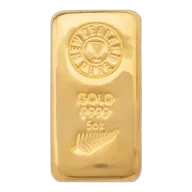
A 5 oz gold bar is noticeably larger and heavier than a small bar, reflecting its weight of around 155 grams. Minted bars are flat and rectangular, typically bearing the refiner's hallmark, a unique serial number, and the weight and purity stamped on the face. Cast bars of the same weight are chunkier and less geometrically precise.
- 5 oz 9Fine Mint Gold Bar
- 5 oz ABC Cast Bar Gold Bar
- 5 oz Ainslie Gold Bar
- 5 oz Argor-Heraeus Gold Bar
- 5 oz Credit Suisse Gold Bar
- 5 oz Fortuna Gold Bar
- 5 oz Go Gold Bar
- 5 oz Gold Bar
- 5 oz Gold Bullion Australia Gold Bar
- 5 oz Istanbul Gold Refinery Gold Bar
- 5 oz Italpreziosi Bars Gold Bar
- 5 oz Johnson Matthey Gold Bar
- 5 oz PAMP Suisse Gold Bar
- 5 oz Perth Mint Gold Bar
- 5 oz Republic Metals Corporation Gold Bar
- 5 oz Royal Canadian Mint Gold Bar
- 5 oz Scottsdale Mint Gold Bar
- 5 oz Sunshine Minting Gold Bar
- 5 oz Valcambi Gold Bar
- Pre-Owned 5 oz Baird & Co. Gold Bar
- Pre-Owned 5 oz Engelhard Gold Bar
- Pre-Owned 5 oz Fortuna Gold Bar
- Pre-Owned 5 oz Gold Bar
- Pre-Owned 5 oz Perth Mint Gold Bar