32 listings
Filters
| Product | /oz | Premium | Price | |
|---|---|---|---|---|

 IDC Coin and Bullion
|
$4,494.19 | +1.95% | $2,247.10 | View Deal |
 Bullion Standard
|
$4,523.86 | +2.63% | $2,261.94 | View Deal |
 Bullion Standard
|
$4,568.64 | +3.64% | $2,284.33 | View Deal |
 Coins Online
|
$4,724.47 | +7.18% | $2,362.24 | View Deal |
 Golden Eagle Coins
|
$4,766.13 | +8.12% | $2,383.07 | View Deal |
 Golden Eagle Coins
|
$4,766.13 | +8.12% | $2,383.07 | View Deal |
| $4,800.96 | +8.91% | $2,400.47 | View Deal | |
|
1/
BullionStar US
|
$4,808.50 | +9.08% | $2,404.26 | View Deal |

 Baird & Co.
|
$4,747.33 | +9.25% |
$2,373.66
£1,779
|
View Deal |
 Golden Eagle Coins
|
$4,832.00 | +9.62% | $2,416.01 | View Deal |
 Golden Eagle Coins
|
$4,842.74 | +9.86% | $2,421.38 | View Deal |
 Golden Eagle Coins
|
$4,892.75 | +10.99% | $2,446.38 | View Deal |
 Golden Eagle Coins
|
$4,919.86 | +11.61% | $2,459.94 | View Deal |
| $4,929.28 | +13.44% |
$2,464.72
£1,847
|
View Deal | |
| $4,929.28 | +13.44% |
$2,464.72
£1,847
|
View Deal | |
| $4,929.28 | +13.44% |
$2,464.72
£1,847
|
View Deal | |
| $4,929.28 | +13.44% |
$2,464.72
£1,847
|
View Deal | |
 Golden Eagle Coins
|
$5,051.64 | +14.60% | $2,525.83 | View Deal |
 Golden Eagle Coins
|
$5,051.64 | +14.60% | $2,525.83 | View Deal |

 BullionStar
|
$5,012.02 | +15.05% |
$2,506.06
S$3,204
|
View Deal |
|
20
BullionStar
|
$5,012.02 | +15.05% |
$2,506.06
S$3,204
|
View Deal |
|
20
BullionStar
|
$5,012.02 | +15.05% |
$2,506.06
S$3,204
|
View Deal |
| $5,147.63 | +18.46% |
$2,573.79
£1,929
|
View Deal | |
|
19
BullionStar
|
$5,185.26 | +19.03% |
$2,592.62
S$3,314
|
View Deal |
|
19
BullionStar
|
$5,185.26 | +19.03% |
$2,592.62
S$3,314
|
View Deal |
 Golden Eagle Coins
|
$5,271.28 | +19.58% | $2,635.65 | View Deal |
 Golden Eagle Coins
|
$5,271.28 | +19.58% | $2,635.65 | View Deal |
 Golden Eagle Coins
|
$5,359.14 | +21.57% | $2,679.58 | View Deal |
 Golden Eagle Coins
|
$5,359.14 | +21.57% | $2,679.58 | View Deal |
 Golden Eagle Coins
|
$5,447.00 | +23.57% | $2,723.51 | View Deal |













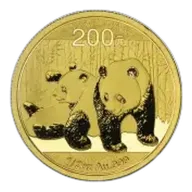


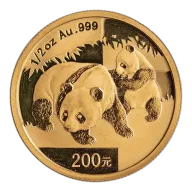

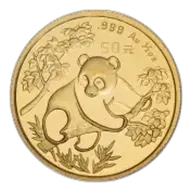


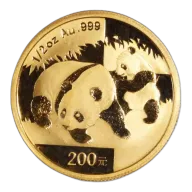


Prices are fetched automatically and may not reflect current merchant prices. Currency conversions and tax treatment are approximate. Rankings are based solely on price. We are not a dealer and accept no responsibility for transactions with listed merchants. Past performance is not indicative of future results. This site does not provide investment advice. Full disclaimer
About the 1/2 oz Panda Gold Coin
The 1/2 oz Gold Panda in Context
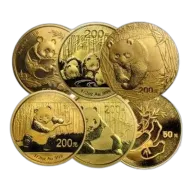
The 1/2 oz Gold Panda from China Gold Coin Corporation contains 15.5518 grams of .999 fine gold and serves as the mid-range fractional option in the Panda series. For buyers drawn to the Panda's annually changing reverse designs, the 1/2 oz size offers a meaningful gold position at roughly half the cost of the full-size coin, with a premium penalty that sits below that of the smaller 1/4 oz and 1/10 oz denominations.
The Panda occupies an unusual position in the bullion market. Its annually rotating panda designs create collector demand that pushes premiums above most competing coins at the same weight. A 1/2 oz Gold Philharmonic or 1/2 oz Gold Maple Leaf will typically cost less per gram of gold, but neither carries the year-specific collectibility that Pandas offer. Buyers need to decide whether they are purchasing primarily for metal content or for the combination of metal and collector appeal.
One detail that catches many buyers off guard: pre-2016 Gold Pandas at this size weighed a full 1/2 troy ounce (15.552 g) and carried a 50 yuan face value. From 2016 onwards, China switched the series from troy ounces to metric grams, making the standard size 15 grams (0.4823 troy oz) with a 200 yuan face value. The current 1/2 oz listing on most dealer sites refers to the pre-2016 format or uses "1/2 oz" loosely for the 15 g coin. The practical difference is small (about 3.5% less gold in post-2016 coins), but it matters for exact comparisons with Western coins that remain in troy ounce format.
Counterfeiting is a more significant concern with Pandas than with most sovereign coins. The annually changing designs make visual verification harder, and the series lacks the advanced anti-counterfeiting features found on coins like the 1/2 oz Gold Britannia, which carries latent images, surface animation, micro-text, and tincture lines from 2021 onwards. Buying from established dealers or purchasing coins with NGC/PCGS certification reduces this risk substantially.
1/2 oz Gold Panda Specifications
| Specification | Pre-2016 | Post-2016 |
|---|---|---|
| Fine gold content | 15.552 g (1/2 troy oz) | 15 g (0.4823 troy oz) |
| Purity | .999 (24 karat) | .999 (24 karat) |
| Diameter | 27.00 mm | 27 mm |
| Thickness | 1.85 mm | 1.85 mm |
| Face value | 50 yuan | 200 yuan |
| Edge | Reeded | Reeded |
| Mint | China Gold Coin Corporation (Beijing, Shanghai, Shenyang, or Shenzhen) | |
The physical dimensions remained unchanged when China switched from troy ounces to metric grams in 2016. The 200 yuan face value on post-2016 coins replaced the earlier 50 yuan denomination, a fourfold increase that aligned the face values more proportionally with the denomination structure of the new metric sizes. The switch itself was the most significant weight system change in modern bullion history; China argued it aligned the series with the metric system used domestically, but the practical effect was 3.5% less gold per coin at comparable retail prices.
Unlike Western sovereign mints that operate a single facility, the CGCC strikes Pandas at multiple locations (Beijing, Shanghai, Shenyang, and Shenzhen) without standardised mintmarks. This makes attribution to a specific mint difficult. Some years have subtle die differences that specialists can identify, but this is not a consistent system and the CGCC provides no official guidance on distinguishing production facilities.
The .999 purity (three nines) sits below the .9999 (four nines) standard used by the Gold Maple Leaf, Gold Britannia, Gold Philharmonic, and Gold Kangaroo. This is a design choice China has maintained since the series launched in 1982. The security features on the Panda have improved in recent years with radial line backgrounds and micro-engraved security marks, but the series still lacks the advanced anti-counterfeiting technology found on coins like the Maple Leaf (Bullion DNA) or the Britannia (latent image, surface animation).
Gold Panda Tax Treatment by Country
The Gold Panda's tax position varies by jurisdiction, with one notable surprise around US retirement account eligibility.
- United Kingdom: Gold Pandas are VAT-exempt as investment gold, meeting the purity threshold for post-1800 legal tender coins at 99.9% fineness. They are not CGT-exempt, as only UK legal tender coins (such as the Gold Britannia) qualify for that exemption. The annual CGT allowance is currently £3,000.
- United States: Gold Pandas are generally considered not IRA-eligible. The IRS does not recognise the Chinese mint as an approved foreign mint for gold IRA purposes, and the coins' semi-numismatic nature can classify them as collectibles. This is a significant distinction from the 1/4 oz American Eagle, which has explicit IRA approval. Silver Pandas, by contrast, are typically accepted for IRA inclusion at .999 purity. Capital gains on gold Pandas are taxed at the collectibles rate of up to 28%. State sales tax varies; roughly 35 states exempt bullion purchases.
- Canada: GST/HST-exempt on gold at 99.5% or higher purity. The Panda's .999 fineness qualifies. Capital gains are taxed at the standard 50% inclusion rate. Gold Pandas are not eligible for RRSP or TFSA accounts.
- Australia: GST-free as investment-grade gold (99.5%+ purity threshold met). Capital gains tax applies on disposal, with a 50% discount for holdings over 12 months.
- European Union: VAT-exempt under the EU investment gold directive. Silver Pandas are subject to local VAT rates, which vary from 17% (Luxembourg) to 27% (Hungary).
- Singapore: GST-exempt under the Investment Precious Metals (IPM) scheme for gold at 99.5%+ purity. No capital gains tax in Singapore.
- Hong Kong: No sales tax, no import duty, and no capital gains tax on gold. One of the most tax-efficient jurisdictions for Panda purchases, with strong regional availability.
- South Africa: Gold coins are zero-rated for VAT purposes. Capital gains are taxed with a 40% inclusion rate for individuals.
1/2 oz Gold Panda vs Competing Fractional Coins
The 1/2 oz Gold Panda sits in a crowded field of half-ounce sovereign coins. The key question is whether the Panda's distinctive characteristics justify its typically higher premiums.
Against the 1/2 oz Gold Philharmonic, the Panda trades at a notable premium difference. The Philharmonic is .9999 fine (one nine purer), carries a euro face value, and benefits from the Austrian Mint's 800-year heritage. The Philharmonic's design is fixed, so no year-to-year collector premium exists. For buyers focused purely on gold content per dollar, the Philharmonic is the stronger choice. For buyers who value the annually changing designs and are comfortable paying for that collector element, the Panda offers something the Philharmonic does not.
The 1/2 oz Gold Krugerrand takes a different approach entirely. At 22 karat (.9167 fine), the Krugerrand contains exactly 1/2 troy oz of fine gold but weighs 16.965 g total due to its copper alloy. This gives it a distinctive orange-gold colour and greater scratch resistance than the softer .999 Panda. The Krugerrand typically carries the lowest premiums of any major sovereign half-ounce coin, thanks to decades of massive production volume. It lacks the Panda's collector appeal but offers the deepest secondary market.
The 1/2 oz Gold Maple Leaf is .9999 fine and benefits from the Royal Canadian Mint's Bullion DNA authentication system, which allows individual coin-level verification. This is a meaningful advantage over the Panda, which has no comparable digital authentication. The Maple Leaf's fixed design means no year-specific collector premium, keeping its premiums lower and more predictable.
For UK buyers specifically, the 1/2 oz Gold Britannia has a decisive tax advantage: CGT exemption as UK legal tender. The Panda does not share this benefit. The Britannia also carries four visual security features from 2021, including a latent image and surface animation created with picosecond lasers. On pure security and tax efficiency, the Britannia outperforms the Panda for UK-based investors.
The Panda's genuine differentiator is its annually changing reverse design, which creates a secondary market dynamic that no other coin in this comparison shares except the 1/2 oz Gold Kangaroo. Both change designs each year, but the Kangaroo is .9999 fine, has clearer single-mint provenance, and carries lower counterfeiting risk. The Panda's cultural significance and the strength of its collector community in Asian markets remain its core appeal.
1/2 oz Panda Gold Coin: frequently asked questions
-
The cheapest 1/2oz Gold Panda available across the dealers we track is $2,247.10 at IDC Coin and Bullion, a premium of around 2.0% over the $4,408.10 gold spot price. Gold Pandas typically carry a higher premium than comparable bullion coins because the annually changing design gives them collector appeal alongside their metal content.
-
Since 2016 the Gold Panda has been issued in metric gram sizes: 1g, 3g, 8g, 15g, and 30g, with larger sizes of 50g, 100g, 150g, and 1kg produced in smaller quantities. Before 2016 the series used troy-ounce denominations (1/20 oz, 1/10 oz, 1/4 oz, 1/2 oz, and 1 oz). The switch means the standard large coin now contains 30g of gold rather than a full troy ounce (31.1g).
-
Yes. The reverse panda design changes every year, which is one of the defining features of the series since it launched in 1982. The obverse, featuring the Hall of Prayer for Good Harvests at the Temple of Heaven in Beijing, has never changed. The only exception was 2001 and 2002, when the reverse design was held over for a second year, a decision that was reversed following collector criticism.